AI Monitor & Report BuilderResearch ToolAI Data Mining
Users of this tool
Solo indie developers and bootstrapped founders choosing a first or next product to shipSmall startup teams of two to ten people running quarterly product discovery and roadmap planningGrowth marketers and SEO consultants prospecting for backlink and directory submission opportunitiesEarly-stage investors, scouts, and analysts screening freshly registered domains for tractionProduct managers and competitive analysts at small and mid-size SaaS companiesNewsletter writers, community moderators, and directory operators who need source-linked market dataAgencies and freelance consultants who need a defensible research layer when scouting niches for clients
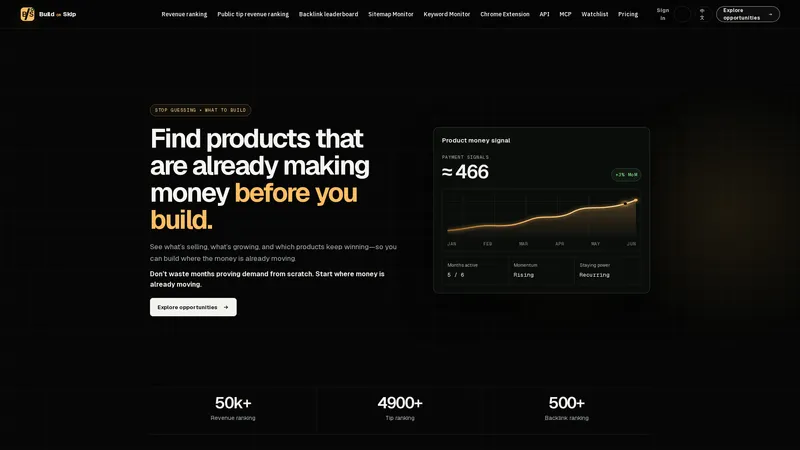
Build or Skip (buildorskip.dev) is a product opportunity research platform for independent developers, startup teams, and website owners who want evidence before they commit to a build. It aggregates public payment signals, voluntary tip revenue, domain intelligence, and backlink resources into filterable rankings, then lets you compare momentum across months so you can judge whether a category is still rising or already cooling. The homepage states the mission in one line: stop guessing what to build. Everything else on the site, from the leaderboards to the site profiles to the API and MCP integration, exists to support that single decision.
Website Positioning
Build or Skip sits between idea discovery tools that only show what is trending and full competitive intelligence suites that cost more than most indie projects earn in their first year. It is narrower than a market research platform and considerably more evidence-driven than a launch directory. The positioning is decision support before code. The homepage frames the workflow in three steps: find opportunities, read the trend, make the call. It also names the three verdicts the product is designed to produce, which are Build, Watch, or Skip. That structure is deliberate. The platform is not selling ideas; it is shortening the distance between an observed signal and a committed decision, which is exactly where solo builders lose the most time.
A second positioning choice is candor about data limits. Registration dates do not establish launch dates. Payment signals are traffic estimates, not verified revenue or orders. Tip amounts are publicly visible amounts, not confirmed income. This restraint makes the published signals more useful rather than less, because it forces you to treat them as evidence instead of truth.
Target Audience
The primary audience is the solo builder or two-person team shipping small web products, usually a SaaS tool, a directory, a marketplace, or a niche content site. These users rarely have budget for enterprise research tools and rarely have months to spend on discovery. They need a fast answer to a narrow question: is anyone paying for something like this right now?
The second audience is the small startup team doing quarterly roadmap planning. A founder and a product lead can use the product revenue ranking to check whether a planned feature overlaps with a category that has visible momentum, and whether the leaders in that category are growing steadily or simply trading rank month to month.
Growth marketers and SEO consultants form the third group. They come for the comment backlink library and the AI tool backlink library, which list submission URLs, submission methods, fee requirements, and last-check dates. That turns a tedious prospecting chore into a sortable list.
Early-stage investors, scouts, and analysts make up the fourth group. They use new-site rankings to spot freshly registered domains that already generate payment signals, then cross-check domain rating, registration date, product category, and capability tags to decide whether a deal deserves a conversation.
Product managers and analysts inside small SaaS companies are a fifth audience. They use the six-month momentum columns to sanity-check competitive assumptions and to see which adjacent categories are heating up.
A sixth group is the creator economy: newsletter writers, community moderators, and directory operators who need credible, source-linked data for posts and weekly digests.
Finally, agencies and freelance consultants use the platform as a scouting layer. A ready to use ranking that refreshes every month gives them a defensible starting point when a client asks where the next opportunity is.
Core Features
The centerpiece is the new site revenue ranking. It lists newly registered domains that show payment signals, sorted by rank, with domain rating, domain creation date, payment channels, primary and secondary category, product type, and capability tags. A published preview for a recent month showed 185 sites, with the leader carrying more than fourteen thousand payment signals. The homepage also exposes headline counters such as 50k+ ranked revenue sites, 4,900+ tip entries, and 500+ backlink entries, so you can gauge dataset size before you subscribe.
The product revenue ranking is the working horse. You can filter by product area, payment channel, domain rating, registration date, and payment signal volume, then compare six months of movement side by side. This is where a spike gets separated from a trend.
The tip revenue ranking narrows in on publicly visible Buy Me a Coffee amounts. It tracks active months and six-month amount trends, which is a surprisingly strong demand signal: people rarely tip for something they do not value.
Two backlink libraries round out the research layer. The comment backlink library organizes collected comment articles by domain and review date, with direct links to the original page so you can judge quality yourself. The AI tool backlink library catalogs AI product directories and resource sites with submission URL, submission method, fee requirement, and last check date, which makes outreach more efficient and far less guesswork.
Monitoring features include a sitemap monitor for up to twenty public sitemaps on the monthly plan and fifty on the yearly plan, plus a keyword monitor, a watchlist for tracking candidates over time, and a Chrome extension for capturing sites while you browse.
For programmatic users, an API returns domain rating, registration date, monthly traffic, and structured homepage data. Paid tiers receive unlimited queries, and MCP access lets supported AI clients browse the dataset catalog, discover products, and read site snapshots with unlimited calls.
Content Features
The content layer is written for practitioners rather than analysts. The homepage is short and direct, with plain-language explanations of what each signal means and what it does not. The rankings print their caveats next to the data instead of burying them in a footnote, which is unusual and welcome. A built-in FAQ answers the questions buyers actually ask: who the tool is for, what tipping behavior reveals about demand, how to use the two backlink libraries, and how to request a correction or removal if your own site is listed. There are also practical tips and tricks threaded through the interface in the form of filter hints, category labels, and coverage toggles that make the dataset easier to navigate without a tutorial. Short dated stamps appear on rankings and site records, so freshness is always visible.
User Experience
The experience is utilitarian and fast. Tables load quickly, columns are sortable, and every metric carries a short definition or a footnote. The site supports a Chinese locale in addition to English, and the language switcher sits in the top navigation next to the sign-in link. Navigation groups the product into revenue ranking, tip ranking, backlink leaderboard, sitemap monitor, keyword monitor, Chrome extension, API, MCP, watchlist, and pricing, so the information architecture mirrors the workflow rather than a marketing funnel. A ranking preview section sits above the pricing block, letting visitors see the shape of the data before they commit. Feedback is presented as privacy-redacted screenshots translated into English, which is an honest, low-polish approach that matches the tone of the rest of the product.
Technical Features
Revenue rankings follow calendar-month reporting, while comment and AI tool backlink resources update daily, and other site data displays its relevant date directly on the page. The API exposes domain rating, registration, monthly traffic, and structured homepage data through a single account token. MCP support means supported AI clients can query the catalog and pull site snapshots directly into a conversation, which removes a manual copy-paste step from the research loop. None of these technical pieces are decorative; they exist to make a repeated research habit more efficient.
Pricing and Access Model
Build or Skip runs a freemium model. The free preview shows the shape of the rankings, and Pro unlocks complete rankings, all filtering and sorting dimensions, the full comment and AI tool backlink libraries, sitemap monitoring, MCP access with unlimited calls, and a VIP community. Pro Monthly costs 19 dollars per month. Pro Yearly costs 190 dollars billed yearly, which works out to 15.83 dollars per month and gives two months free, plus API access with unlimited queries and a higher sitemap monitoring limit. The site warns that standard Pro pricing will rise after the next feature release, and that partner pricing renews at the same rate as long as the subscription stays continuous.
Why It Matters
Most failed products are not badly built, they are built in the wrong place. Build or Skip does not remove risk, and it does not claim to. What it does is replace a guess with a documented signal, a trend line, and a timestamp, so the decision to build, watch, or skip is at least anchored to something observable. For a solo developer deciding where to spend the next ninety days, that is the difference between a cheap experiment and an expensive lesson.
Top Features
New site revenue ranking: newly registered domains with payment signals, ranked with domain rating, domain creation date, payment channels, category, product type, and capability tags
Product revenue ranking with filters for product area, payment channel, domain rating, registration date, and payment signal volume
Six-month momentum comparison showing growth, persistence, and active-month continuity for each ranked product
Tip revenue ranking built on publicly visible Buy Me a Coffee tip amounts, active months, and six-month amount trends
Comment backlink library organized by domain and review date with direct links to the original pages
AI tool backlink library listing submission URLs, submission methods, fee requirements, and last check dates
Account API returning domain rating, registration date, monthly traffic, and structured homepage data with unlimited queries on paid tiers
MCP access so supported AI clients can browse datasets, discover products, and read site snapshots with unlimited calls
Sitemap monitor for up to 20 public sitemaps on monthly and 50 on yearly plans
Keyword monitor for tracking term-level movement alongside product categories
Watchlist for saving and following candidate products over time
Chrome extension for capturing site data while browsing
Ranking previews, dated data stamps, and inline caveats that separate estimates from verified numbers
VIP member community access for Pro subscribers
Correction and removal request process for listed site owners
Simple Definition of Usecases
A solo developer has three product ideas and no budget for validation. They open the new site revenue ranking, switch coverage to early new sites, and filter to categories that match their existing skills. Reading site profiles for the top fifty entries, they notice that most leaders in one category have only a single month of activity while another category shows five or six consecutive active months. They use the six-month momentum column in the product revenue ranking to confirm that the second category grows steadily rather than spiking. The problem solved is choosing between three ideas without spending a month on customer interviews, and the outcome is a build decision backed by visible payment behavior instead of gut feel.
A two-person startup is planning its next quarter and the roadmap is split between two features. The product lead pulls the product revenue ranking, filters by their product area and payment channel, colocations the leaders, and compares momentum across six months. They discover that one planned feature maps to a category where the top sites have flat momentum, while the other maps to a category with rising payment signals and several new entrants. They reallocate engineering time accordingly. The problem solved is internal disagreement about direction, and the fix is a shared, dated evidence set that the whole team can look at in one meeting.
A growth marketer at a small agency needs link and listing opportunities for a client site in a narrow niche. They open the comment backlink library, filter by domain and review date, and export a shortlist of pages where a genuine comment would add value. They then open the AI tool backlink library, sort by submission method and fee requirement, and separate free submissions from paid ones so the client can approve a budget. The problem solved is weeks of manual prospecting, replaced by a filtered list with last-check dates that confirms each opportunity is still live.
A freelance SEO consultant is asked by a client whether a niche is worth entering. Instead of quoting an expensive keyword tool report, the consultant uses the tip revenue ranking to check whether free-to-use products in that niche attract voluntary payment, which indicates perceived value. They combine that with the backlink leaderboard to estimate how crowded the distribution channels are. The problem solved is answering a strategic question with two independent signal types rather than one, and the deliverable is a short memo with dated evidence the client can verify.
An early-stage scout screens deal flow by scanning newly registered domains that already show payment signals. For each candidate they check domain rating, registration date, primary and secondary category, and capability tags, then open the live site through the ranking entry. Because the platform warns that registration dates do not establish launch dates and that payment signals are estimates, the scout treats the list as a sourcing funnel rather than a revenue statement and validates separately. The problem solved is finding small, early companies that never appear in funding databases, and the outcome is a shortlist worth an outbound email.
A newsletter writer needs a recurring data segment for a weekly issue. They monitor a handful of public sitemaps through the sitemap monitor, keep a watchlist of the products they have covered before, and check the monthly revenue ranking when it rolls over to the new reporting month. They write the segment using the numbers on the page along with the platform's own caveats. The problem solved is producing a repeatable, credible data section every week without building a scraping pipeline, and the outcome is an efficient editorial routine built on a dataset someone else maintains.
User Reviews
Desmond Villalobos
Solo SaaS founder
★★★★★
"I run a one-person SaaS business and I have killed more projects than I have shipped, mostly because I built first and looked for demand later. Build or Skip reversed that order for me. I started with the new site revenue ranking for the latest report month, filtered down to categories that matched my skillset, and spent two evenings reading site profiles instead of writing code. The momentum column mattered most: a single-month spike looks completely different from a product that has been quietly collecting payment signals for five or six straight months. I never treat any of it as verified revenue, and the site is careful to say so on every table, but as a directional signal it beats keyword tools by a wide margin. I picked a narrow problem inside a category with recurring momentum, shipped a small tool in five weeks, and landed my first paying customer three days after launch. That had never happened in four years of building. The interface is plain and fast, the filters are genuinely useful, and the free preview was enough for me to know the paid tier was worth it. If you keep building things nobody asked for, this is the cheapest correction you can buy."
Desmond Villalobos
Solo SaaS founder
★★★★★
"I run a one-person SaaS business and I have killed more projects than I have shipped, mostly because I built first and looked for demand later. Build or Skip reversed that order for me. I started with the new site revenue ranking for the latest report month, filtered down to categories that matched my skillset, and spent two evenings reading site profiles instead of writing code. The momentum column mattered most: a single-month spike looks completely different from a product that has been quietly collecting payment signals for five or six straight months. I never treat any of it as verified revenue, and the site is careful to say so on every table, but as a directional signal it beats keyword tools by a wide margin. I picked a narrow problem inside a category with recurring momentum, shipped a small tool in five weeks, and landed my first paying customer three days after launch. That had never happened in four years of building. The interface is plain and fast, the filters are genuinely useful, and the free preview was enough for me to know the paid tier was worth it. If you keep building things nobody asked for, this is the cheapest correction you can buy."
Ingrid Halvorsen
Technical co-founder and CTO
★★★★
"I evaluate tools the way I evaluate infrastructure, so my first question was whether Build or Skip could be queried programmatically rather than clicked through. The API returns domain rating, registration date, monthly traffic, and structured homepage data, and the yearly plan makes those queries unlimited, which is what made the purchase easy to justify. We wired it into an internal script that watches a shortlist of categories and posts a weekly digest to our team channel. The MCP integration is the other reason we stayed: our AI client pulls site snapshots directly into a session instead of us copying rows into a spreadsheet by hand. Where I dock a point is data granularity. Payment signals are estimates, not orders, and the platform says this repeatedly, so you cannot treat any single row as ground truth. Cross-referencing three or four rows in the same category before forming an opinion is mandatory. Also, timezone and reporting-month boundaries mean we occasionally see a category shift before we expect it. None of that is disqualifying. The technical surface is solid, documented enough to use, and honest about its limits, which is rarer than it should be."
Tobias Oyelaran
Growth marketer at a small agency
★★★★★
"I spend most of my working week hunting distribution opportunities for client sites, and the tip revenue ranking turned out to be the part of Build or Skip I did not expect to use this much. When people can use a product for free and still choose to pay something, that tells you more about perceived value than a vanity traffic chart ever will. I use the tip ranking to check whether a niche rewards quality, then I use the six-month amount trends to see whether that willingness to pay is stable or fading. The AI tool backlink library is the other half of my workflow: submission URL, submission method, fee requirement, and last check date in one table means I no longer open forty tabs to find out which directories charge money. I have run two client campaigns directly off shortlists built here, and both produced links within a month. The layout is unglamorous, and I mean that as a compliment. It does not try to impress me, it just gives me the columns I need, keeps them dated, and gets out of the way. For the price of a monthly plan this replaced a much more expensive research subscription."
Marisol Quiñones
Independent SEO consultant
★★★★
"Most research tools I have used are confident to the point of being useless, so the caveat discipline on Build or Skip was refreshing. Every backlink entry in the comment library shows the domain, the review date, and a link to the original page, which means I can judge context before I recommend anything to a client. The AI tool backlink listing is organized the same way, and knowing whether a directory charges a fee before I open it saves real hours across a month of outreach. Two things would make it stronger. First, coverage in less trendy verticals is thinner than in the AI and SaaS categories, so consultants working in finance or local services will find fewer rows to work with. Second, I would like a saved filter preset so I do not rebuild the same query every Monday, though the watchlist partially covers that gap. The correction and removal process is also handled properly, which matters because I have had client sites appear in third-party rankings without warning before. Overall this is a practical tool that respects my time, and the honest labeling means I never have to walk back a claim in front of a client."
Delphine Aucoin
Early-stage venture scout
★★★★
"My job is finding small companies before they appear in any funding database, so a leaderboard of newly registered domains that already show payment signals is directly useful to me. I work the new site revenue ranking the way an analyst works a screen: rank order first, then domain rating, then domain creation date, then primary and secondary category, then capability tags to filter out anything outside my thesis. The site is explicit that registration dates do not establish launch dates and that payment signals are conservative estimates rather than verified revenue, which is exactly the right framing for a sourcing tool. I treat every candidate as an unqualified lead and do my own diligence before an intro, and I have never been embarrassed by a name that came off this list. The one-time watchlist feature is what keeps me coming back, because it lets me see whether a domain that caught my eye last month is still moving or has gone quiet. Limitations are real: without verified revenue you are reading tea leaves to some degree, and consumer categories are covered better than B2B. But as an early-warning system for indie-scale products, it earns its subscription."
Frequently Asked Questions
Q:
What is Build or Skip?
A:
Build or Skip is a product opportunity research platform. It collects public payment signals, voluntary tip revenue, domain intelligence, and backlink resources, then organizes them into filterable rankings so independent developers and startup teams can see which products already show commercial activity and how that activity changes over time. The site summarizes its purpose as finding products that are already making money before you build, and it frames every decision as Build, Watch, or Skip.
Q:
What does a payment signal mean on Build or Skip?
A:
A payment signal is a conservative traffic-based estimate that a site is generating payment activity. It is not verified revenue, not an order count, and not a customer count. Ranked rows show payment signal volume, payment channels, and a momentum indicator built from active months, so you should read it as directional evidence that money is moving toward a product, then validate the specific business yourself before drawing conclusions.
Q:
What to look at first on the new site revenue ranking?
A:
Start with rank order, then check the domain creation date and domain rating to understand how new and how established each site is. Next, compare the payment signal volume with the months-active and momentum fields: a large one-month number with a single active month is a spike, while five or six consecutive active months is persistence. Finally, filter by primary and secondary category and capability tags to keep only the entries that match what you are actually able to build.
Q:
How to find product opportunities fast without a large research budget?
A:
Use the free preview to see the shape of the current rankings, then narrow your search with three filters only: category, payment channel, and domain creation date. Read the ten highest-momentum rows instead of the ten highest-volume rows, since momentum tells you where movement is happening now. Check the tip revenue ranking for the same niche to confirm people pay voluntarily when a product is free, and use the backlink libraries to see how crowded the distribution channels are. That sequence can be completed in a single evening.
Q:
What is included in the free preview compared with Pro?
A:
The free preview shows ranking previews and headline figures so you can evaluate the dataset before paying. Pro unlocks every published revenue ranking, the full tip revenue ranking, the complete comment backlink and AI tool backlink libraries, all filtering and sorting dimensions, sitemap monitoring, MCP access with unlimited calls, and the VIP member community. Pro Yearly adds unlimited API queries for domain rating, registration, traffic, and site data plus a higher sitemap monitoring limit.
Q:
Can I request a correction or removal if my website is listed?
A:
Yes. If you own the website or are authorized to represent it, email support@buildorskip.dev. After the team verifies your ownership or authorization, inaccurate information will be corrected or an eligible site will be removed from the public rankings.
Q:
Does Build or Skip offer an API and MCP access?
A:
Yes to both. The API returns domain rating, domain registration, monthly traffic, and structured homepage data through a single account console, and Pro Yearly includes unlimited queries. MCP access lets supported AI clients browse the dataset catalog, discover products, and read site snapshots, with unlimited MCP calls on paid plans.
Q:
How often is the data updated?
A:
Revenue rankings follow calendar-month reporting, so a new report month replaces the previous one on a monthly cycle. Comment and AI tool backlink resources update daily, and other site data displays its relevant date directly on the page. Because registration dates and estimates carry different freshness characteristics, always check the date stamp attached to the specific table you are reading.
AI STL Generator is a specialized web platform built for makers, designers, educators, and small businesses that need to turn 2D images or text prompts into 3D printable STL files. Positioned as the fastest free AI STL maker, it focuses on a specific bottleneck in the 3D printing workflow: converting ideas into watertight, slicing-ready models without requiring CAD expertise. Instead of forcing users to learn Blender, Fusion 360, or Meshmixer, the site offers a ready to use AI workbench that generates geometry from natural language or reference images and then automatically repairs the mesh for 3D printing. For anyone tired of cleaning non-manifold edges, inverted normals, zero-thickness walls, or floating islands, this platform promises a more efficient path from concept to physical print. It is not a generic 3D asset generator; it is a print-first tool designed around the realities of FDM and resin printing, slicer compatibility, and the practical needs of people who actually run printers every day.
Website Positioning: AI STL Generator positions itself as the number one AI STL generator for 3D printing and makers. The homepage emphasizes speed, print readiness, and compatibility with popular slicers such as Bambu Studio, Cura, PrusaSlicer, OrcaSlicer, Creality Print, and ideaMaker. Rather than competing as a broad 3D modeling suite, it owns the narrow but valuable niche of AI-powered STL creation. Its tagline and hero section make the value proposition clear: turn 2D images and prompts into 3D printable STL files. The site also includes auxiliary tools like a 3D viewer, 3D converter, printability checker, and STL repair, which together form a compact ecosystem for makers who want to go from idea to download without leaving the browser. This positioning is smart because the hardest part of AI 3D generation is not creating an attractive mesh; it is creating a mesh that survives a slicer without manual repair. AI STL Generator addresses that directly.
Target Audience: The platform speaks to a wide range of users. FDM hobbyists who own Bambu Lab, Prusa, Creality, or similar printers are a core audience. They want functional parts, custom organizers, replacement pieces, and decorative models that print reliably. Tabletop gamers and Dungeon Masters are another key group. They need custom miniatures, monsters, terrain pieces, and character models from Midjourney art, character sketches, or text prompts. Etsy sellers and small-batch print shops use the tool to shorten turnaround times for personalized keychains, plaques, cake toppers, and gifts. STEM educators and FabLab coordinators use it to introduce 3D printing without a CAD learning curve. Product designers and mechanical engineers use it for rapid concept models and form studies. Cosplay makers and prop builders use it to turn reference images into printable armor pieces, props, and accessories. Finally, AI enthusiasts and hobbyist 3D artists use it to explore generative geometry without needing to master a traditional modeling package. For all these users, the promise is the same: reduce the friction between an idea and a printed object.
Core Features: The feature set is built around a few powerful capabilities. Text-to-STL generation lets users type a description, such as a tabletop paladin, a mechanical rocker arm, or a minimalist rubber duck, and receive a 3D mesh ready for printing. Image-to-STL generation accepts JPG and PNG files, including photos, concept art, sketches, and logos, then reconstructs depth, volume, and topology. Multi-image support allows multiple angles for more accurate reconstruction. The printability check automatically detects non-manifold edges, inverted normals, and zero-thickness walls. The built-in STL repair then seals the mesh to create a watertight solid. Users can choose AI model detail levels such as Basic, Pro, and Ultra detail, with Ultra detail available on Pro and costing additional credits. Output formats include STL and 3MF. Character pose options include None, A-Pose, and T-Pose, which is helpful for miniature and character generation. Real-world size scaling allows users to scale to an estimated height with the origin at the base. The platform also includes a 3D viewer so users can inspect geometry in the browser, plus converters such as SVG to STL, STL to 3MF, and 3MF to STL. There is an AI miniature generator and a remesh and repair tool that acts as a lightweight STL editor. For 3D printing specifically, the system optimizes for flat-bottom geometry, bed adhesion, and minimal support requirements, which helps reduce warping and failed prints.
Content Features: The website content is designed to educate and reassure. It uses clear, benefit-driven headlines, step-by-step workflow explanations, and real examples of generated models such as a knight paladin, a precision rocker arm, a Nefertiti bust, and a designer rubber duck. Each featured creation includes triangle counts, a 3D inspection link, and a prompt or description. This helps users understand what is possible and sets realistic expectations about detail levels. The FAQ section answers common questions about STL generation, image-to-STL conversion, watertightness, editing, and pricing. The homepage also highlights compatibility with major slicers and includes user testimonials from an FDM hobbyist, tabletop gamer, Etsy seller, and STEM educator. The content is concise, practical, and focused on outcomes rather than technical jargon. It also offers tips and tricks for getting better results, such as using clear reference images, choosing the right detail level, and checking printability before downloading. These tips and tricks are valuable for beginners and experienced makers alike. For users who want to push the tool further, the site includes tricks for combining text prompts with image references and for using multiple images to improve reconstruction. Overall, the content builds trust by showing real models, real users, and real print workflows.
User Experience: The user experience is designed to be simple and fast. The workbench is the center of the product. Users choose Image to STL or Text to STL, upload images or enter a prompt, select an AI model, choose output format, set pose and size options, and click Generate 3D Model. A credit cost is shown next to the button, so there are no surprises. The 3D Model Preview pane lets users inspect the result before downloading. The workflow is split into three phases: input your idea, AI mesh generation and auto-watertight, and download STL and slice to print. This structure makes the process feel manageable even for first-time users. The site also offers a daily check-in for free credits, which encourages return visits and lowers the barrier to entry. Sign-in is available for account management, while Start Free leads directly into the workbench. The visual design is clean and modern, with a dark theme and bright accents that appeal to maker and tech audiences. The navigation includes STL Studio, 3D Viewer, 3D Converter, Pricing, Daily Check-in, Sign in, and Start Free. The overall experience is intuitive, and the platform avoids unnecessary complexity. For makers who value speed, this is one of the most efficient ways to go from an idea to a printable file. Many users will find it to be the most efficient option for quick, print-ready STL generation, especially when compared with manual modeling or repairing failed AI meshes.
Technical Features: Under the hood, AI STL Generator uses advanced neural networks to analyze images and prompts, then generate 3D geometry. The system performs automatic topology repair, remeshing, and mesh closure. It checks for non-manifold edges, inverted normals, and zero-thickness walls, then fixes them. The output is a manifold, watertight solid suitable for slicing. The platform supports STL and 3MF export, with GLB mentioned for visualization. It is compatible with Bambu Studio, Cura, PrusaSlicer, OrcaSlicer, Creality Print, and ideaMaker. The AI model tiers allow users to trade credits for detail, with Pro and Ultra detail options for higher-fidelity meshes. The system also supports character pose settings, real-world scaling, and flat-base optimization. The 3D viewer provides interactive inspection, and the converter tools handle format changes. The printability checker is a critical technical differentiator because it catches problems before the slicer does. The STL repair tool can adjust mesh density, simplify polygon counts, and flatten the base. This combination of generative AI and mesh repair is what makes the platform practical for real 3D printing, not just visual rendering. The technical stack is oriented toward reliability, repeatability, and slicer compatibility, which are the metrics that matter most to makers.
Workflow and Practical Benefits: The typical workflow is straightforward. A user starts with an idea, a sketch, a photo, or a text prompt. They upload or type it into the workbench. They select a detail level, output format, pose, and size. The AI generates a mesh, runs automatic repair, and presents a preview. The user inspects the model in 3D, then downloads the STL or 3MF. The file imports directly into their slicer without third-party repairs. This saves time, reduces failed prints, and lowers material waste. For Etsy sellers, it can cut turnaround from days to minutes. For educators, it removes the CAD barrier and lets students see their drawings become physical objects. For tabletop gamers, it enables custom miniatures that match a campaign or character concept. For engineers, it provides rapid concept validation. For cosplay makers, it accelerates prop development. The platform is especially useful for anyone who needs a ready to use output rather than a raw 3D asset. It is also a more efficient alternative to learning complex software for simple shapes and organic models. The site's focus on watertight geometry and printability means fewer failed prints, less wasted filament, and less time spent in repair tools. That is a practical, measurable benefit that matters to both hobbyists and businesses.
Pricing and Accessibility: AI STL Generator uses a freemium model. Users can log in daily to claim free check-in credits and generate STL files without paying. There are also pay-as-you-go credit packs and subscription plans for regular creators. The Generate 3D Model button shows a credit cost, typically 5 credits for a standard generation, with Ultra detail costing additional credits and available on Pro. This makes the pricing transparent and flexible. Casual users can rely on daily free credits, while power users can buy credits or subscribe. The Start Free call to action emphasizes no credit card required and instant download. This lowers the barrier for first-time users and encourages experimentation. The pricing page likely contains more details, but the homepage already communicates that the tool is accessible to hobbyists, educators, and small businesses. The freemium approach is well suited to the maker market, where usage can be sporadic or project-based. It also allows users to test the quality before committing to a paid plan. For many, the free daily credits are enough for occasional projects, while professionals will find the paid options affordable compared with the time saved.
Why It Matters for US Makers: In the United States, 3D printing has moved from a niche hobby to a mainstream tool for prototyping, education, small business, and creative expression. Makers expect fast results, clear pricing, and compatibility with the printers they already own. AI STL Generator fits that expectation by focusing on the most popular slicers and by promising watertight, print-ready files. American small businesses, especially Etsy sellers and custom gift shops, need to respond to customer requests quickly. A tool that turns a sketch into a printable STL in minutes can be a competitive advantage. Educators need low-barrier tools that work in a classroom without extensive training. Hobbyists want to spend time printing, not repairing meshes. Cosplayers and prop makers need to scale models accurately and avoid fragile walls. By addressing these needs, AI STL Generator aligns with the practical, outcome-oriented culture of the US maker community. It also fits the growing interest in AI-assisted design, where generative tools augment human creativity rather than replace it. The platform's emphasis on printability, repair, and slicer compatibility makes it more than a novelty; it is a workflow tool.
Final Thoughts: AI STL Generator is a focused, practical, and accessible platform for turning ideas into 3D printable STL files. Its core strengths are image-to-STL and text-to-STL generation, automatic printability checking, watertight repair, slicer compatibility, and a simple three-step workflow. It serves hobbyists, tabletop gamers, Etsy sellers, educators, engineers, cosplay makers, and AI enthusiasts. The freemium pricing and daily free credits make it easy to try, while credit packs and subscriptions support regular use. For anyone who wants a ready to use solution that is more efficient than manual modeling and more reliable than generic AI 3D generators, AI STL Generator is worth exploring. With the right tips and tricks, users can get better results from prompts and images, and with a few advanced tricks, they can push detail and scale further. In a crowded field of AI 3D tools, this platform stands out by focusing on the essential requirement: a file that actually prints. That focus makes it one of the most efficient and practical tools available for makers today.
Overview
MiroFish is a chat-first prediction engine that turns a plain-language question into a living scenario. Instead of returning one confident answer, it builds a knowledge graph, runs a multi-agent simulation, and hands back a structured prediction report. You ask the question the way you would ask ChatGPT, and the system handles seed material, simulation, and reporting as one continuous workflow. The product states its own promise plainly: predict anything, but talk to it like ChatGPT. That single sentence captures both the ambition and the interface. The ambition is broad scenario prediction for questions where human reaction drives the outcome. The interface is deliberately familiar, so the learning curve stays close to zero.
Website Positioning
MiroFish does not position itself as an oracle. It positions itself as a rehearsal space. The homepage makes the distinction explicit in its comparison section, which sets a single chat answer, manual research, and the MiroFish simulation side by side. A single chat answer is fast but collapses competing audience reactions into one confident response. Manual research is grounded and careful but slow when a decision depends on many groups influencing each other at once. MiroFish sits between them: a ready to use environment where agents, memory, social surfaces, emergent clusters, and a report you can keep questioning live in one place. The value proposition is not absolute accuracy. It is speed of insight into how reactions might compound.
Why Reaction Beats a Static Answer
Most planning questions fail not because the analysis is wrong, but because the analysis ignores feedback loops. A price change does not produce a single customer response. It produces a first reaction, a narrative that forms around that reaction, and a second wave of people reacting to the narrative rather than the price. A policy announcement behaves the same way. MiroFish is built for this class of problem. Its use case sections frame the product around moments where reaction matters more than a static answer: campaign tests, pricing reactions, policy stress tests, and market narratives. Each moment has the same shape. A small group moves first, a story forms, and everyone else responds to the story.
Target Audience
The tool targets anyone whose decision depends on how groups of people will respond to each other. Product marketers use it to pressure-test a launch narrative before the first dollar of spend. Pricing and revenue managers use it to model which customer segment pushes back first after an increase. Policy and public affairs teams use it as a tabletop exercise for coalition formation and second-order reactions. Strategy consultants use it to generate hypotheses faster than a research cycle allows. Founders use it to sanity-check positioning against a skeptical category. Crisis communications teams use it to rehearse how an accusation could outrun an official explanation. Screenwriters and narrative designers use it for creative continuation. The common thread is that all of these users need plausible reactions, not a single verdict.
Core Features
The product is text-first by design. You start with a question, then decide whether supporting files are necessary, without losing the speed of a chat interface. An orchestration layer runs graph building, simulation, and reporting behind the scenes while you stay inside one conversation. Every answer ends with a structured result card that contains a summary, a report entry point, and a follow-up path. Optional attachments in PDF, Markdown, and plain text act as reality seeds, grounding the simulation in a specific strategy memo, product FAQ, policy brief, market note, or research summary. A sample orchestration preview on the homepage shows three example questions so a first-time visitor can see the shape of a good prompt before committing to one.
Knowledge Graph Step
Before any agent speaks, the system extracts actors, relationships, pressures, and factual anchors from your question and any attached material. This step is why the output holds together. A simulation that starts from raw text tends to drift, because the model has no explicit structure to reason from. Building the graph first forces the scenario to name its stakeholders and the forces acting on them. In practice, this is often the most valuable part of the run, because writing the actors and incentives down reveals assumptions you did not know you were making. Users who want tighter results learn to front-load this step by naming the decision, the audience, the trigger, and the time horizon in the question itself.
Agent Simulation Step
The simulation stage lets personas interact across short-form and threaded social surfaces over multiple rounds. Agents carry memory, so a position taken in round one shapes behavior in round three. Clusters form. Moderate voices stay quiet until a specific framing appears. Early backlash from one segment supplies vocabulary that later segments reuse. This is the part that separates the product from a sentiment dashboard, because sentiment dashboards tell you what people think now, while the simulation explores what they might think after hearing what everyone else thinks. The number of rounds, the surfaces, and the persona set remain adjustable through how you frame the question and what seed material you provide.
Prediction Report
The run condenses emergent behavior into a structured report. A typical report contains an executive summary, risk signals, narrative paths, and follow-up questions. The sample report previewed on the site covers a price increase and identifies the highest-risk path as a compressed story that turns the announcement into a trust issue before value evidence becomes visible. Risk signals list early backlash from price-sensitive segments, narrative compression into a simpler accusation, and influencer framing that outruns the official message. Narrative paths describe what happens if the value story holds, if comparison charts are missing, and if supporters lack reusable language. That structure is designed to make the next question obvious rather than to close the topic.
Deep Interaction
The workflow does not stop at the report. You continue asking questions against the generated world. Which persona creates the first negative cascade. What changes if we announce a transition plan. Which evidence line reduces confusion fastest. This is where the most efficient use of the tool appears, because a single seeded world can answer a dozen related questions that would each require a separate research project in the physical world. Follow-up questions also function as an assumption audit, since the answers show which variables actually move the outcome and which ones barely matter.
Prompt Craft and Playbooks
The site ships short, practical playbooks so a visitor gets value before opening the full product. The guidance is direct: name the decision, the audience, the likely trigger, and the time horizon. A narrow question gives the simulated world less room to drift. The playbook section also covers seed files and report reading, and it collects the tips and tricks that experienced users converge on, such as treating the output as decision support and hunting for resistance signals, narrative bridges, and assumptions worth checking with real data. The recommended next step after reading a report is to ask which group changes the result if its incentive changes.
Use Cases in Practice
Four scenarios anchor the product page. Campaign test asks what happens if a positioning statement launches in a skeptical category, and it simulates how audience groups might amplify, resist, or reinterpret the message before money is spent. Pricing reaction explores the friction behind an increase by modeling sentiment, value perception, and objection paths across segments before the announcement. Policy stress test acts as a tabletop exercise for controversy, coalition formation, and second-order effects. Market narrative examines how narrative, incentives, and sentiment interact in situations where spreadsheets miss the feedback loop between analysts, retail attention, and public discourse. Each scenario shares a common purpose: surfacing the reaction you did not budget for.
Content Features
The homepage is unusually task-oriented for a landing page. It pairs bilingual section labels in English and Chinese with concrete sample prompts, a workflow diagram in five steps, four playbooks, a comparison table, a report preview, and a plain FAQ. The comparison table does real work, because it tells a visitor when not to use the product as clearly as when to use it. The FAQ avoids overclaiming and states that the output is exploratory decision support rather than a guaranteed forecast. A long row of small directory badges sits at the bottom of the page, kept deliberately compact so the product experience stays focused.
User Experience
The experience is built around staying inside a single conversation. There is no separate graph editor to learn, no dashboard to configure, and no report builder to assemble. You type a question, attach files only if they help, and read a result card that links to the deeper report. The text-first approach makes the first run fast and the hundredth run faster. Because the orchestration runs behind the chat, the user never has to manage a pipeline manually. That design choice is what makes the tool practical for someone who needs an answer before a meeting rather than after a research sprint.
Technical Features
Under the interface, four technical components cooperate. A knowledge graph layer extracts structure from unstructured input. A multi-agent simulation layer runs personas with memory across multiple rounds and multiple social surfaces. A synthesis layer compresses emergent behavior into narrative paths, risk signals, and confidence cues. An orchestration layer sequences the three and keeps the conversation state intact across follow-up questions. File ingestion handles PDF, Markdown, and text, which covers the seed formats that knowledge workers actually produce. The architecture is designed for repeated interrogation of a persistent world rather than one-shot generation.
Limitations and Honest Framing
The product repeats one caution in several places, and the repetition is a feature. MiroFish is not a guaranteed forecast. Personas are plausible archetypes rather than your actual customers. Reports are designed to be edited by a human before they reach an executive audience. Any result worth acting on deserves validation with analytics, customer research, or a real pilot. Users who treat the output as a hypothesis generator get the most from it. Users who treat it as a verdict will be disappointed. The site says as much, which is rare and useful in a category full of confident claims.
Getting Started
The fastest path is to open the chat and type one narrow question about a decision you already face. Add a seed file only when the scenario needs specific actors, incentives, or prior context. Read the result card, open the report, then ask the follow-up questions the report suggests. Keep the question tight, keep the time horizon explicit, and treat every run as a rehearsal. When the question is worth simulating, MiroFish turns a few minutes of typing into a structured world you can interrogate for hours, which is a more efficient trade than most planning tools offer.
Meme Picture is a free, ready to use AI face meme generator that turns a selfie, a friend's photo, or a pet picture into a classic meme template in seconds. The site requires no login for its free tier, offers three generations per day, and delivers two to four candidates per run. This makes it one of the most efficient ways to join meme culture without learning Photoshop, GIMP, or any layered design software. The core workflow is simple: upload a photo, pick a Meme Picture template, add an optional caption, choose a visual style, and generate. About thirty seconds later, you can download a share-ready PNG optimized for WhatsApp, iMessage, Discord, Telegram, or WeChat.
Website positioning. Meme Picture positions itself as a no-login, free face meme generator. The homepage immediately presents the value proposition with the heading Free Face Meme Generator Put Your Face in Memes. It emphasizes free access, classic templates, AI-generated candidates, and a fast workflow. Unlike general-purpose image editors, Meme Picture is focused on one job: placing your face or pet into recognizable meme formats. This narrow focus allows the tool to be more efficient than manual editing while remaining approachable for people who have never made a meme before.
Target audience. The primary audience includes social media users, group chat participants, Discord and Reddit community members, pet owners, students, and content creators. These users often need quick, relatable visual reactions for conversations and posts. They may not have design experience, may be on mobile devices, and may not want to create an account just to make one image. Meme Picture addresses this by offering a lightweight, automated workflow that works in a browser without registration. Secondary audiences include small business social media managers and streamers who want branded or personalized meme content without hiring a designer.
Core features. The generator includes fifteen hand-picked classic templates, including Distracted Boyfriend, Woman Yelling at Cat, Drake Hotline Bling, Surprised Pikachu, This Is Fine, Change My Mind, One Does Not Simply, Success Kid, Hide the Pain Harold, Stonks, Expanding Brain, Two Buttons, Unsettled Tom, Doge, and Grumpy Cat. Users can select from four visual styles: Cartoon, Pixel Art, Hand-drawn, and Realistic. The AI handles face placement and stylization automatically, so no manual cutting or color matching is needed. Each run produces two to four candidates, allowing users to choose the funniest result. The free plan includes three generations per day and two candidates per request. Pro plans increase this to thirty generations per day and four candidates per request, with no watermark, GIF memes, HD export, and cloud history. One-time packs of ten or thirty permanent generations are also available for users who want extra runs after the daily quota is used.
Content features. The site includes a dedicated Templates page with links to individual template pages. Each template page provides captions, history, and FAQ for that specific format. The homepage also contains a picture-to-meme guide, a how-to section, and a comparison with Imgflip and Canva. This content is practical and focused on helping users understand how to get the best results. The site answers common questions such as whether the tool is free, whether an account is required, what photos work best, and how long generation takes. Because the content is organized around clear user tasks, it acts as a practical tutorial without requiring a separate manual.
Detailed template guidance. The homepage lists eight template links and a full catalog. Distracted Boyfriend is ideal for showing divided attention. Woman Yelling at Cat works for arguments or callouts. Drake Hotline Bling is perfect for comparing two options. Surprised Pikachu expresses shock at predictable outcomes. This Is Fine suits moments when everything is falling apart but you pretend otherwise. Change My Mind invites debate. One Does Not Simply adds dramatic flair. Success Kid celebrates small victories. Hide the Pain Harold is for forced smiles. Stonks represents absurd financial or logical reasoning. Expanding Brain shows escalating ideas. Two Buttons presents a difficult choice. Unsettled Tom captures discomfort. Doge and Grumpy Cat add animal humor. Each template remains recognizable, which is essential for meme communication.
User experience. The interface is intuitive and streamlined. The hero section includes two clear calls to action: Create from your photo and Browse Templates. Below that, the page shows a three-step process: upload photo, pick template, download and share. The generator section includes a file upload area that accepts JPEG, PNG, or WebP files up to 4 MB, with automatic compression for large photos. Users can also try a sample portrait or sample pet photo. The template picker is organized into All, Reaction, Comparison, Animals, and Classic categories. The style selector, caption field, and optional extra instructions are all on the same page, so users do not need to navigate between steps. Results appear on the same page after generation. This single-page design creates a seamless experience from upload to download.
Technical features. Meme Picture is powered by GPT Image 2 and operates as an independent product, not affiliated with OpenAI. The site's browser-based workflow supports both phone and desktop uploads. Original photos are deleted right after generation, and signed-in users only keep finished meme images. The site states that it does not train on or sell user photos, which is a strong privacy commitment. PNG export is optimized for instant sharing, and Pro users gain access to HD export and GIF generation. The service uses an automated pipeline for face swapping and style transfer, reducing the need for manual intervention.
Accessibility and mobile. Because Meme Picture is browser-based, it requires no installation. The upload control works with drag and drop on desktop and file selection on phones. Large photos are automatically compressed to fit the 4 MB limit, which keeps mobile data usage reasonable. The interface scales to small screens, and the single-page workflow avoids confusing multi-step navigation. This makes the tool accessible to users who only have a phone and want to create memes during a conversation. The automatic compression also ensures that uploads do not fail on slower connections.
Privacy and trust. The site's privacy-first approach is a differentiator. Many free tools monetize user uploads or require account creation, but Meme Picture deletes original photos immediately after generation. This matters for people who want to use personal selfies or pet photos without worrying about data retention. The homepage clearly states this policy in the why people love section and in the FAQ. The lack of mandatory login lowers the barrier to entry and reduces friction for first-time visitors. The site also maintains standard pages for Privacy, Terms, Refund Policy, About, and Guides, which builds credibility.
Community and cultural relevance. Internet memes are a shared language, and communities such as Know Your Meme have documented these formats for years. Meme Picture builds on that familiarity by keeping iconic layouts intact. When a user sees a Distracted Boyfriend image with a friend's face, the joke is immediate because the format is already understood. This cultural relevance is part of the product's effectiveness. The tool does not attempt to invent new formats; it personalizes existing ones. This approach reduces the learning curve and makes the output instantly useful in groups.
How to get the most out of Meme Picture. To achieve the best results, users should upload a clear, well-lit selfie or pet photo. The site recommends trying sample photos if you do not have a suitable image. Choosing the right template for the intended joke matters: Distracted Boyfriend works for distractions, Woman Yelling at Cat for arguments, Drake Hotline Bling for comparisons, Surprised Pikachu for predictable surprises, This Is Fine for chaotic acceptance, and Change My Mind for bold opinions. Adding a caption or selecting an example joke improves the meme. Users can also use the Extra instructions field to request specific expressions or framing. Because the generator produces two to four candidates, users should review all outputs and pick the funniest one. For multiple memes, the Pro plan's higher quota and no watermark are useful.
Comparison with alternatives. Imgflip and Canva are strong tools for text overlays on stock templates, but Meme Picture specializes in face-insertion memes. In Photoshop, placing a face into a meme can take twenty to forty-five minutes of layer work, masking, and color adjustment. Meme Picture reduces that to roughly thirty seconds per run. The free daily quota makes it easy to try without commitment, and the one-time packs offer a pay-per-use supplement for occasional bursts of activity. This makes the tool both more efficient and more accessible than traditional editing.
Potential use cases. The tool suits reaction memes for Discord, funny pet images for family groups, custom visuals for social posts, student humor for group projects, and streamer engagement content. Because the output is a PNG, it can be dropped into almost any chat app or social platform. The picture-to-meme page provides a dedicated workflow for users who already have an image in mind. This flexibility supports both spontaneous and planned meme creation.
SEO and discoverability. Meme Picture targets keywords around free face meme generator, put my face in a meme, no login meme maker, AI face swap, and classic meme templates. The site's template pages create additional entry points for specific formats such as Distracted Boyfriend or Woman Yelling at Cat. The homepage includes internal links to these template pages, which helps visitors explore the catalog and improves search visibility.
Conclusion. Meme Picture is a focused, automated, and intuitive tool for creating personalized memes. Its ready to use interface, free daily tier, and privacy-first upload policy make it an attractive option for casual users. The Pro and one-time pack pricing offer flexible upgrades for power users. By removing the complexity of traditional editing and delivering share-ready results in seconds, Meme Picture delivers a seamless experience from photo to meme. Whether you need a single reaction image for a group chat or a daily stream of custom memes, the service provides a practical, lightweight solution that respects your time and privacy.
Perchance AI Image Generator is a free, browser-based text-to-image workspace that turns natural-language prompts into downloadable images without accounts, subscriptions, or paywalls. The full product lives on the homepage, making it ready to use from the first visit. There is no app to install, no demo page that merely teases the product, and no paid tier hiding the best features. You land on perchanceaiimagegenerator.app, choose a model, write a prompt, click generate, watch the result appear, and then download the file. The workflow is simple, direct, and built for people who value speed and convenience over complex setup.
Website Positioning: This service is positioned as a multi-model AI image generator for a broad U.S. audience. It deliberately avoids the sign-up wall that most AI tools place between users and the product. The homepage is the workspace; the workspace is the homepage. That makes it an ideal destination for quick visual exploration, professional concept art, casual creative play, and practical marketing assets. Because the tool supports multiple model families, including FLUX, Stable Diffusion, Z Image Turbo, and Qwen Image, it can also serve users who like to compare models without installing software or maintaining local GPU setups.
Target Audience: The design of Perchance AI Image Generator appeals to several distinct groups. Freelance illustrators can use it for rapid character and setting concepts. Social media managers can create backgrounds, headers, and campaign mood boards. Students and educators can produce engaging visuals for slides and posters. Indie game developers can explore art directions and creature designs. Product teams can prototype mock scenarios. The service's zero-cost, zero-account approach is particularly useful for students and freelancers who need capable tools without licensing burdens.
Core Features: The central element is a text-to-image workspace. Users enter prompts in natural English, select from common aspect ratios such as 1:1, 16:9, and 9:16, and, when supported by the model, adjust advanced settings like steps, guidance, seed, and negative prompt. The multi-model dropdown is the standout feature. By default, Z Image Turbo offers fast generation, while FLUX.1 [dev] and FLUX.1 [Schnell] provide a strong balance of quality and speed. Stable Diffusion 3 and 3.5 offer flexible diffusion output, and Qwen Image plus realism LoRAs provide a different aesthetic direction. This variety means users are not locked into a single interpretation of their prompt.
Content Features: The site includes a few valuable content aids. The prompt input area offers sample starts such as a golden retriever running, a neon cyberpunk alley, a watercolor Japanese garden, a product shot of earbuds, and an astronaut riding a horse on Mars. These chips are more than decoration; they teach first-time users how to structure a useful prompt. The tutorial section explains the workspace in four short steps: open, pick a model, write a clear prompt, and generate. The FAQ answers common questions about limits, model availability, NSFW policy, and direct access. This built-in guidance reduces the learning curve.
User Experience: The experience is clean and concise, but not feature-bloated. Everything happens on one page, which eliminates confusion. A busy user can open the link from a bookmark, generate several images, download the best ones, and move on. Downloading is one click. The result panel is simple, and the advanced controls are optional, so beginners are not overwhelmed. For people who want tighter control, the negative prompt field is especially useful. The site also avoids intrusive marketing. The only external placement we see is a link to Pollo AI, an all-in-one AI image and video generator, which is clearly labeled as a sponsored resource and is not required for use. The tone of the copy is direct and transparent, especially about host-based limits.
Technical Features: Behind the interface, Perchance AI Image Generator works by packaging the user's prompt and settings and sending them to free public model hosts. Those hosts return the generated image. This distributed architecture is why the service can remain free and why users can rotate through multiple models. It does mean that generation speed and availability can vary; queues, cold starts, and rate limits are real constraints. The FAQ is honest about this: there is no fixed daily quota, but each host has practical capacity. The recommended workaround for any hiccup is switching models, which is an integrated part of the main workflow.
Why It Is more efficient: For people who need quick visual thinking, the tool shines because it is lightweight and doesn't require background downloads. The entire workflow is browser-based. Compared to a full digital art suite, it is dramatically more efficient for early-stage ideation. You can generate a grid of ideas in minutes, download them, and share them in a chat thread. Since no account is tied to the workspace, it is also easy to use across different computers; the only thing you need to remember is the prompt that produced a good result. This stripped-down approach is the essential formula for a tool that should get out of your way and let you create.
Tips and Tricks: To get the most out of Perchance AI Image Generator, start with a specific prompt. Mention the subject, setting, art style, lighting, and mood. Use the sample chips as starting points if you are not sure how to phrase an idea. When a model supports negative prompts, describe what you want to exclude, such as blurry edges, extra fingers, or text artifacts. Use the seed field to reproduce a promising composition and then vary small details as needed. If one model returns disappointing results or sits in a long queue, switch to another family. The multi-model design exists precisely to keep creative momentum going. Also, be aware that public hosts can behave differently, so experimenting with different models is part of the process rather than a bug.
Pricing Model and Value: There are no paid plans. This is not freemium with locked Pro features; it is simply free. There are no credits to buy, no feature tiers, no watermark requirement, and no pay-to-remove-artifact upgrade. The site supports itself through clearly labeled referrals and directory listings. For U.S. users tired of free-trial-then-paywall products, this business model is refreshing. The tradeoff is host dependency. When one GPU host is busy, the user may wait or switch to another model. The interface does not artificially throttle usage with a daily counter, though third-party hosts can still rate-limit heavy users. For the vast majority of casual and professional tasks, the free access remains the headline.
Practical Use Cases in Detail: A freelance illustrator can use the workspace to build an early visual library for a comic series, generating character expressions and background studies in one session. A social media manager can prepare 9:16 story backgrounds and 1:1 feed images by simply changing the aspect ratio and reusing a proven prompt. An educator can generate clean illustrations for a lecture deck, using negative prompts to avoid distracting artifacts. An indie game designer can explore dozens of creature silhouettes in minutes, switching models when one aesthetic feels too generic. A marketing team can produce mood boards before a photoshoot, saving time and money on early creative direction. These scenarios share one pattern: low-friction generation leads to more ideas, faster iteration, and better final decisions.
Comparison with Alternatives: Perchance AI Image Generator sits between subscription commercial tools and local diffusion setups. Subscription tools often offer polished UI and fast GPUs, but they ask for monthly payments and can impose strict content rules. Local tools such as Stable Diffusion give users total control, but they require a powerful computer, technical setup, and regular model updates. This browser workspace offers a middle path. You get a ready-to-use interface, multiple model choices, and no installation. The tradeoff is host availability. For a user who wants speed without setup, this is often the best option; for a user who needs guaranteed uptime or complete privacy, a paid service or local install may be better. The website is clear about this tradeoff, and the FAQ explains how to use multi-model switching to work around common bottlenecks.
Privacy and Security: Because the service does not require an account, there is less personal data collected at the generation layer. The site does have a Privacy Policy and a Cookie Policy, and users should review them for details. Prompts are sent to third-party model hosts in order to generate images, so users should avoid entering confidential information into the prompt field. For business users handling sensitive data, this is an important consideration. For everyday creative exploration, the no-account design is both convenient and privacy-friendly. The legal pages also cover terms of service and acceptable use, giving users a transparent view of what is permitted.
Realistic Expectations: No free AI image generator can promise perfect results every time. Prompt understanding varies by model; some prompts yield stunning compositions, while others need to be rewritten. The site's value lies in its iterative workflow and model diversity. Instead of paying for credits, a user can try a prompt on several models and select the best image. This is a smarter way to work than waiting for one proprietary model to improve. The service is particularly powerful when used as an idea engine. Final art may still require editing in Photoshop, GIMP, or another image editor, but the time saved in early exploration is enormous. Users who invest a little time in prompt writing and model selection will consistently get better results.
Honest Constraints and Policy: The site does not promise a magic uncensored switch. Each model host applies its own safety filters. The Terms of Service prohibit illegal content, harm to minors, and non-consensual intimate imagery, and local laws always apply. Users should keep this in mind when experimenting. Despite these constraints, the free access and open-ended prompt field make it suitable for a wide range of legitimate creative projects.
Conclusion: Perchance AI Image Generator is a practical, free, no-sign-up image generator built for modern browsing habits. Its website positioning is clear: a multi-model workspace that works the moment you open it. Its target audience spans artists, marketers, students, and hobbyists. Its core features center on prompt-to-image generation, model switching, aspect ratio controls, negative prompts, and one-click download. The content features include prompt inspiration chips, a concise tutorial, and an honest FAQ. The user experience is simple and transparent, and the technical design is distributed enough to remain cost-free. In a sea of AI tools that demand accounts and payments, this service stands out for being ready to use, more efficient, and remarkably practical. Whether you are sketching an idea for a client, creating social media visuals, or just exploring what AI can draw, this generator is a reliable starting point. Bookmark the workspace, write a prompt, generate, download, and let your imagination do the rest.
MusicGenerater.com is a browser-based AI music and song generator that turns a plain-language sentence or a set of finished lyrics into a complete, fully sung track in roughly one minute. The service is Ready to use the second you open the page, yet it carries the editing, splitting and export capabilities that working creators genuinely need. Where many AI music sites stop at a single generated clip, MusicGenerater.com wraps a full production workflow around leading third-party generation models: describe an idea, receive two takes, then extend, re-cover, re-sing, split or export the result. This analysis covers the site's positioning, its audience, its feature set, its content strategy, its user experience and its technical foundation.
Website Positioning
MusicGenerater.com positions itself as an end-to-end AI song studio rather than a one-trick generator. The headline promise, Free AI Music Generator Turn Ideas into Songs, is deliberately broad, but the supporting copy narrows it sharply: vocals are included, two full songs arrive in about a minute, and paid plans carry commercial rights. The site competes in a crowded field of AI music tools, so it differentiates on workflow rather than on raw audio quality alone. Its own FAQ concedes that the underlying audio comes from leading third-party AI music models, and argues that the real value it adds is everything around the model: a streamlined creation form, a two-take output that lets users compare before committing, and a chain of follow-up tools that keep a whole project inside one browser tab. That chain includes a vocal remover, a stem splitter, an AI song extender, an AI song cover generator, a singing-voice cloner, an audio-to-MIDI converter, a BPM changer, a lyrics generator and a song name generator. In practice this makes the platform more efficient than stitching together four or five single-purpose services, each with its own account, its own credit system and its own file format quirks.
The pricing page reinforces that positioning. There is a genuine free tier with twenty credits, roughly eight songs, plus five more credits handed out for a daily check-in. Paid tiers start at 7.99 dollars a month on an annual plan and climb to an unlimited generation tier at 59 dollars a month billed yearly. There are also one-time credit top-ups that never expire, a deliberately unusual choice that signals the product is aimed at occasional and irregular creators as much as at daily ones. Nothing in the layout pushes a hard upsell; the free call to action sits beside the paid ones with equal visual weight, and the copy repeats that no credit card is needed to start. The site is run by a single person, which shows in the plain, uncluttered tone and in the promise of real human replies to support email.
Target Audience
The audience this site writes for is broad but not shapeless. At least six distinct groups are visible in the copy, the example songs and the pricing structure. The first is content creators, YouTubers, TikTokers and vloggers who need original background music that will not trigger a copyright claim and that can be licensed commercially on a paid plan. The second is songwriters and bedroom producers who want to hear their lyrics sung before booking a studio session, or who want a quick melodic sketch they can pull into a DAW as MIDI. The third is gift givers: people making a birthday song with a name baked into the chorus, an anniversary track, or a personal song for a parent, partner or child. The fourth is teachers and educators, who use the study-song and calming-classroom templates to turn curriculum material into something children will actually remember. The fifth is small businesses and independent marketers who need a jingle, an ad bed or a brand anthem without commissioning a composer. The sixth, and increasingly visible in the template list, is the wellness and hobby crowd: people converting a mood, a dream, a poem or a bout of anxiety into a calming instrumental.
Core Features
The centerpiece is the text-to-song engine. A user types up to roughly two hundred characters describing mood, genre and recipient, or pastes finished lyrics, and the system composes melody, harmony, arrangement and sung vocals. Two versions are produced every time, and the standard turnaround is about a minute, with the FAQ quoting two to three minutes for more complex requests. Instrumental-only generation is supported for anyone who wants a beat or a bed rather than a sung track.
Around that core sits a genuinely unusual toolbelt. The AI Lyrics Generator produces structured verses, a chorus and a bridge before any credits are spent, which is a smart way to let users iterate on words for free. The Vocal Remover strips a track down to an instrumental for karaoke or covers, or keeps only the vocals as an acapella. The Stem Splitter goes further and separates vocals, drums, bass and other into four tracks. The Song Extender lets a user pick the exact point where a track should continue and writes the next section in the same style. The Song Cover Generator keeps a melody but swaps the genre, so a lo-fi loop can be auditioned as jazz or as an orchestral piece. The Singing Voice Generator clones a short vocal sample so new songs, or songs already made, can be sung in the user's own voice. The Audio to MIDI Converter runs entirely in the browser and turns an MP3 or WAV into an editable MIDI file, which is a Convenient bridge for anyone with a DAW.
Content Features
The site is unusually rich in templated entry points. Rather than dumping users into an empty text box, it offers named occasions, including songs for mom, dad, wife, husband, girlfriend, boyfriend, a daughter, kids, an anniversary and a birthday with a name. It offers style generators for lo-fi, 8-bit, hip-hop, country, ambient, beats, electronic and rap. And it offers a long tail of conversion pages that turn almost anything into music: a story, a dream, a mood, the weather, a quote, a poem, a study topic, a feeling of anxiety, plus background, relaxing, sleep and calming-classroom music. Each of these pages doubles as a targeted landing page, which is almost certainly the point. Example songs sit on the homepage with the prompt that produced each one and a Make one like this button that pre-fills the generator, turning the explore feed into a conversion funnel rather than a gallery.
User Experience
The flow is deliberately short: describe the song, let the AI write and sing it, then pick a take and download. Three steps, no music theory, no plugin installation. The interface keeps the prompt box at the centre, with quick-fill chips for a birthday song, a funny rap, a love song or a workout anthem, and a visible character counter to prevent overlong prompts. Generation shows a progress state and notifies the user on completion. On the free plan songs appear publicly in the Explore feed, while paid plans flip the default to private, which is a clean and understandable trade. Comparisons across plans are laid out in a dense but readable feature matrix, and the site is honest about what the free tier does not include, namely downloads, commercial use and the faster models.
Technical Features
Under the hood the platform is Automated end to end. It splits long lyrics into parts automatically so the model can handle them, chains melody generation with vocal synthesis in a single pass, and exposes parameter choices as plain language rather than as frequency sliders. Three model generations are offered, labelled V1 standard, V2 enhanced and V3 premium, and the newer models are gated behind higher tiers, which gives the pricing ladder a real technical justification. Output handling is solid: in-browser playback on every plan, MP3 downloads and lossless WAV export on paid plans, MIDI export on the top tier, plus cover art and lyric video generation. The site publishes an llms.txt file and a plain-text version of the homepage for machine readers, and it offers one-click prompts that ask ChatGPT, Claude, Perplexity, Gemini and Grok to describe the product, an unconventional but clever discovery tactic. Access is gated through account creation, credits are tracked and roll over, top-ups never expire, and billing is handled by a processor that appears as WAFFO on statements. The whole experience is Simple, fast and remarkably light for what it does.
VidRush AI is an all-in-one generative AI creation platform built for modern creators who need video, image, and music production tools without the overhead of managing five different subscriptions. The platform combines some of the world's most advanced foundation models, including Google Veo 3.1, Seedance 2.5, Kling 3.0, Wan 2.6, Nano Banana Pro, Seedream 5.0, GPT Image 2, and Suno AI, inside a single streamlined workspace. It is designed for both independent storytellers and professional production teams who want to transform text prompts, still photos, existing footage, or simple musical ideas into finished creative assets in minutes.
Website Positioning
VidRush AI positions itself as the definitive all-in-one alternative to fragmented creative AI workflows. In a market where powerful video tools are often separated from image tools, and music generation remains a separate platform, VidRush AI brings the entire production chain into one place. The site emphasizes broad accessibility: beginners can describe an idea in natural language, while professionals can fine-tune outputs with model selection, resolution, aspect ratio, camera motion, and multi-reference controls. The value proposition is straightforward: instead of learning many different interfaces, users can switch between cinematic text-to-video generation, photo animation, image editing, and AI music creation without leaving the workspace.
Target Audience
The platform is especially relevant for creators in the United States and other major media markets who want outputs that are ready to use for commercial publishing. YouTube creators and vloggers can build complete videos using Veo 3.1 footage, Nano Banana thumbnails, and Suno background music inside one dashboard. Social media marketers serving TikTok, Instagram Reels, and YouTube Shorts need fast turnaround for vertical ad formats, and VidRush AI responds with 9:16 aspect ratio support, native audio, and commercial licensing clarity. E-commerce brands can animate product photos into lifestyle videos and produce professional product shots from text descriptions. Independent filmmakers, video editors, and digital studios rely on the integrated model suite for previsualization, style transfer, and scene extension. Game developers use image generation for concept art, video-to-video for cinematic in-engine capture, and AI music for original soundtracks without expensive licensing fees. Musicians and audio producers can also create full vocal tracks, instrumental beds, and dynamic song variations from simple lyric prompts.
Core Features
VidRush AI provides six main creative modes: Text to Video, Image to Video, Video to Video, Text to Image, Image to Image, and AI Music Generation. The Text to Video mode lets users turn narrative scripts into cinematic clips with realistic physics, complex camera movement, and synchronized native audio. Image to Video is optimized for animating photographs, artwork, and product images while preserving identity and minimizing the character drift that often appears in earlier AI tools. Video to Video offers style transformation, motion replication, and footage extension based on user-provided reference clips. The Text to Image tool creates photorealistic portraits, commercial product visuals, concept art, and illustrations from descriptive words, while Image to Image supports remixing, restyling, and upscaling with identity retention. The AI Music Generator, powered by Suno 5.5 and previous Suno versions, turns text prompts and lyrics into complete songs with natural vocals, expressive instrumentation, and full dynamic range.
Foundation AI Model Integration
A major technical advantage offered by VidRush AI is its direct access to multiple state-of-the-art models. For video creation, users can choose Google Veo 3.1 for its impressive native audio and physics, Seedance 2.5 for multi-modal referencing and character consistency, Kling 3.0 for lifelike human motion, or Wan 2.6 for cinematic camera movement. For image generation, the platform includes Nano Banana Pro for photorealistic skin tones and lighting, Seedream 5.0 for high-resolution artistic texture, GPT Image 2 for complex typography and visual reasoning, and Flux 2 for rapid texture synthesis. Music generation is handled through Suno 5.5, 5.0, and 4.5, giving users access to the latest developments in AI vocal synthesis and arrangement. By offering a menu of excellent models rather than a single proprietary engine, VidRush AI lets users select the right tool for each specific job.
User Experience and Workflow
VidRush AI turns complex production tasks into a direct four-step process. First, users choose a media type and preferred model. Second, they write a prompt in natural language or upload reference assets such as start and end frames, existing images, or audio clips. Third, they configure output parameters such as aspect ratio, duration, camera behavior, lyrics, and instrumental preferences. Fourth, they generate, preview, iterate, and export high-resolution files ready for publishing. This workflow removes the friction commonly associated with installing open-source models, managing GPU hardware, or jumping between multiple web apps. For creators who have struggled with technical setup, the platform offers a convenient, simplified path forward. Even with no prior machine learning experience, users can produce compelling results because the interface highlights intuitive presets and model guidance.
Content Quality and Media Capabilities
VidRush AI supports a broad range of content creation needs. Text-to-video results can include cinematic sci-fi cityscapes, product-focused luxury advertising, documentary-style nature footage, and narrative action scenes. Image-to-video examples demonstrate animated character sequences, clothing physics, hair motion, and environmental effects that match the photographic source. Image generation covers futuristic portraits, commercial packaging, e-commerce product images, and stylized digital art. Music tracks are suitable for YouTube backgrounds, social media ads, game audio, podcasts, and full streaming releases. This breadth makes VidRush AI unusually practical for creators who produce in multiple formats. The same team can generate a product hero image, turn it into an engaging animation, and add an original soundtrack before publishing a coordinated campaign from one workspace.
Commercial Rights and Licensing
For many creators, especially those operating in the United States, commercial rights are among the most important considerations when selecting an AI tool. VidRush AI states that content created under active paid subscription plans or purchased credit packages includes full commercial licensing rights. Users can monetize videos on YouTube and TikTok, run client advertising campaigns, publish game assets, sell generated images, distribute music through streaming platforms, and deliver content for commercial television or film projects. This removes the uncertainty and legal friction that often come with open-source weights or free-tier restrictions. For agencies and small studios, that licensing clarity is a major reason to move beyond fragmented free tools and centralize production on a platform with transparent terms.
Performance and Technical Infrastructure
VidRush AI uses distributed, high-throughput GPU clusters to accelerate rendering. According to the platform's published workflow information, images typically render in 5 to 15 seconds, full-length or cinematic video clips complete in one to three minutes, and song generation typically produces two variations in one to two minutes. This speed matters enormously for content teams working on tight deadlines. In addition to speed, the technical backend supports up to 4K upscaling and flexible aspect ratios including 16:9 widescreen, 9:16 vertical shorts, and 1:1 square content. The platform's architecture is designed to balance high-volume user demand and priority processing through different tier plans.
Optimization and Community Resources
The site includes a community and showcase area where creators can examine authentic video and image outputs, including cinematic science fiction scenes, stylized anime-inspired visuals, e-commerce animations, and realistic wildlife footage. These examples serve as creative references and offer practical tips and tricks for users who are still learning prompt design or model selection. The showcase also helps users understand the stylistic differences between models such as Veo 3.1, Seedance, Kling, and Nano Banana. By seeing how different models handle color, motion, lighting, and character consistency, users can make more informed choices before spending credits. This educational layer makes the platform more accessible to newcomers and helps experienced users optimize their workflows.
Productivity and Business Value
For a production team, the ability to handle video, image, and music in one tool is a major cost saver. A creator who previously paid separately for a text-to-video service, an image model subscription, a background music license, and a standalone image animation platform can replace these fragmented tools with one subscription. This consolidation lowers monthly expenses, reduces time spent copying files between platforms, and simplifies account administration. The integrated environment allows creators to keep their entire content pipeline in one place, which is especially important for teams that produce daily content. Workflows become more efficient when creators are not forced to leave their editing context to generate a thumbnail or a music bed.
The Essential Creative Controls
Although VidRush AI is designed to be simple enough for beginners, it also delivers the essential creative controls required by advanced users. Model choice gives users control over aesthetic style and motion handles. The multi-reference feature allows image inputs to guide character appearance, composition, and product detail, which is extremely useful for branded content. Output controls include resolution, aspect ratio, duration, camera motion, and lyric inputs for music generation. Advanced users can enter the same visual prompt into different models, compare results, and choose the most effective output. This makes the platform a serious tool for art directors and production designers who need predictable visual outcomes rather than random generations.
Getting Started and Pricing Flexibility
VidRush AI invites new users to start with free starter credits, meaning individuals can test video, image, and music generation without immediately making a financial commitment. After testing, users can choose between monthly subscription plans for recurring creation needs or on-demand credit packs for occasional bursts of work. The credit system is based on model complexity, output length, and resolution, giving fair and transparent usage expectations. The platform also runs promotional discounts, including limited-time offers such as 20% off, which add additional value for early adopters. Because free credits, subscriptions, and pay-as-you-go packs are all available, VidRush AI can suit hobbyists, professional creators, and large production companies at different stages of growth.
Conclusion
VidRush AI is much more than a simple text-to-video generator. It is a serious unified creative studio that responds to the real production needs of a generation of creators working across YouTube, social media, e-commerce, film, games, and music. By integrating powerful models, prioritizing commercial usability, emphasizing fast rendering, and providing flexible pricing, it gives modern creators the most efficient route from an idea to a polished asset. For those who want professional output without the overwhelming complexity of running separate AI tools, VidRush AI offers a ready to use creative environment that feels both familiar and groundbreaking. It respects the craft of content creation while removing unnecessary technical barriers, making it one of the most compelling all-in-one AI platforms for the United States market and beyond.
Pixal3D is a state-of-the-art image-to-3D generation platform developed by researchers at Tsinghua University and TencentARC. It transforms ordinary 2D images into high-fidelity, production-ready 3D assets in seconds. The platform was designed to solve one of the most frustrating problems in modern AI content creation: the loss of design detail. Most 3D-native generators approximate a shape in a generic canonical pose and use loose attention mechanisms, which often produces warped silhouettes, hallucinations, and blurry faces. Pixal3D rejects that approach. Instead, it explicitly lifts multi-scale image features into a 3D feature volume through pixel back-projection. This method establishes direct pixel-to-3D correspondence, meaning the output is aligned exactly to the source image. For 3D artists, game developers, spatial computing creators, and AI researchers, this is a significant shift. The generated objects are not just vaguely similar; they are reconstruction-level faithful. The work is grounded in rigorous academic research and accepted to SIGGRAPH 2026, making it one of the most credible systems in the field. These assets are ready to use in modern engines, with clean geometry, PBR textures, and standard GLB export.
Web positioning: Pixal3D is positioned as the next evolution in image-to-3D generation. It is neither a toy demo nor a slow offline solver; it is a professional tool that sits between generative AI and photorealistic 3D reconstruction. The platform combines the speed and convenience of generative models with the visual precision of reconstruction. It is aimed at people who need real assets, not inspiration. Accepted to SIGGRAPH 2026, the project establishes academic credibility and signals that it is built on a reproducible, peer-reviewed foundation. The public website is structured to communicate this positioning clearly. The homepage speaks to concept artists who are tired of seeing their main view transformed by AI, technical artists who need usable mesh topology, and developers who want open-source access to the pipeline. The tagline captures the core promise: pixel-level accuracy, fast output, and production convenience. The platform does not market itself as a generic 3D generator; it positions itself as a precision tool for those who require visual faithfulness above all else.
Target audience is broad but focused. The first and most obvious users are 3D artists and modelers. They benefit from a tool that can turn concept art into a base mesh in minutes, allowing them to focus on higher-level creative decisions. The second group is game developers and technical artists, who need game-ready models with PBR materials. They no longer need to model every prop from scratch or spend days on UV mapping and texture baking. The third group is indie developers and solo creators, who often lack the time and budget to hire a full art team. For them, Pixal3D provides an accessible way to populate games, VR worlds, and portfolio pieces. The fourth group is AI researchers and students. Because the code is open source and hosted on GitHub, they can reproduce the results, study the back-projection mechanism, and build new systems based on the Trellis.2 backbone. The fifth group is XR and VRChat creators, who need avatars, props, and environments that match their original illustrated designs. Finally, product designers and e-commerce teams can use the platform to create 3D product views from regular photos. This diversity makes Pixal3D useful for small independent projects and large production pipelines alike.
Core features distinguish Pixal3D from older tools. The primary feature is pixel back-projection, which takes multi-scale 2D features and projects them into a 3D feature volume. This creates a direct correspondence that is absent from canonical-space generators. With this method, the visible side of the model matches the input image with one-to-one spatial accuracy. The system also supports multi-view aggregation. If a user supplies a character turnaround or multiple camera angles, Pixal3D combines the back-projected volumes and greatly improves 360-degree consistency. The Trellis.2 backbone powers the generation, providing optimized inference speed and high-quality feature extraction. The output uses standard GLB format with PBR maps for base color, normal, and roughness. This combination means the exported file can be dropped directly into Unity, Unreal, Blender, or web-based viewers. The system also supports modular scene synthesis, which can parse a complex 2D scene into object-separated 3D assets. That is useful for rapid environment prototyping and set dressing. Finally, the entire tool is accessible as an open-source research project. Users can try the Gradio demo on Hugging Face, run the code locally, or integrate the pipeline into custom tools.
Content features are designed for both beginners and experts. The landing page explains the workflow in four simple stages: upload a reference image, perform pixel back-projection, generate geometry and textures, and download the GLB asset. Each step is supported by concise copy that describes the technical benefit. The site also includes a FAQ section that answers common questions about file formats, hardware requirements, multi-image support, and the research origin. The resources section includes model pages for Trellis.2, Hunyuan3D, Hi3DGen, Direct3D-S2, Sparc3D, InstantMesh, and Stable Fast 3D. This helps users understand the broader ecosystem and compare techniques. The GitHub repository contains documentation and inference scripts, which is essential for developers who want to run Pixal3D in a local environment. The Hugging Face demo gives immediate, browser-based access for people who do not have a powerful GPU. The site also includes testimonials from professionals in different roles: a senior tech artist, an indie developer, and an AI researcher. These testimonials reinforce the message that Pixal3D is not just a research experiment; it is a day-to-day production tool.
The user experience is intentionally low friction. A user starts at the homepage, clicks Start For Free, and goes directly to the Playground. There is no registration wall, no email verification, and no complicated setup. The Playground allows the user to upload a single image or multiple views and receive a generated model quickly. This design is crucial for professional workflows where time is limited. Instead of spending hours learning a new tool, a creator can get a usable asset in minutes. The browser-based version is ideal for quick testing and concept validation. For users who need more control, local execution through the GitHub repository provides access to the full pipeline. The code examples, inference scripts, and open model weights make it easy to integrate Pixal3D into automated build processes. The overall user experience emphasizes speed, clarity, and results. The UI does not overwhelm users with technical jargon, even though the underlying method is sophisticated. Clear visual hierarchy, simple labels, and direct calls to action guide the user from image to 3D asset.
On the technical side, Pixal3D is built around a fundamentally different architecture from the typical image-to-3D model. Traditional generators output shapes in a canonical space, which requires the network to learn an implicit correspondence between the image and a generic pose. This often produces incorrect depth, warped textures, and poor front-view fidelity. Pixal3D instead uses explicit back-projection, lifting image features into a 3D volume before synthesizing the final mesh. The Trellis.2 backbone is highly scalable and optimized for fast inference, making the system practical for real-world use. The output mesh is high-resolution and clean enough for immediate deployment. The PBR material generation adds standard maps that behave correctly under dynamic lighting. Multi-view aggregation allows the system to merge feature volumes from different angles, improving topological accuracy and filling in occluded areas. The system can handle a single rough sketch or a complete multi-view character sheet. Rendered from any angle, the result is more consistent than what canonical generators produce. Because the project is open source, the technical details are transparent, and researchers can verify, extend, and improve the method. This makes it a practical tool and a meaningful scientific contribution.
Interoperability is one of the strongest aspects of Pixal3D. Many AI 3D generators produce OBJ files with only vertex colors or unoptimized geometry that still requires hours of cleanup. Pixal3D creates GLB files with standard PBR maps, so the asset can be used immediately in game engines, digital content creation tools, and web platforms. Game developers can import the model into Unity or Unreal without converting formats. Blender artists can retain the PBR material setup and start editing immediately. Web developers can drop the GLB into Three.js or React Three Fiber. Spatial computing developers can use the models in VRChat, Unity XR, and other immersive projects. The open-source nature of the project further improves interoperability. Developers can write custom scripts that call the inference pipeline, batch-generate assets, or connect the tool to internal production software. This flexibility reduces the friction between concept art and final implementation. It also supports more efficient asset pipelines because one artist can generate an entire prop library from simple concept sketches, freeing the rest of the team to focus on animation, gameplay, and composition.
Pricing and accessibility are major advantages. Pixal3D is free to use in its current form. The browser playground is free, the Hugging Face Gradio demo is free, and the GitHub source code is freely available. This makes the tool inclusive for students, hobbyists, and small studios who cannot justify the cost of expensive 3D software or paid AI generation services. The open model weights and inference scripts allow users to run the tool on their own hardware, which is particularly important for companies with strict data privacy requirements. This accessibility does not compromise quality. The same technology that powers the public demo can be used in a private production environment. Users can avoid per-image fees and subscription plans, and they retain control over their assets. Open-source access also encourages community-driven improvements, so the system evolves faster than a closed proprietary tool likely would. For many teams, the most compelling value proposition is the combination of professional output and zero acquisition cost.
Real-world use cases are numerous. In game development, a technical artist can upload a character concept, generate a base mesh with correct front-facing details, then import it into ZBrush or Blender for further sculpting. In virtual production, an art director can use multiple concept camera angles to generate a consistent 3D hero prop. In e-commerce, a product photographer can upload a single studio photo and create an interactive 3D product view for a web store. In VRChat and social VR, a creator can upload an illustrated avatar concept and receive a usable GLB with PBR textures. In education, a teacher can make 3D models from historical images or archaeological illustrations. In architecture, a designer can turn a hand-drawn perspective into a rough volumetric massing model. In robotics and simulation, researchers can generate synthetic assets from real photographs to train AI systems. In all of these examples, the central benefit remains the same: visual fidelity. The generated asset looks like the input image, not an AI's invented interpretation.
Comparison with traditional pipelines makes the value clear. Manual modeling can take days, especially for complex props or stylized characters. Photogrammetry requires controlled lighting, multiple camera angles, and heavy cleanup. Older image-to-3D AI generators may produce impressive silhouettes but often fail under close inspection; the front view may be blurred, the eyes may be misaligned, or the texture may wrap around the model incorrectly. Pixal3D addresses these failure modes directly. The pixel-aligned generation ensures the front face of the model matches the source image with high accuracy. The PBR maps provide realistic material response, eliminating the need to spend hours repainting textures. The GLB export removes compatibility barriers, reducing the time between generation and deployment. The ability to accept one or multiple images makes the tool flexible. For users who need only a simple concept blockout, a single image is enough. For users who need a production-quality hero asset, multi-view input can dramatically improve the 360-degree result. This adaptability means Pixal3D can support a wide range of fidelity requirements.
In summary, Pixal3D is a powerful new standard for image-to-3D generation. It combines the best of generative AI and 3D reconstruction, producing assets that are ready to use in professional pipelines. The platform is supported by serious academic research, open-source code, and an accessible browser demo. It is more efficient than manual modeling or older AI generators because it preserves the original design's pixel-level, practical details. It outputs lightweight GLB files with standard PBR maps, making it a practical addition to game engines, XR platforms, and web rendering stacks. For artists, developers, and researchers, Pixal3D offers a rare combination: state-of-the-art technology, production-ready results, and free access. Whether the task is a single character prop, a full multi-view hero asset, or a modular scene, Pixal3D turns a 2D image into a faithful 3D reality. This is the future of content creation, where the gap between artwork and engine-ready model finally disappears.
PiTarot is a free AI-powered tarot reading platform that combines the ancient symbolism of tarot with modern artificial intelligence. It is designed for anyone who wants instant, personalized guidance without the cost, scheduling, or intimidation of traditional tarot consultations. The platform offers several reading modes: an advanced AI Reader with six-card spreads for love, career, and truth; a Yes/No Tarot for fast binary answers; a Daily Tarot for daily intention setting; and a Card Generator for exploratory single-card pulls. Visitors also have access to a comprehensive tarot card meanings library and tarot spreads guide, plus a blog with tips and tricks for deepening practice.
The website positions itself at the intersection of spirituality and technology. It targets spiritual seekers who do not have regular access to a tarot reader, busy professionals who want quick but meaningful clarity, students of tarot who want a ready-to-use reference tool, and curious users who want to test AI interpretations. Because the service is completely free and instant, it removes barriers that often keep people away from tarot: cost, time, and privacy concerns. Users can start a reading without creating an account, which makes it more efficient than traditional websites that require signup before the first card appears.
Core features are built around simplicity and accessibility. The AI Reader is the flagship tool, offering six-card spreads that are specialized for love, career, and truth. Each reading uses carefully constructed prompts and symbolism, then generates a human-like interpretation. The Yes/No Tarot answers binary questions with one or three cards, giving users a simple yes, no, or nuanced answer. Daily Tarot provides a one-card pull intended to set the tone for the day. The Card Generator creates a single random card for contemplation. In addition to readings, the site hosts educational resources such as card meanings, common spreads, and a blog with rituals, reflection prompts, and practical guidance.
Content is organized with concise copy and clear calls to action. The homepage presents three main reading options, each with a short benefit statement. A dedicated Learn Tarot section helps beginners move from casual curiosity to structured study. The card meanings database allows users to look up each card individually and understand the core meaning, reversed meaning, love meaning, and career meaning. Tarot spread guides explain layouts ranging from one-card pulls to complex Celtic Crosses. Blog posts are designed to offer actionable wisdom and useful tips and tricks for integrating tarot into everyday life.
User experience is minimal and intuitive. Bright, mystical colors, clean layout, and direct navigation make the site easy to use for visitors with no prior tarot knowledge. Readings load quickly, which is essential for people who want an answer during a stressful moment. There is no login requirement, so every reading is just a few clicks away. This frictionless design encourages repeated use and makes the website an integrated part of a user's daily routine. On mobile devices, the interface remains responsive and readable, offering a seamless experience from desktop to smartphone.
Technical features include a lightweight architecture that supports fast page loads. The AI engine behind the readings has been trained to follow traditional tarot interpretations while producing language that feels natural and supportive. The site also includes an automated card generator for random draws, and structured data for each tarot card to enable easy indexing by search engines. Although the service is free, it is not chaotic; the platform is carefully organized with categories for readings, resources, and legal information. The footer contains links to privacy policy, terms of service, and contact email, which helps establish trust.
PiTarot also encourages learning by doing. Its Daily Tarot function is especially useful for people who want to build a reflective habit but do not know where to begin. A user can open the site every morning, click Daily Tarot, and receive a card that acts as a guiding theme. Over time, repetition helps users understand the cards and their recurring patterns. The Yes/No tool is helpful for tough decisions, such as whether to send a message or how to approach a job interview. The AI Reader goes deeper and is better suited for complex emotional situations.
The website also appeals to content creators and writers. A novelist, for example, can use the Card Generator to create prompts for a character's inner journey. A content marketer can use the AI Reader to brainstorm themes for posts. Such practitioners find the tool convenient because it is always available and produces fresh combinations of archetypes. The card meanings database serves as a quick reference when they need symbolic details.
On a broader level, PiTarot is an example of how AI can be applied to personal growth. It does not claim to predict the future with absolute certainty. Instead, it presents the user with an external framework that can stimulate reflection. This honesty makes it distinct from many fortune-telling sites that promise unrealistic outcomes. The FAQ reinforces this by explaining that online tarot can be as accurate as in-person readings because the symbolism stays consistent, but it also encourages users to approach readings with intention and an open mind.
For those who want to improve their tarot understanding, the platform provides the essential vocabulary and layout knowledge. It is also designed for users who are skeptical of AI but curious enough to experiment. Because there are no charges or time limits, experimentation is easy. Users can compare a daily reading for two weeks, test the same question in different modes, or cross-reference the card meanings to assess consistency. This makes the platform a valuable testing ground for both spiritual development and AI literacy.
Another advantage of PiTarot is its privacy-friendly approach. Users do not need to enter personal details to receive a reading. This is especially important for people who ask sensitive questions about relationships, career moves, or personal anxieties. By minimizing data collection, the website makes it possible to explore difficult subjects without fear of exposure. The privacy policy and cookie policy are linked directly in the footer, which further reinforces transparency.
The free model is also significant. Many tarot websites charge per reading or require a subscription. PiTarot offers its full range of features at no cost. This makes it an excellent starting point for students, low-income users, or anyone who is not ready to invest money in an unproven tool. The phrase "free, instant, and mystical" appears on the homepage, and it accurately describes the core promise. Users receive immediate insight, zero charges, and a sense of wonder that remains part of the tarot tradition.
People sometimes wonder whether a machine can truly perform a tarot reading. PiTarot addresses this by blending probabilistic card selection with carefully written interpretive text. While a human reader brings intuition and empathy, AI brings consistency, speed, and an enormous vocabulary of symbolic associations. The result is not identical to a human session, but it is coherent, thoughtful, and often surprisingly resonant. Users who treat the reading as a mirror for their own thoughts tend to get the most value from it.
The website is also useful as a teaching aid. Beginners can use the card meanings database to memorize each card. More advanced users can study spreads and compare how different layouts influence interpretation. Blog articles provide additional context on themes such as shadow work, manifesting, and daily reflection. This combination of features makes PiTarot feel like a mini online course in addition to a tool for direct answers.
In terms of user experience, every element has been simplified. The navigation menu is short and logical. There are no popups demanding email sign-up, no paywalls, and no confusing upsells. The homepage clearly presents the main actions: AI Reader, Yes or No Tarot, Daily Reading, Card Meanings, and Tarot Spreads. Users can move from one tool to another without losing context. This is particularly helpful for someone who starts with a daily card and then wants to explore the meaning of that card in the database.
PiTarot is also optimized for repeated use. Because the reading options are fewer than on a full commercial tarot site, users do not feel overwhelmed. The focused format creates a clutter-free environment. It is easy to build a morning ritual without wading through dozens of paid extras. The the most efficient way to use the site is to bookmark the Daily Tarot page and visit it as part of a daily check-in.
Ultimately, PiTarot is not just a simple tarot website. It is a complete digital toolkit for reflection, learning, and decision making. Its free, instant, and AI-enhanced approach makes tarot accessible to a global English-speaking audience. Whether someone is looking for a morning ritual, a yes/no answer to an urgent question, a six-card deep dive into a relationship, or a structured course of study, PiTarot offers a path that is ready to use, straightforward, and surprisingly accurate. The combination of spiritual tradition and AI technology is now a practical companion for modern life.
Religion
Free
Frequently Asked Questions
What is MaoMaoYu Top4 AI Tools Directory?
Top 4 AI — '4' means 'For', MaoMaoYu Top For AI Tools Directory - top4ai.com is building an ai tools directory that helps you get your favorite ai tools, free ai tools list. It can get best ai writing tools, best free ai tools for writing articles, content at scale ai detector, best ai email marketing tools, ai paraphrasing tools, best ai seo tools, ai study tools, 'pearson' and 'ai' and 'study tools', ai generator tools, ai hashtags generator tools, best ai tools for research, ai art tools, ai music tools, ai video editing tools, ai pair coding tools, ai photo tools, ai tools for detecting photoshopped imagers, best ai tools for start up companies who are researching their market and more here.
How to found your ai tools in MaoMaoYu Top4 AI tools directory?
1. Open top4ai.com.
2. Explore the ai tools in the MaoMaoYu Top4 AI tools directory.
3. Click the ai tools that you need to get the detail and visit it.
What are the main features of MaoMaoYu Top4 AI Tools Directory?
1. Explore a simple definition of AI tools and discover how to fast find the perfect one for your needs. Streamline your workflow with the right AI solution.
2. Intelligent Search Engine: Thinking of what you think, saving you time, saving you trouble
Is it free to submit ai tools to MaoMaoYu Top4 AI Tools Directory?
Yes, it's free currently.
What's the categories list of AI Tools that MaoMaoYu Top4 AI Tools Directory support?
We will support all kinds of AI Tools later. Please wait for a few days.
What's the frequency for the up of AI tools in MaoMaoYu Top4 AI Directory?
The list of AI tools will be updated daily.
Is it support QuillBot, GPT-4o or Sora AI here?
You can get the QuillBot, GPT-4o or Sora AI tool here. Here is the introduction of GPT-4o and Sora video, and you can visit the website of the tools.
Troubleshooting
If the content aren't appearing, try a different browser, clear your cache. If issues persist, contact us at support@top4ai.com | support@maomaoyu.coffee.
What are the usage rights of the AI tools?
MaoMaoYu Top4 AI Tools Directory is just the AI Directory for AI tools. The usage rights of the AI tools are based on the AI tools' website.