AI Video GeneratorAI Personalized Video GeneratorAI Face Swap Generator
Users of this tool
TikTok and Instagram Reels creators who want to join a viral trend with their own face instead of reposting the original clipMeme page administrators who need fresh character-swap variations for fast-moving audiencesCollege students and friend groups making inside jokes, birthday posts, and group-chat videosPet owners who want a surreal, funny video starring their dog or cat in a recognizable trendSmall business owners and solo marketers looking for a lightweight attention hook for a product, event, or local promotionCouples and families creating playful anniversary, holiday, or long-distance messagesPeople who avoid video editing tools but still want a shareable AI video with sound and no watermark
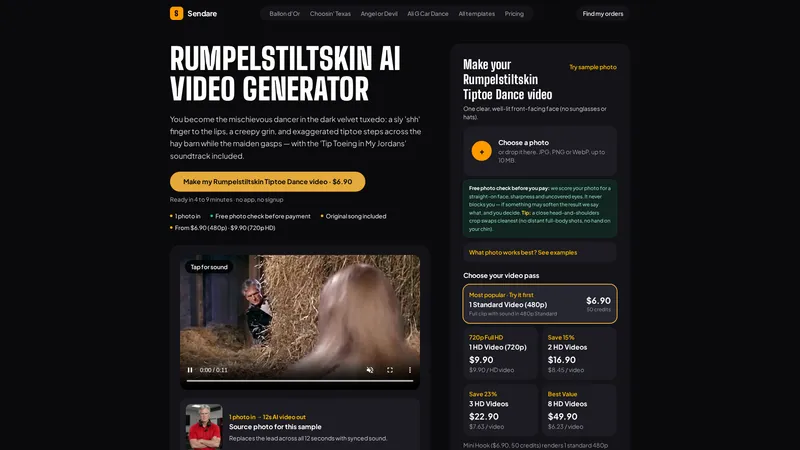
Sendare AI Studio is a focused web-based AI video generator built around a very specific promise: turn one clear photo into a short, shareable meme video that already has the timing, camera cuts, costumes, and soundtrack of a viral trend. The Rumpelstiltskin Tiptoe Dance template is the clearest example. A user uploads one front-facing photo, the system runs a free photo check, and then ByteDance Seedance 2.5 recasts the face and hairstyle into the mischievous imp in the black velvet tailcoat across a 12-second barn dance. The experience is Ready to use because there is no app to install, no account to create, and no editing timeline to learn. The site positions itself less as a general video editor and more as a one-photo trend studio for people who want to join a meme wave before it cools. That positioning matters. Most social trends move fast, and the gap between seeing a funny clip and wanting to post a version of it is where ordinary editors lose people. Sendare closes that gap with a single upload, a transparent one-time price, and delivery by private order page and email.
The Rumpelstiltskin template is based on a 12-second AI-generated clip styled like grainy 1980s European fantasy film. Inside a candle-lit hay barn, a small imp in a black velvet tailcoat and bow tie peeks from behind a haystack, raises one finger to his lips in a sly shh gesture, grins, and performs an exaggerated high-knee tiptoe dance while a startled blonde woman in a white dress reacts. The page explains that the clip is not from the 1987 musical film Rumpelstiltskin, despite viral comments claiming otherwise, and cites Know Your Meme and NBC News reporting that traced the footage to AI filmmaker Tatyana Tereshchenko and collaborators. TikTok editors later paired the barn dance with RiFF RAFF's Tip Toe Wing In My Jawwdinz, also known as Tip Toeing in My Jordans, which turned the scene into a character-swap trend. Sendare's product response is practical: keep the reference clip's shot order, reaction cuts, film grain, costume, and soundtrack intact, then replace only the imp with the user's face, skin tone, and hairstyle. For creators who need a more efficient route from trend awareness to a finished post, this shot-for-shot approach removes the need for CapCut templates, manual masking, or prompt engineering.
The target audience is broad because the use case is emotional and social rather than technical. TikTok and Instagram Reels creators use the template to join a trend with their own face instead of reposting the same clip. Meme page administrators use it to produce fresh character swaps for audiences that expect rapid iterations. College students and friend groups use it for group chats, birthdays, and inside jokes. Pet owners upload a dog or cat photo to create a surreal version of the dance. Small business owners and solo marketers use the resulting video as a lightweight attention hook for a product, event, or local promotion. Couples and families use it for playful anniversary posts or holiday messages. Even people who normally avoid video editing are part of the audience because the page promises no signup, no app, and no watermark. The common thread is not professional production. It is the desire to participate in a recognizable cultural moment with a personal twist that feels funny, slightly absurd, and easy to publish.
The core features are straightforward and tightly scoped. A user chooses the Rumpelstiltskin template, uploads one JPG, PNG, or WebP photo up to 10 MB, and receives a 12-second MP4 in 16:9. The generator supports 480p Standard and 720p Full HD output. The original soundtrack is synced to the tiptoe steps, and a silent MP4 option is available for users who want to attach the official sound inside TikTok, Instagram Reels, or YouTube Shorts. A free AI photo check runs before payment and reports angle, framing, sharpness, and whether the eyes are uncovered. The check does not block the user. It gives guidance so the buyer can decide whether to continue or try a better photo. The model can still refuse a photo during rendering, and in that case credits return automatically. A single credit balance works across all 25 templates, so a user who buys a pack for Rumpelstiltskin can spend remaining credits on another trend such as Dime Dime Baby, Burning Bridges Party, Ozil Champions League Goal, Single Ladies Pet Dance, A2O Lite Neon Dance, or Stones to Castle. Failed renders are refunded automatically, and unused credits never expire.
The content features are designed to answer buying questions before they become support tickets. The page includes a shot-by-shot breakdown from 0 to 12 seconds, a sample input photo and sample output frame, a prompt explanation, posting captions and hashtags, common issues and fixes, and a detailed FAQ. It also explains what photos work best: straight-on face, head and shoulders, even lighting, plain background, no sunglasses or hats, and one person only. The content is candid about limitations. The velvet tuxedo remains part of the character, so only the head, face, and hairstyle are carried over. The blonde woman keeps her own face because the replacement is locked to the imp. The close-up shh moment can look soft if the source portrait is blurry or heavily filtered. This kind of content builds trust because it sets expectations instead of promising a perfect face swap. The page also names the trend, explains its origin, cites sources, and updates the context, which helps users understand why the template looks the way it does.
The user experience is intentionally short. A visitor can tap a sample, upload a photo, see the free check, choose a pass, enter an email, and pay once. There is no password and no account dashboard to manage. After payment, the finished video opens on the same screen and is also emailed as a private order link. Users who return later can click Find my orders and enter their checkout email to receive all video links and remaining credits. This flow is convenient for mobile users who discover the trend inside TikTok or Instagram and do not want to switch to a desktop editor. The page also offers practical tips and tricks for better results: use a close head-and-shoulders crop, face the camera straight on, avoid hands near the chin, use even natural light, and keep the background uncluttered. These instructions are specific enough to improve output without turning the purchase into a tutorial. The overall experience feels more like buying a single effect than learning a software suite.
Technical features are presented in plain language. The site says the Rumpelstiltskin template runs a shot-for-shot Seedance 2.5 edit on the 12-second reference clip and preserves both reaction cuts and the shh finger gesture. A first-party benchmark measured on October 21, 2026 reports a 12-second 720p 16:9 recast settling in 4 to 7 minutes, with an upstream compute estimate of about $3.07. Public render estimates are usually 4 to 9 minutes. The output is an MP4 with synced audio, no watermark, and a silent option. The model redraws every frame rather than pasting a flat face, which is why the result can follow the camera cuts and body movement. The page also discusses safety and consent. The user must confirm the photo is of themselves, their pet, or an adult who agreed, with no children and no celebrities. Terms, privacy policy, safety page, refund policy, and support email are linked. These technical and policy details are unusual for a meme tool, and they support the site's positioning as a paid product with clear boundaries rather than a free, anonymous toy.
Pricing is one-time and credit-based. The Mini Hook Pass costs $6.90 and provides 50 credits for one standard 480p video. The Single Video Pass costs $9.90 and provides 100 credits for one 720p Full HD video. The Duo Pack costs $16.90 for two HD videos, the Creator Trio Pack costs $22.90 for three HD videos, and the Party Studio Pack costs $49.90 for eight HD videos. The per-video price falls from $9.90 to $8.45, $7.63, and $6.23 as the pack size increases. All passes use the same credit balance across 25 templates. Unused credits never expire. Failed renders return credits automatically. Users who need a refund can email support within 14 days with an order reference. This structure is simple for buyers who do not want a subscription for a one-off meme. It also gives heavier users a reason to buy a larger pack without locking them into recurring billing. The most efficient choice for a single test is the $6.90 480p pass, while the $9.90 HD pass is better for posting because the face and costume details are clearer at 720p.
Compared with free meme generators and general AI video tools, Sendare's advantage is focus. Free tools often add watermarks, queues, or unclear limits. General video tools require prompt writing, model selection, and editing. Sendare reduces the job to one template, one photo, one payment, and one download. The trade-off is that users cannot redesign the scene or change the costume in this specific template. The Rumpelstiltskin clip is a fixed 12-second format with a fixed soundtrack and fixed reaction cuts. That constraint is the product. It makes the result recognizable and fast. The site also provides comparison and benchmark pages for users who want to understand cost and model performance. For a United States audience that is used to subscription fatigue and app overload, the no-signup, no-subscription, one-time purchase model is a clear differentiator. The page speaks directly to people who want a funny video for a group chat, a post, or a small campaign without committing to a monthly plan.
Sendare AI Studio is therefore best understood as a trend participation tool. It is not a full editing suite, not a replacement for a social media scheduler, and not a custom animation studio. It is a narrow product that does one thing well: it puts a user's face into a recognizable viral scene with synced sound and a clean download. The Rumpelstiltskin Tiptoe Dance template combines a strange, memorable character, a clear soundtrack hook, and a simple input requirement. The site supports that combination with transparent pricing, a free pre-payment photo check, automatic credit returns for failed renders, and a set of content features that explain the trend and the process. For creators who want a fast, low-friction way to join the joke, the product is Ready to use, more efficient than manual editing, and supported by practical tips and tricks that improve the odds of a clean result. Users who follow the photo guidance and choose the HD pass get the most efficient balance of price, speed, and shareable quality.
Top Features
One-photo upload for a 12-second AI video output
Shot-for-shot Seedance 2.5 character recast that preserves camera cuts and timing
Original trend soundtrack synced to the tiptoe dance, plus a silent MP4 option
Free AI photo check before payment with guidance on angle, framing, sharpness, and uncovered eyes
No signup and no password; private order page and email delivery after checkout
480p Standard and 720p Full HD output options
One credit balance that works across all 25 templates
Automatic credit return if a render fails or is refused by the model safety filter
Unused credits never expire
No watermark on downloaded videos
Detailed shot-by-shot breakdown, prompt explanation, captions, hashtags, and common fixes
One-time credit packs with no recurring subscription
Simple Definition of Usecases
A TikTok creator sees the Rumpelstiltskin tiptoe trend rising on a Friday afternoon and wants to post before the weekend. They open Sendare on a phone, upload a recent front-facing selfie, use the free photo check to confirm the face is sharp and uncovered, choose the $9.90 HD pass, and receive a 12-second 720p MP4 with the synced Tip Toeing in My Jordans soundtrack. The feature that solves the problem is the shot-for-shot recast: the user does not need to recreate the barn, costume, reaction cuts, or timing. The problem is speed and relevance. The result is a trend-ready post that feels personal without a editing session.
A meme page administrator needs several variants because the audience tires of the same clip quickly. They buy the Party Studio Pack for $49.90, use the same credit balance across multiple templates, and produce a small batch of character swaps for Rumpelstiltskin, Dime Dime Baby, and other trends. The features that matter are the shared credit pool, the 25-template library, and automatic credit returns for failed renders. The problem is content volume without a production team. The result is a repeatable workflow that keeps the page active while avoiding a subscription or a monthly commitment.
A college student wants to make a friend laugh in a group chat but does not want to pay for a full editing app. They choose the $6.90 Mini Hook Pass, upload a clear head-and-shoulders photo, and download the 480p standard video. The free photo check warns them that a photo shot from above may tilt the head, so they switch to a straight-on portrait. The features that solve the problem are the low one-time entry price and the pre-payment check. The problem is cost and uncertainty. The result is a funny, recognizable video that costs less than a sandwich and does not require an account.
A pet owner wants a silly video starring their dog. They upload a well-lit photo with the pet's face clearly visible, use the silent MP4 option, and add the official sound inside TikTok so the post fits the platform's audio ecosystem. The feature that matters is the silent download combined with the synced soundtrack version. The problem is platform-native posting. The result is a pet video that joins the trend while giving the owner control over how the audio is attached.
A small business owner wants a quick attention hook for a weekend promotion. They use the Rumpelstiltskin template with a staff photo, download the HD version, and post it with a caption that ties the tiptoe dance to a limited-time offer. The feature that solves the problem is the ready-made scene and soundtrack, which would be expensive and time-consuming to produce from scratch. The problem is creating scroll-stopping content on a small budget. The result is a playful post that feels native to social feeds rather than like a traditional ad.
A couple in a long-distance relationship wants a private joke for an anniversary. They upload one partner's photo, choose the HD pass, and send the finished video by message. The feature that matters is the private order page and email delivery, which keeps the file easy to find later. The problem is making a personal moment feel special without planning a production. The result is a lightweight, shareable gift that uses a trend both people recognize.
User Reviews
Marlowe Vantrease
Social media manager
★★★★★
"I run social for a small lifestyle brand, and I am usually the person who has to turn a trend into a post before the audience stops caring. What sold me on Sendare was the no-signup flow. I uploaded a portrait from my phone, the free photo check told me the image was slightly angled but still usable, and I paid for the HD pass. The finished Rumpelstiltskin video arrived by email and opened on the order page in about six minutes. The camera cuts and the shh moment were intact, and my face actually followed the movement instead of looking pasted on. I used the silent MP4 and attached the sound natively on Instagram, which performed better for us. The fact that the credit balance works across the other templates is a real advantage because I can test a second trend without buying a new pack. It is not a full editing suite, and the velvet costume is fixed, but for the job I needed it was fast, clear, and easy to explain to my team."
Marlowe Vantrease
Social media manager
★★★★★
"I run social for a small lifestyle brand, and I am usually the person who has to turn a trend into a post before the audience stops caring. What sold me on Sendare was the no-signup flow. I uploaded a portrait from my phone, the free photo check told me the image was slightly angled but still usable, and I paid for the HD pass. The finished Rumpelstiltskin video arrived by email and opened on the order page in about six minutes. The camera cuts and the shh moment were intact, and my face actually followed the movement instead of looking pasted on. I used the silent MP4 and attached the sound natively on Instagram, which performed better for us. The fact that the credit balance works across the other templates is a real advantage because I can test a second trend without buying a new pack. It is not a full editing suite, and the velvet costume is fixed, but for the job I needed it was fast, clear, and easy to explain to my team."
Séraphine Okafor
College student
★★★★
"I bought the $6.90 standard pass because I wanted to see whether the trend would work with my face before spending more. The upload process was simple, and the photo check was more helpful than I expected. It warned me that my first selfie was cropped too close at the top, so I switched to a better portrait. The 480p video was funny and the soundtrack was already synced, which made it easy to post in a group chat. The only reason I am not giving five stars is that the lower resolution softens the close-up a little, especially around the eyes. For a meme, that is fine, but if I were posting to a public account I would choose the HD pass. I appreciate that there is no subscription and that failed renders return credits. I also like that the site explains what photos work best instead of pretending every image will produce the same result. I would use it again for a quick trend post, but I would budget for 720p next time."
Dashiell Quintero
Pet owner and casual creator
★★★★★
"I have a very patient dog who is used to being photographed, so I tried the Rumpelstiltskin template with a close-up of his face. I was not sure whether a pet photo would work, but the page says one photo of yourself or your pet, and the upload accepted it. The result was absurd in the best way. The barn, the tuxedo, and the tiptoe moves stayed the same, while my dog's face carried the shh close-up. I downloaded the silent version and added the official sound on TikTok because I wanted the post to sit inside the platform's audio page. The whole process took maybe seven minutes, and I did not have to create an account. I did have to retake the photo once because the first one had a hand near his chin, which the check flagged. That guidance was accurate. This is not a custom animation tool, but for a pet meme it is a very specific, very funny product."
Nadira Bellweather
Meme page administrator
★★★★
"I manage a meme page, so I care less about the novelty and more about whether the output matches the reference clip. Sendare's Rumpelstiltskin template does a good job of keeping the reaction cuts, the blonde woman's face, and the timing of the tiptoe dance. My face replaced the imp in every shot where the imp appears, and the velvet tailcoat stayed consistent. I bought the three-video pack and used the credits across two other templates to test whether the balance really works everywhere. It does. The main limitation is that you cannot change the costume or redesign the scene, so if you want a different look, this is not the tool. But for trend participation, the constraint is useful because it keeps the result recognizable. The HD version is worth the extra money for a public post. I also like that unused credits do not expire, because I do not always use a full pack in one sitting. The order page makes it easy to find old videos without a password."
Peregrine Halvorsen
Small business owner
★★★★★
"I own a small bakery and I am always looking for low-cost content that does not look like a corporate ad. I used the Rumpelstiltskin template with a photo of our front counter manager, and we posted it with a caption about tiptoeing into the weekend. The video was ready faster than I expected, and the sound was already attached. I chose the eight-video pack because I knew we would want a few variations for different staff members and a second template for a holiday post. The one-time payment model was the deciding factor. I did not want another monthly subscription for something we might use once a month. The page explains the consent rule clearly, so I made sure the employee agreed before uploading. We had one render fail because the photo was too shadowed, and the credits came back automatically. Support also answered a question about the silent download within a day. It is a narrow tool, but it solved a real problem for us."
Frequently Asked Questions
Q:
What is Sendare AI Studio?
A:
Sendare AI Studio is a web-based AI video generator that turns one photo into a short meme video using built-in trend templates. The Rumpelstiltskin template creates a 12-second 16:9 MP4 with the user's face recast as the imp, synced soundtrack, and optional silent download.
Q:
What does the Rumpelstiltskin AI video generator do?
A:
It recreates the 12-second barn dance shot for shot with ByteDance Seedance 2.5. It keeps the hay barn, the blonde woman's reaction cuts, the velvet tailcoat, and the timing, while replacing the imp with the face, skin tone, and hairstyle from the uploaded photo.
Q:
What to upload for the best Rumpelstiltskin tiptoe dance video?
A:
Upload one clear, well-lit, front-facing photo of an adult person or pet. Use a head-and-shoulders crop, keep the whole face and hairline visible, avoid sunglasses, hats, hands near the chin, group photos, heavy filters, and strong shadows.
Q:
How to make a Rumpelstiltskin AI video from one photo?
A:
Open the Rumpelstiltskin template, upload a JPG, PNG, or WebP photo up to 10 MB, review the free photo check, choose a credit pass, enter your email, and pay once. The finished video opens on the order page and is also emailed to you.
Q:
How to fast check whether my photo will work before paying?
A:
The site runs a free AI photo check as you upload. It reports angle, framing, sharpness, and whether the eyes are uncovered. The check does not block you, but it warns you if something may soften the result so you can switch photos before payment.
Q:
Does the finished video include the Tip Toeing in My Jordans soundtrack?
A:
Yes. The downloaded MP4 includes the RiFF RAFF Tip Toe Wing In My Jawwdinz audio synced to the tiptoe dance. The order page also provides a silent MP4 option for users who want to attach the official sound inside TikTok, Instagram Reels, or YouTube Shorts.
Q:
Is Sendare a subscription or a one-time purchase?
A:
It is a one-time purchase. Credit packs range from $6.90 for one 480p video to $49.90 for eight HD videos. There is no recurring subscription, unused credits never expire, and the same credit balance works across all 25 templates.
Q:
What happens if a render fails or my photo is refused?
A:
If a render fails, times out, or is refused by the model safety filter, the credits return to your order automatically so you can try another photo at no extra cost. Refunds are also available by emailing support within 14 days with your order reference.
Q:
Can I post the video on TikTok, Instagram Reels, and YouTube Shorts?
A:
Yes. The video is a standard MP4 in 16:9. You can download the version with synced sound or the silent version and add the official sound natively on each platform. The site provides captions and hashtags, including #rumpelstiltskin, #tiptoeinginmyjordans, and #aitrend.
Q:
How do I find my video and remaining credits later?
A:
After checkout, the video opens on a private order page and is emailed to the address you entered. To find it again, click Find my orders in the top bar, enter your checkout email, and the site emails you all paid orders, finished MP4s, and remaining credits.
VidRush AI is an all-in-one generative AI creation platform built for modern creators who need video, image, and music production tools without the overhead of managing five different subscriptions. The platform combines some of the world's most advanced foundation models, including Google Veo 3.1, Seedance 2.5, Kling 3.0, Wan 2.6, Nano Banana Pro, Seedream 5.0, GPT Image 2, and Suno AI, inside a single streamlined workspace. It is designed for both independent storytellers and professional production teams who want to transform text prompts, still photos, existing footage, or simple musical ideas into finished creative assets in minutes.
Website Positioning
VidRush AI positions itself as the definitive all-in-one alternative to fragmented creative AI workflows. In a market where powerful video tools are often separated from image tools, and music generation remains a separate platform, VidRush AI brings the entire production chain into one place. The site emphasizes broad accessibility: beginners can describe an idea in natural language, while professionals can fine-tune outputs with model selection, resolution, aspect ratio, camera motion, and multi-reference controls. The value proposition is straightforward: instead of learning many different interfaces, users can switch between cinematic text-to-video generation, photo animation, image editing, and AI music creation without leaving the workspace.
Target Audience
The platform is especially relevant for creators in the United States and other major media markets who want outputs that are ready to use for commercial publishing. YouTube creators and vloggers can build complete videos using Veo 3.1 footage, Nano Banana thumbnails, and Suno background music inside one dashboard. Social media marketers serving TikTok, Instagram Reels, and YouTube Shorts need fast turnaround for vertical ad formats, and VidRush AI responds with 9:16 aspect ratio support, native audio, and commercial licensing clarity. E-commerce brands can animate product photos into lifestyle videos and produce professional product shots from text descriptions. Independent filmmakers, video editors, and digital studios rely on the integrated model suite for previsualization, style transfer, and scene extension. Game developers use image generation for concept art, video-to-video for cinematic in-engine capture, and AI music for original soundtracks without expensive licensing fees. Musicians and audio producers can also create full vocal tracks, instrumental beds, and dynamic song variations from simple lyric prompts.
Core Features
VidRush AI provides six main creative modes: Text to Video, Image to Video, Video to Video, Text to Image, Image to Image, and AI Music Generation. The Text to Video mode lets users turn narrative scripts into cinematic clips with realistic physics, complex camera movement, and synchronized native audio. Image to Video is optimized for animating photographs, artwork, and product images while preserving identity and minimizing the character drift that often appears in earlier AI tools. Video to Video offers style transformation, motion replication, and footage extension based on user-provided reference clips. The Text to Image tool creates photorealistic portraits, commercial product visuals, concept art, and illustrations from descriptive words, while Image to Image supports remixing, restyling, and upscaling with identity retention. The AI Music Generator, powered by Suno 5.5 and previous Suno versions, turns text prompts and lyrics into complete songs with natural vocals, expressive instrumentation, and full dynamic range.
Foundation AI Model Integration
A major technical advantage offered by VidRush AI is its direct access to multiple state-of-the-art models. For video creation, users can choose Google Veo 3.1 for its impressive native audio and physics, Seedance 2.5 for multi-modal referencing and character consistency, Kling 3.0 for lifelike human motion, or Wan 2.6 for cinematic camera movement. For image generation, the platform includes Nano Banana Pro for photorealistic skin tones and lighting, Seedream 5.0 for high-resolution artistic texture, GPT Image 2 for complex typography and visual reasoning, and Flux 2 for rapid texture synthesis. Music generation is handled through Suno 5.5, 5.0, and 4.5, giving users access to the latest developments in AI vocal synthesis and arrangement. By offering a menu of excellent models rather than a single proprietary engine, VidRush AI lets users select the right tool for each specific job.
User Experience and Workflow
VidRush AI turns complex production tasks into a direct four-step process. First, users choose a media type and preferred model. Second, they write a prompt in natural language or upload reference assets such as start and end frames, existing images, or audio clips. Third, they configure output parameters such as aspect ratio, duration, camera behavior, lyrics, and instrumental preferences. Fourth, they generate, preview, iterate, and export high-resolution files ready for publishing. This workflow removes the friction commonly associated with installing open-source models, managing GPU hardware, or jumping between multiple web apps. For creators who have struggled with technical setup, the platform offers a convenient, simplified path forward. Even with no prior machine learning experience, users can produce compelling results because the interface highlights intuitive presets and model guidance.
Content Quality and Media Capabilities
VidRush AI supports a broad range of content creation needs. Text-to-video results can include cinematic sci-fi cityscapes, product-focused luxury advertising, documentary-style nature footage, and narrative action scenes. Image-to-video examples demonstrate animated character sequences, clothing physics, hair motion, and environmental effects that match the photographic source. Image generation covers futuristic portraits, commercial packaging, e-commerce product images, and stylized digital art. Music tracks are suitable for YouTube backgrounds, social media ads, game audio, podcasts, and full streaming releases. This breadth makes VidRush AI unusually practical for creators who produce in multiple formats. The same team can generate a product hero image, turn it into an engaging animation, and add an original soundtrack before publishing a coordinated campaign from one workspace.
Commercial Rights and Licensing
For many creators, especially those operating in the United States, commercial rights are among the most important considerations when selecting an AI tool. VidRush AI states that content created under active paid subscription plans or purchased credit packages includes full commercial licensing rights. Users can monetize videos on YouTube and TikTok, run client advertising campaigns, publish game assets, sell generated images, distribute music through streaming platforms, and deliver content for commercial television or film projects. This removes the uncertainty and legal friction that often come with open-source weights or free-tier restrictions. For agencies and small studios, that licensing clarity is a major reason to move beyond fragmented free tools and centralize production on a platform with transparent terms.
Performance and Technical Infrastructure
VidRush AI uses distributed, high-throughput GPU clusters to accelerate rendering. According to the platform's published workflow information, images typically render in 5 to 15 seconds, full-length or cinematic video clips complete in one to three minutes, and song generation typically produces two variations in one to two minutes. This speed matters enormously for content teams working on tight deadlines. In addition to speed, the technical backend supports up to 4K upscaling and flexible aspect ratios including 16:9 widescreen, 9:16 vertical shorts, and 1:1 square content. The platform's architecture is designed to balance high-volume user demand and priority processing through different tier plans.
Optimization and Community Resources
The site includes a community and showcase area where creators can examine authentic video and image outputs, including cinematic science fiction scenes, stylized anime-inspired visuals, e-commerce animations, and realistic wildlife footage. These examples serve as creative references and offer practical tips and tricks for users who are still learning prompt design or model selection. The showcase also helps users understand the stylistic differences between models such as Veo 3.1, Seedance, Kling, and Nano Banana. By seeing how different models handle color, motion, lighting, and character consistency, users can make more informed choices before spending credits. This educational layer makes the platform more accessible to newcomers and helps experienced users optimize their workflows.
Productivity and Business Value
For a production team, the ability to handle video, image, and music in one tool is a major cost saver. A creator who previously paid separately for a text-to-video service, an image model subscription, a background music license, and a standalone image animation platform can replace these fragmented tools with one subscription. This consolidation lowers monthly expenses, reduces time spent copying files between platforms, and simplifies account administration. The integrated environment allows creators to keep their entire content pipeline in one place, which is especially important for teams that produce daily content. Workflows become more efficient when creators are not forced to leave their editing context to generate a thumbnail or a music bed.
The Essential Creative Controls
Although VidRush AI is designed to be simple enough for beginners, it also delivers the essential creative controls required by advanced users. Model choice gives users control over aesthetic style and motion handles. The multi-reference feature allows image inputs to guide character appearance, composition, and product detail, which is extremely useful for branded content. Output controls include resolution, aspect ratio, duration, camera motion, and lyric inputs for music generation. Advanced users can enter the same visual prompt into different models, compare results, and choose the most effective output. This makes the platform a serious tool for art directors and production designers who need predictable visual outcomes rather than random generations.
Getting Started and Pricing Flexibility
VidRush AI invites new users to start with free starter credits, meaning individuals can test video, image, and music generation without immediately making a financial commitment. After testing, users can choose between monthly subscription plans for recurring creation needs or on-demand credit packs for occasional bursts of work. The credit system is based on model complexity, output length, and resolution, giving fair and transparent usage expectations. The platform also runs promotional discounts, including limited-time offers such as 20% off, which add additional value for early adopters. Because free credits, subscriptions, and pay-as-you-go packs are all available, VidRush AI can suit hobbyists, professional creators, and large production companies at different stages of growth.
Conclusion
VidRush AI is much more than a simple text-to-video generator. It is a serious unified creative studio that responds to the real production needs of a generation of creators working across YouTube, social media, e-commerce, film, games, and music. By integrating powerful models, prioritizing commercial usability, emphasizing fast rendering, and providing flexible pricing, it gives modern creators the most efficient route from an idea to a polished asset. For those who want professional output without the overwhelming complexity of running separate AI tools, VidRush AI offers a ready to use creative environment that feels both familiar and groundbreaking. It respects the craft of content creation while removing unnecessary technical barriers, making it one of the most compelling all-in-one AI platforms for the United States market and beyond.
Meme Picture is a free, ready to use AI face meme generator that turns a selfie, a friend's photo, or a pet picture into a classic meme template in seconds. The site requires no login for its free tier, offers three generations per day, and delivers two to four candidates per run. This makes it one of the most efficient ways to join meme culture without learning Photoshop, GIMP, or any layered design software. The core workflow is simple: upload a photo, pick a Meme Picture template, add an optional caption, choose a visual style, and generate. About thirty seconds later, you can download a share-ready PNG optimized for WhatsApp, iMessage, Discord, Telegram, or WeChat.
Website positioning. Meme Picture positions itself as a no-login, free face meme generator. The homepage immediately presents the value proposition with the heading Free Face Meme Generator Put Your Face in Memes. It emphasizes free access, classic templates, AI-generated candidates, and a fast workflow. Unlike general-purpose image editors, Meme Picture is focused on one job: placing your face or pet into recognizable meme formats. This narrow focus allows the tool to be more efficient than manual editing while remaining approachable for people who have never made a meme before.
Target audience. The primary audience includes social media users, group chat participants, Discord and Reddit community members, pet owners, students, and content creators. These users often need quick, relatable visual reactions for conversations and posts. They may not have design experience, may be on mobile devices, and may not want to create an account just to make one image. Meme Picture addresses this by offering a lightweight, automated workflow that works in a browser without registration. Secondary audiences include small business social media managers and streamers who want branded or personalized meme content without hiring a designer.
Core features. The generator includes fifteen hand-picked classic templates, including Distracted Boyfriend, Woman Yelling at Cat, Drake Hotline Bling, Surprised Pikachu, This Is Fine, Change My Mind, One Does Not Simply, Success Kid, Hide the Pain Harold, Stonks, Expanding Brain, Two Buttons, Unsettled Tom, Doge, and Grumpy Cat. Users can select from four visual styles: Cartoon, Pixel Art, Hand-drawn, and Realistic. The AI handles face placement and stylization automatically, so no manual cutting or color matching is needed. Each run produces two to four candidates, allowing users to choose the funniest result. The free plan includes three generations per day and two candidates per request. Pro plans increase this to thirty generations per day and four candidates per request, with no watermark, GIF memes, HD export, and cloud history. One-time packs of ten or thirty permanent generations are also available for users who want extra runs after the daily quota is used.
Content features. The site includes a dedicated Templates page with links to individual template pages. Each template page provides captions, history, and FAQ for that specific format. The homepage also contains a picture-to-meme guide, a how-to section, and a comparison with Imgflip and Canva. This content is practical and focused on helping users understand how to get the best results. The site answers common questions such as whether the tool is free, whether an account is required, what photos work best, and how long generation takes. Because the content is organized around clear user tasks, it acts as a practical tutorial without requiring a separate manual.
Detailed template guidance. The homepage lists eight template links and a full catalog. Distracted Boyfriend is ideal for showing divided attention. Woman Yelling at Cat works for arguments or callouts. Drake Hotline Bling is perfect for comparing two options. Surprised Pikachu expresses shock at predictable outcomes. This Is Fine suits moments when everything is falling apart but you pretend otherwise. Change My Mind invites debate. One Does Not Simply adds dramatic flair. Success Kid celebrates small victories. Hide the Pain Harold is for forced smiles. Stonks represents absurd financial or logical reasoning. Expanding Brain shows escalating ideas. Two Buttons presents a difficult choice. Unsettled Tom captures discomfort. Doge and Grumpy Cat add animal humor. Each template remains recognizable, which is essential for meme communication.
User experience. The interface is intuitive and streamlined. The hero section includes two clear calls to action: Create from your photo and Browse Templates. Below that, the page shows a three-step process: upload photo, pick template, download and share. The generator section includes a file upload area that accepts JPEG, PNG, or WebP files up to 4 MB, with automatic compression for large photos. Users can also try a sample portrait or sample pet photo. The template picker is organized into All, Reaction, Comparison, Animals, and Classic categories. The style selector, caption field, and optional extra instructions are all on the same page, so users do not need to navigate between steps. Results appear on the same page after generation. This single-page design creates a seamless experience from upload to download.
Technical features. Meme Picture is powered by GPT Image 2 and operates as an independent product, not affiliated with OpenAI. The site's browser-based workflow supports both phone and desktop uploads. Original photos are deleted right after generation, and signed-in users only keep finished meme images. The site states that it does not train on or sell user photos, which is a strong privacy commitment. PNG export is optimized for instant sharing, and Pro users gain access to HD export and GIF generation. The service uses an automated pipeline for face swapping and style transfer, reducing the need for manual intervention.
Accessibility and mobile. Because Meme Picture is browser-based, it requires no installation. The upload control works with drag and drop on desktop and file selection on phones. Large photos are automatically compressed to fit the 4 MB limit, which keeps mobile data usage reasonable. The interface scales to small screens, and the single-page workflow avoids confusing multi-step navigation. This makes the tool accessible to users who only have a phone and want to create memes during a conversation. The automatic compression also ensures that uploads do not fail on slower connections.
Privacy and trust. The site's privacy-first approach is a differentiator. Many free tools monetize user uploads or require account creation, but Meme Picture deletes original photos immediately after generation. This matters for people who want to use personal selfies or pet photos without worrying about data retention. The homepage clearly states this policy in the why people love section and in the FAQ. The lack of mandatory login lowers the barrier to entry and reduces friction for first-time visitors. The site also maintains standard pages for Privacy, Terms, Refund Policy, About, and Guides, which builds credibility.
Community and cultural relevance. Internet memes are a shared language, and communities such as Know Your Meme have documented these formats for years. Meme Picture builds on that familiarity by keeping iconic layouts intact. When a user sees a Distracted Boyfriend image with a friend's face, the joke is immediate because the format is already understood. This cultural relevance is part of the product's effectiveness. The tool does not attempt to invent new formats; it personalizes existing ones. This approach reduces the learning curve and makes the output instantly useful in groups.
How to get the most out of Meme Picture. To achieve the best results, users should upload a clear, well-lit selfie or pet photo. The site recommends trying sample photos if you do not have a suitable image. Choosing the right template for the intended joke matters: Distracted Boyfriend works for distractions, Woman Yelling at Cat for arguments, Drake Hotline Bling for comparisons, Surprised Pikachu for predictable surprises, This Is Fine for chaotic acceptance, and Change My Mind for bold opinions. Adding a caption or selecting an example joke improves the meme. Users can also use the Extra instructions field to request specific expressions or framing. Because the generator produces two to four candidates, users should review all outputs and pick the funniest one. For multiple memes, the Pro plan's higher quota and no watermark are useful.
Comparison with alternatives. Imgflip and Canva are strong tools for text overlays on stock templates, but Meme Picture specializes in face-insertion memes. In Photoshop, placing a face into a meme can take twenty to forty-five minutes of layer work, masking, and color adjustment. Meme Picture reduces that to roughly thirty seconds per run. The free daily quota makes it easy to try without commitment, and the one-time packs offer a pay-per-use supplement for occasional bursts of activity. This makes the tool both more efficient and more accessible than traditional editing.
Potential use cases. The tool suits reaction memes for Discord, funny pet images for family groups, custom visuals for social posts, student humor for group projects, and streamer engagement content. Because the output is a PNG, it can be dropped into almost any chat app or social platform. The picture-to-meme page provides a dedicated workflow for users who already have an image in mind. This flexibility supports both spontaneous and planned meme creation.
SEO and discoverability. Meme Picture targets keywords around free face meme generator, put my face in a meme, no login meme maker, AI face swap, and classic meme templates. The site's template pages create additional entry points for specific formats such as Distracted Boyfriend or Woman Yelling at Cat. The homepage includes internal links to these template pages, which helps visitors explore the catalog and improves search visibility.
Conclusion. Meme Picture is a focused, automated, and intuitive tool for creating personalized memes. Its ready to use interface, free daily tier, and privacy-first upload policy make it an attractive option for casual users. The Pro and one-time pack pricing offer flexible upgrades for power users. By removing the complexity of traditional editing and delivering share-ready results in seconds, Meme Picture delivers a seamless experience from photo to meme. Whether you need a single reaction image for a group chat or a daily stream of custom memes, the service provides a practical, lightweight solution that respects your time and privacy.
AI STL Generator is a specialized web platform built for makers, designers, educators, and small businesses that need to turn 2D images or text prompts into 3D printable STL files. Positioned as the fastest free AI STL maker, it focuses on a specific bottleneck in the 3D printing workflow: converting ideas into watertight, slicing-ready models without requiring CAD expertise. Instead of forcing users to learn Blender, Fusion 360, or Meshmixer, the site offers a ready to use AI workbench that generates geometry from natural language or reference images and then automatically repairs the mesh for 3D printing. For anyone tired of cleaning non-manifold edges, inverted normals, zero-thickness walls, or floating islands, this platform promises a more efficient path from concept to physical print. It is not a generic 3D asset generator; it is a print-first tool designed around the realities of FDM and resin printing, slicer compatibility, and the practical needs of people who actually run printers every day.
Website Positioning: AI STL Generator positions itself as the number one AI STL generator for 3D printing and makers. The homepage emphasizes speed, print readiness, and compatibility with popular slicers such as Bambu Studio, Cura, PrusaSlicer, OrcaSlicer, Creality Print, and ideaMaker. Rather than competing as a broad 3D modeling suite, it owns the narrow but valuable niche of AI-powered STL creation. Its tagline and hero section make the value proposition clear: turn 2D images and prompts into 3D printable STL files. The site also includes auxiliary tools like a 3D viewer, 3D converter, printability checker, and STL repair, which together form a compact ecosystem for makers who want to go from idea to download without leaving the browser. This positioning is smart because the hardest part of AI 3D generation is not creating an attractive mesh; it is creating a mesh that survives a slicer without manual repair. AI STL Generator addresses that directly.
Target Audience: The platform speaks to a wide range of users. FDM hobbyists who own Bambu Lab, Prusa, Creality, or similar printers are a core audience. They want functional parts, custom organizers, replacement pieces, and decorative models that print reliably. Tabletop gamers and Dungeon Masters are another key group. They need custom miniatures, monsters, terrain pieces, and character models from Midjourney art, character sketches, or text prompts. Etsy sellers and small-batch print shops use the tool to shorten turnaround times for personalized keychains, plaques, cake toppers, and gifts. STEM educators and FabLab coordinators use it to introduce 3D printing without a CAD learning curve. Product designers and mechanical engineers use it for rapid concept models and form studies. Cosplay makers and prop builders use it to turn reference images into printable armor pieces, props, and accessories. Finally, AI enthusiasts and hobbyist 3D artists use it to explore generative geometry without needing to master a traditional modeling package. For all these users, the promise is the same: reduce the friction between an idea and a printed object.
Core Features: The feature set is built around a few powerful capabilities. Text-to-STL generation lets users type a description, such as a tabletop paladin, a mechanical rocker arm, or a minimalist rubber duck, and receive a 3D mesh ready for printing. Image-to-STL generation accepts JPG and PNG files, including photos, concept art, sketches, and logos, then reconstructs depth, volume, and topology. Multi-image support allows multiple angles for more accurate reconstruction. The printability check automatically detects non-manifold edges, inverted normals, and zero-thickness walls. The built-in STL repair then seals the mesh to create a watertight solid. Users can choose AI model detail levels such as Basic, Pro, and Ultra detail, with Ultra detail available on Pro and costing additional credits. Output formats include STL and 3MF. Character pose options include None, A-Pose, and T-Pose, which is helpful for miniature and character generation. Real-world size scaling allows users to scale to an estimated height with the origin at the base. The platform also includes a 3D viewer so users can inspect geometry in the browser, plus converters such as SVG to STL, STL to 3MF, and 3MF to STL. There is an AI miniature generator and a remesh and repair tool that acts as a lightweight STL editor. For 3D printing specifically, the system optimizes for flat-bottom geometry, bed adhesion, and minimal support requirements, which helps reduce warping and failed prints.
Content Features: The website content is designed to educate and reassure. It uses clear, benefit-driven headlines, step-by-step workflow explanations, and real examples of generated models such as a knight paladin, a precision rocker arm, a Nefertiti bust, and a designer rubber duck. Each featured creation includes triangle counts, a 3D inspection link, and a prompt or description. This helps users understand what is possible and sets realistic expectations about detail levels. The FAQ section answers common questions about STL generation, image-to-STL conversion, watertightness, editing, and pricing. The homepage also highlights compatibility with major slicers and includes user testimonials from an FDM hobbyist, tabletop gamer, Etsy seller, and STEM educator. The content is concise, practical, and focused on outcomes rather than technical jargon. It also offers tips and tricks for getting better results, such as using clear reference images, choosing the right detail level, and checking printability before downloading. These tips and tricks are valuable for beginners and experienced makers alike. For users who want to push the tool further, the site includes tricks for combining text prompts with image references and for using multiple images to improve reconstruction. Overall, the content builds trust by showing real models, real users, and real print workflows.
User Experience: The user experience is designed to be simple and fast. The workbench is the center of the product. Users choose Image to STL or Text to STL, upload images or enter a prompt, select an AI model, choose output format, set pose and size options, and click Generate 3D Model. A credit cost is shown next to the button, so there are no surprises. The 3D Model Preview pane lets users inspect the result before downloading. The workflow is split into three phases: input your idea, AI mesh generation and auto-watertight, and download STL and slice to print. This structure makes the process feel manageable even for first-time users. The site also offers a daily check-in for free credits, which encourages return visits and lowers the barrier to entry. Sign-in is available for account management, while Start Free leads directly into the workbench. The visual design is clean and modern, with a dark theme and bright accents that appeal to maker and tech audiences. The navigation includes STL Studio, 3D Viewer, 3D Converter, Pricing, Daily Check-in, Sign in, and Start Free. The overall experience is intuitive, and the platform avoids unnecessary complexity. For makers who value speed, this is one of the most efficient ways to go from an idea to a printable file. Many users will find it to be the most efficient option for quick, print-ready STL generation, especially when compared with manual modeling or repairing failed AI meshes.
Technical Features: Under the hood, AI STL Generator uses advanced neural networks to analyze images and prompts, then generate 3D geometry. The system performs automatic topology repair, remeshing, and mesh closure. It checks for non-manifold edges, inverted normals, and zero-thickness walls, then fixes them. The output is a manifold, watertight solid suitable for slicing. The platform supports STL and 3MF export, with GLB mentioned for visualization. It is compatible with Bambu Studio, Cura, PrusaSlicer, OrcaSlicer, Creality Print, and ideaMaker. The AI model tiers allow users to trade credits for detail, with Pro and Ultra detail options for higher-fidelity meshes. The system also supports character pose settings, real-world scaling, and flat-base optimization. The 3D viewer provides interactive inspection, and the converter tools handle format changes. The printability checker is a critical technical differentiator because it catches problems before the slicer does. The STL repair tool can adjust mesh density, simplify polygon counts, and flatten the base. This combination of generative AI and mesh repair is what makes the platform practical for real 3D printing, not just visual rendering. The technical stack is oriented toward reliability, repeatability, and slicer compatibility, which are the metrics that matter most to makers.
Workflow and Practical Benefits: The typical workflow is straightforward. A user starts with an idea, a sketch, a photo, or a text prompt. They upload or type it into the workbench. They select a detail level, output format, pose, and size. The AI generates a mesh, runs automatic repair, and presents a preview. The user inspects the model in 3D, then downloads the STL or 3MF. The file imports directly into their slicer without third-party repairs. This saves time, reduces failed prints, and lowers material waste. For Etsy sellers, it can cut turnaround from days to minutes. For educators, it removes the CAD barrier and lets students see their drawings become physical objects. For tabletop gamers, it enables custom miniatures that match a campaign or character concept. For engineers, it provides rapid concept validation. For cosplay makers, it accelerates prop development. The platform is especially useful for anyone who needs a ready to use output rather than a raw 3D asset. It is also a more efficient alternative to learning complex software for simple shapes and organic models. The site's focus on watertight geometry and printability means fewer failed prints, less wasted filament, and less time spent in repair tools. That is a practical, measurable benefit that matters to both hobbyists and businesses.
Pricing and Accessibility: AI STL Generator uses a freemium model. Users can log in daily to claim free check-in credits and generate STL files without paying. There are also pay-as-you-go credit packs and subscription plans for regular creators. The Generate 3D Model button shows a credit cost, typically 5 credits for a standard generation, with Ultra detail costing additional credits and available on Pro. This makes the pricing transparent and flexible. Casual users can rely on daily free credits, while power users can buy credits or subscribe. The Start Free call to action emphasizes no credit card required and instant download. This lowers the barrier for first-time users and encourages experimentation. The pricing page likely contains more details, but the homepage already communicates that the tool is accessible to hobbyists, educators, and small businesses. The freemium approach is well suited to the maker market, where usage can be sporadic or project-based. It also allows users to test the quality before committing to a paid plan. For many, the free daily credits are enough for occasional projects, while professionals will find the paid options affordable compared with the time saved.
Why It Matters for US Makers: In the United States, 3D printing has moved from a niche hobby to a mainstream tool for prototyping, education, small business, and creative expression. Makers expect fast results, clear pricing, and compatibility with the printers they already own. AI STL Generator fits that expectation by focusing on the most popular slicers and by promising watertight, print-ready files. American small businesses, especially Etsy sellers and custom gift shops, need to respond to customer requests quickly. A tool that turns a sketch into a printable STL in minutes can be a competitive advantage. Educators need low-barrier tools that work in a classroom without extensive training. Hobbyists want to spend time printing, not repairing meshes. Cosplayers and prop makers need to scale models accurately and avoid fragile walls. By addressing these needs, AI STL Generator aligns with the practical, outcome-oriented culture of the US maker community. It also fits the growing interest in AI-assisted design, where generative tools augment human creativity rather than replace it. The platform's emphasis on printability, repair, and slicer compatibility makes it more than a novelty; it is a workflow tool.
Final Thoughts: AI STL Generator is a focused, practical, and accessible platform for turning ideas into 3D printable STL files. Its core strengths are image-to-STL and text-to-STL generation, automatic printability checking, watertight repair, slicer compatibility, and a simple three-step workflow. It serves hobbyists, tabletop gamers, Etsy sellers, educators, engineers, cosplay makers, and AI enthusiasts. The freemium pricing and daily free credits make it easy to try, while credit packs and subscriptions support regular use. For anyone who wants a ready to use solution that is more efficient than manual modeling and more reliable than generic AI 3D generators, AI STL Generator is worth exploring. With the right tips and tricks, users can get better results from prompts and images, and with a few advanced tricks, they can push detail and scale further. In a crowded field of AI 3D tools, this platform stands out by focusing on the essential requirement: a file that actually prints. That focus makes it one of the most efficient and practical tools available for makers today.
Kirkify is a web-based AI face swap platform that has rapidly become the definitive tool for creating Charlie Kirk-themed memes. The service allows anyone to upload a photo and transform every face into the instantly recognizable likeness of Charlie Kirk, a process known as Kirkification. Built on Replicate-hosted face-swap models, Kirkify delivers consistent, share-ready results in typically under 30 seconds. The platform is designed to be ready to use from the moment a visitor lands on the homepage: no account creation, no credit card, and no desktop software are required for the first free Kirkification. This low-friction approach has helped Kirkify ride the viral wave on TikTok, X, Reddit, and Threads, where the Kirkification trend has generated millions of impressions.
Website Positioning
Kirkify positions itself as the most accessible and focused Charlie Kirk face swap tool on the internet. Unlike general-purpose face swap apps that require complex settings or manual masking, Kirkify does one thing exceptionally well: it detects all faces in an uploaded image and applies a single consistent Charlie Kirk reference look. This focus makes Kirkify more efficient for meme creators who need instantly recognizable results without learning a full editing suite. The site emphasizes speed, simplicity, and virality. Headlines such as Free to try, no sign-up required and Join millions creating viral Kirkified memes underline its ambition to be the default choice for anyone participating in the Kirkification trend. The brand voice is playful, direct, and tailored to internet culture, which resonates with its core audience of social media users.
Target Audience
Kirkify's primary audience includes meme creators, TikTok and X influencers, political satire enthusiasts, and everyday users who want to prank friends. The tool also appeals to content marketers looking to jump on viral trends, small social media teams, and bloggers who need quick visual gags. Because Kirkify requires no technical skill, its audience ranges from teenagers sharing group chat jokes to professional content creators producing daily posts. The free first credit and free queue option lower the barrier for casual users, while the credit-based paid model supports power users who need faster processing and batch output. The site's blog and how-to guides further serve beginners who are discovering the Kirkification trend for the first time. Students, office workers, and meme page administrators all find Kirkify accessible because it strips away the complexity of traditional photo editing.
Core Features
Kirkify's feature set is deliberately streamlined but effective. The main workspace is a drag-and-drop upload area that accepts JPG, PNG, and WEBP files up to 8MB. Once an image is uploaded, the automated AI detects every face, regardless of whether the user selects single face or multiple faces mode. GIF support is listed as coming soon, which would extend the tool to animated memes. The face swap engine uses facial landmark mapping and style transfer to impose a consistent Charlie Kirk look. Most jobs complete in under 30 seconds, and the output is delivered as a downloadable PNG or shareable link. The platform also offers a free queue option that processes images without consuming credits, albeit at a slower pace. A built-in showcase gallery displays community-created Kirkified images, providing inspiration and demonstrating the tool's capabilities. An AI Video generator is linked as a secondary tool for creating videos from text or images, extending the brand's utility.
The consistency of the output is a key technical advantage. Kirkify uses one reference image for all renders, which ensures that every Kirkified face looks exactly the same across selfies, group shots, and different lighting conditions. This single-source policy is what makes Kirkify memes instantly recognizable and highly shareable. The platform's dependence on Replicate-hosted models means that processing is handled on robust cloud infrastructure, allowing users to get results without installing anything. The site maintains transparency by linking to Replicate's documentation, signaling a commitment to technical reliability.
Content Features
Beyond the core face swap tool, Kirkify offers a growing content ecosystem. The Showcase page is a gallery of user-generated Kirkified images that serves as social proof and inspiration. The Blog contains articles, tips and tricks, and step-by-step tutorials on how to make the most of Kirkification. Topics likely include best practices for choosing source photos, optimizing memes for different platforms, and staying within satire and fair use boundaries. The site also provides dedicated landing pages for related tools, such as Kirkify AI Free, Kirkify AI Online, and Kirkify AI Generator, each targeting specific search intents. The footer includes a link to an About page, Contact, Pricing, Privacy Policy, Terms of Service, Refund Policy, and Refund Application, indicating a commitment to transparency and user trust. This content depth helps Kirkify rank in search engines and establishes it as an authoritative resource for the Kirkification trend. The existence of a How to Kirkify tutorial page and multiple guides demonstrates the platform's investment in user education.
User Experience
Kirkify's user experience is intentionally intuitive and frictionless. The homepage immediately presents the workspace with a clear call to action: Start Kirkifying Free. Users can drag and drop an image without creating an account, which is rare among AI tools. The interface uses simple language, large buttons, and visual cues to guide users through the three-step process: upload, AI transformation, download and share. The free first credit is prominently advertised, and the free queue option ensures that even users who run out of credits can still use the service. The automated nature of the face swap means users never need to manually select facial landmarks or adjust settings. This level of simplicity makes Kirkify accessible to non-technical users while still delivering professional-quality memes. The inclusion of a 2 Credits indicator for signed-in users suggests a lightweight dashboard for tracking usage, though the full account features are not detailed in the homepage content.
The overall user experience is designed for speed. From landing on the page to downloading a finished meme, the entire workflow can take under a minute. This aligns with the needs of social media users who want to post timely reactions to news events or trending topics. The absence of a mandatory signup eliminates a major drop-off point, and the promise of no credit card required reduces risk perception. For users who do create an account, the credit system likely provides a history of generated images and faster access to premium features. Kirkify's seamless transition from upload to result makes it a favorite among users who value convenience over complexity.
Technical Features
Technically, Kirkify leverages Replicate's face-swap model, which is a hosted machine learning API. This architecture allows the site to offload GPU-intensive processing to Replicate's servers, ensuring consistent performance regardless of the user's device. The model is specifically tuned to replace all faces in an image with a single Charlie Kirk reference look. The output format is PNG, which supports high-quality downloads suitable for sharing on social platforms. The input size limit of 8MB covers most smartphone photos and web images, and the supported formats (JPG, PNG, WEBP) align with common web standards. The automated face detection uses facial landmark mapping, a technique that identifies key points on each face to ensure accurate alignment and blending. This results in natural-looking swaps that preserve the original photo's lighting and proportions, which is essential for the meme to be both recognizable and funny.
The site's technical implementation also includes a queue system. Free users can either spend a credit for rapid processing or join a free queue that processes images when server capacity allows. This dual-track system enables Kirkify to offer free access while incentivizing paid credits for priority processing. The Replicate integration likely includes webhook callbacks or polling to update users when their image is ready, as indicated by the Queue status updates show progress feature. This transparent feedback loop keeps users informed and reduces frustration. The API model codeplugtech/face-swap is mentioned openly, giving technically inclined users confidence in the underlying technology.
Pricing and Accessibility
Kirkify uses a freemium pricing model. New users receive one free Kirkification credit with no credit card required, which serves as a trial. Additional swaps can be obtained either by waiting in the free queue or by purchasing credit packs. The exact pricing tiers are available on the Pricing page, but the homepage emphasizes the free entry point and the optional paid credits for faster processing. This model is well-suited to a viral tool because it allows massive adoption without upfront cost while monetizing power users who need volume or speed. The 2 Credits indicator suggests that signed-in users can see their balance, and the presence of a Refund Policy and Refund Application page indicates a mature billing system. For casual users, the free queue is a practical option that keeps the tool accessible even after the initial free credit is spent. The intuitive credit system is easy to understand and aligns with the pay-per-use expectations of internet users.
Value Proposition
Kirkify's value proposition is straightforward: it offers the simplest and fastest way to create Charlie Kirk face swaps for social media. Compared to general-purpose image editors or other face swap tools, Kirkify saves time, removes technical barriers, and produces consistent results that are optimized for virality. The ready to use nature of the platform means users can create a meme in seconds, not minutes. The automated face detection eliminates manual work, making it more efficient than manual Photoshop alternatives. The intuitive interface ensures that even first-time visitors can succeed, while the tips and tricks on the blog help users refine their meme-making skills. The seamless integration with Replicate's cloud infrastructure guarantees reliable processing on any device, and the single reference image policy ensures that every Kirkified face is instantly recognizable. For content creators, marketers, and casual pranksters alike, Kirkify delivers a unique combination of speed, consistency, and fun. It is not merely a face swap tool; it is a social media trend enabler that turns ordinary photos into shareable cultural moments.
Conclusion
In summary, Kirkify is a focused, ready to use AI face swap tool that has captured the viral Kirkification trend. Its automated, intuitive, and seamless workflow transforms any photo into a Charlie Kirk meme in under 30 seconds, with no signup required for the first use. The freemium model, free queue, and credit-based paid options make it accessible to casual users and power users alike. The site's content ecosystem, including showcase gallery, blog, and dedicated guides, provides added value and SEO strength. With robust technical underpinnings from Replicate and a clear understanding of internet culture, Kirkify is poised to remain the definitive platform for Charlie Kirk transformations. Whether you are a meme creator, a marketer, or just someone who wants to prank friends, Kirkify offers a practical, efficient, and genuinely entertaining way to join the trend.
Perchance AI Image Generator is a free, browser-based text-to-image workspace that turns natural-language prompts into downloadable images without accounts, subscriptions, or paywalls. The full product lives on the homepage, making it ready to use from the first visit. There is no app to install, no demo page that merely teases the product, and no paid tier hiding the best features. You land on perchanceaiimagegenerator.app, choose a model, write a prompt, click generate, watch the result appear, and then download the file. The workflow is simple, direct, and built for people who value speed and convenience over complex setup.
Website Positioning: This service is positioned as a multi-model AI image generator for a broad U.S. audience. It deliberately avoids the sign-up wall that most AI tools place between users and the product. The homepage is the workspace; the workspace is the homepage. That makes it an ideal destination for quick visual exploration, professional concept art, casual creative play, and practical marketing assets. Because the tool supports multiple model families, including FLUX, Stable Diffusion, Z Image Turbo, and Qwen Image, it can also serve users who like to compare models without installing software or maintaining local GPU setups.
Target Audience: The design of Perchance AI Image Generator appeals to several distinct groups. Freelance illustrators can use it for rapid character and setting concepts. Social media managers can create backgrounds, headers, and campaign mood boards. Students and educators can produce engaging visuals for slides and posters. Indie game developers can explore art directions and creature designs. Product teams can prototype mock scenarios. The service's zero-cost, zero-account approach is particularly useful for students and freelancers who need capable tools without licensing burdens.
Core Features: The central element is a text-to-image workspace. Users enter prompts in natural English, select from common aspect ratios such as 1:1, 16:9, and 9:16, and, when supported by the model, adjust advanced settings like steps, guidance, seed, and negative prompt. The multi-model dropdown is the standout feature. By default, Z Image Turbo offers fast generation, while FLUX.1 [dev] and FLUX.1 [Schnell] provide a strong balance of quality and speed. Stable Diffusion 3 and 3.5 offer flexible diffusion output, and Qwen Image plus realism LoRAs provide a different aesthetic direction. This variety means users are not locked into a single interpretation of their prompt.
Content Features: The site includes a few valuable content aids. The prompt input area offers sample starts such as a golden retriever running, a neon cyberpunk alley, a watercolor Japanese garden, a product shot of earbuds, and an astronaut riding a horse on Mars. These chips are more than decoration; they teach first-time users how to structure a useful prompt. The tutorial section explains the workspace in four short steps: open, pick a model, write a clear prompt, and generate. The FAQ answers common questions about limits, model availability, NSFW policy, and direct access. This built-in guidance reduces the learning curve.
User Experience: The experience is clean and concise, but not feature-bloated. Everything happens on one page, which eliminates confusion. A busy user can open the link from a bookmark, generate several images, download the best ones, and move on. Downloading is one click. The result panel is simple, and the advanced controls are optional, so beginners are not overwhelmed. For people who want tighter control, the negative prompt field is especially useful. The site also avoids intrusive marketing. The only external placement we see is a link to Pollo AI, an all-in-one AI image and video generator, which is clearly labeled as a sponsored resource and is not required for use. The tone of the copy is direct and transparent, especially about host-based limits.
Technical Features: Behind the interface, Perchance AI Image Generator works by packaging the user's prompt and settings and sending them to free public model hosts. Those hosts return the generated image. This distributed architecture is why the service can remain free and why users can rotate through multiple models. It does mean that generation speed and availability can vary; queues, cold starts, and rate limits are real constraints. The FAQ is honest about this: there is no fixed daily quota, but each host has practical capacity. The recommended workaround for any hiccup is switching models, which is an integrated part of the main workflow.
Why It Is more efficient: For people who need quick visual thinking, the tool shines because it is lightweight and doesn't require background downloads. The entire workflow is browser-based. Compared to a full digital art suite, it is dramatically more efficient for early-stage ideation. You can generate a grid of ideas in minutes, download them, and share them in a chat thread. Since no account is tied to the workspace, it is also easy to use across different computers; the only thing you need to remember is the prompt that produced a good result. This stripped-down approach is the essential formula for a tool that should get out of your way and let you create.
Tips and Tricks: To get the most out of Perchance AI Image Generator, start with a specific prompt. Mention the subject, setting, art style, lighting, and mood. Use the sample chips as starting points if you are not sure how to phrase an idea. When a model supports negative prompts, describe what you want to exclude, such as blurry edges, extra fingers, or text artifacts. Use the seed field to reproduce a promising composition and then vary small details as needed. If one model returns disappointing results or sits in a long queue, switch to another family. The multi-model design exists precisely to keep creative momentum going. Also, be aware that public hosts can behave differently, so experimenting with different models is part of the process rather than a bug.
Pricing Model and Value: There are no paid plans. This is not freemium with locked Pro features; it is simply free. There are no credits to buy, no feature tiers, no watermark requirement, and no pay-to-remove-artifact upgrade. The site supports itself through clearly labeled referrals and directory listings. For U.S. users tired of free-trial-then-paywall products, this business model is refreshing. The tradeoff is host dependency. When one GPU host is busy, the user may wait or switch to another model. The interface does not artificially throttle usage with a daily counter, though third-party hosts can still rate-limit heavy users. For the vast majority of casual and professional tasks, the free access remains the headline.
Practical Use Cases in Detail: A freelance illustrator can use the workspace to build an early visual library for a comic series, generating character expressions and background studies in one session. A social media manager can prepare 9:16 story backgrounds and 1:1 feed images by simply changing the aspect ratio and reusing a proven prompt. An educator can generate clean illustrations for a lecture deck, using negative prompts to avoid distracting artifacts. An indie game designer can explore dozens of creature silhouettes in minutes, switching models when one aesthetic feels too generic. A marketing team can produce mood boards before a photoshoot, saving time and money on early creative direction. These scenarios share one pattern: low-friction generation leads to more ideas, faster iteration, and better final decisions.
Comparison with Alternatives: Perchance AI Image Generator sits between subscription commercial tools and local diffusion setups. Subscription tools often offer polished UI and fast GPUs, but they ask for monthly payments and can impose strict content rules. Local tools such as Stable Diffusion give users total control, but they require a powerful computer, technical setup, and regular model updates. This browser workspace offers a middle path. You get a ready-to-use interface, multiple model choices, and no installation. The tradeoff is host availability. For a user who wants speed without setup, this is often the best option; for a user who needs guaranteed uptime or complete privacy, a paid service or local install may be better. The website is clear about this tradeoff, and the FAQ explains how to use multi-model switching to work around common bottlenecks.
Privacy and Security: Because the service does not require an account, there is less personal data collected at the generation layer. The site does have a Privacy Policy and a Cookie Policy, and users should review them for details. Prompts are sent to third-party model hosts in order to generate images, so users should avoid entering confidential information into the prompt field. For business users handling sensitive data, this is an important consideration. For everyday creative exploration, the no-account design is both convenient and privacy-friendly. The legal pages also cover terms of service and acceptable use, giving users a transparent view of what is permitted.
Realistic Expectations: No free AI image generator can promise perfect results every time. Prompt understanding varies by model; some prompts yield stunning compositions, while others need to be rewritten. The site's value lies in its iterative workflow and model diversity. Instead of paying for credits, a user can try a prompt on several models and select the best image. This is a smarter way to work than waiting for one proprietary model to improve. The service is particularly powerful when used as an idea engine. Final art may still require editing in Photoshop, GIMP, or another image editor, but the time saved in early exploration is enormous. Users who invest a little time in prompt writing and model selection will consistently get better results.
Honest Constraints and Policy: The site does not promise a magic uncensored switch. Each model host applies its own safety filters. The Terms of Service prohibit illegal content, harm to minors, and non-consensual intimate imagery, and local laws always apply. Users should keep this in mind when experimenting. Despite these constraints, the free access and open-ended prompt field make it suitable for a wide range of legitimate creative projects.
Conclusion: Perchance AI Image Generator is a practical, free, no-sign-up image generator built for modern browsing habits. Its website positioning is clear: a multi-model workspace that works the moment you open it. Its target audience spans artists, marketers, students, and hobbyists. Its core features center on prompt-to-image generation, model switching, aspect ratio controls, negative prompts, and one-click download. The content features include prompt inspiration chips, a concise tutorial, and an honest FAQ. The user experience is simple and transparent, and the technical design is distributed enough to remain cost-free. In a sea of AI tools that demand accounts and payments, this service stands out for being ready to use, more efficient, and remarkably practical. Whether you are sketching an idea for a client, creating social media visuals, or just exploring what AI can draw, this generator is a reliable starting point. Bookmark the workspace, write a prompt, generate, download, and let your imagination do the rest.
Video2Jpg is a ready to use, free online video-to-image converter that turns video content into high-resolution JPG, PNG, or WebP stills directly in the browser. It is built for people who need reliable frame extraction without uploading sensitive media to a remote server. In a world where convenience often comes at the cost of privacy, Video2Jpg offers a refreshingly simple model: your video stays on your device, the conversion happens locally, and the result is a downloadable image or a full ZIP archive of frames. This makes it more efficient than traditional cloud converters because there is no waiting for uploads, no file size limits imposed by a server, and no need to trust a third party with your content.
Website Positioning:
Video2Jpg positions itself as the essential tool for converting video into image formats. It is neither a heavyweight desktop application nor a cloud service with hidden limits. Instead, it occupies a practical niche: a fast, browser-native utility that works on both desktop and mobile devices. The design focuses on a single job done exceptionally well. The interface strips away unnecessary complexity and guides users from file selection to frame extraction in three steps. This positioning is especially valuable for users who need a dependable solution for tasks such as generating video thumbnails, extracting stills from product demos, creating PNG sequences for VFX work, or building WebP assets for performance optimized websites.
Target Audience:
The audience for Video2Jpg is wide. Content creators and YouTubers need custom thumbnails and highlight frames. Social media managers repurpose video content into static posts and ads. Video editors, animators, and VFX artists need pixel-perfect PNG sequences for compositing, rotoscoping, and reference material. Educators and e-learning developers extract slides from recorded lectures to include in handouts and study guides. Web developers and designers use WebP output to optimize images for faster page loads. Photographers may need to grab still frames from client video sessions or convert motion clips to printable images. Journalists and archivists may need to preserve important moments from news footage. Because the tool is free and requires no account, it is also ideal for students, hobbyists, and small business owners who need occasional conversions without downloading software.
Core Features:
The core feature set is focused on format flexibility and batch extraction. Users can choose JPG for fast, compact snapshots; PNG for lossless quality; and WebP for modern web graphics. The JPG mode allows users to balance compression and quality, producing lightweight images that are easy to share, upload, and store. PNG mode is ideal for projects where compression artifacts are unacceptable, such as VFX plates, transparent graphics, or high-quality prints. WebP mode provides a modern alternative that can help reduce image file sizes while maintaining visual fidelity. The tool supports common video containers including MP4, WebM, MOV, AVI, and MKV. There is no arbitrary file size limit because the video is never uploaded. Users can extract a single frame by seeking to a precise timestamp, or they can set an interval to automatically capture a sequence of frames across the video. Multiple frames are compiled into a single downloadable ZIP file, simplifying storage and transfer.
Content Features:
The website’s content is organized to answer the most common user questions immediately. The homepage clearly explains the conversion capabilities, showing the three output formats and their ideal use cases. A three-step “How to Convert” section breaks the process into Upload Video, Set Format & Timing, and Download Frames. This structure reduces friction for first-time users. The FAQ section addresses practical concerns about privacy, mobile use, PNG sequences, and online conversion. The site also includes dedicated service pages for popular conversions such as MP4 to JPG, WebM to JPG, AVI to JPG, video to frames, and video to GIF. These pages help target search traffic from users who are looking for format-specific solutions. The language is clear, direct, and benefit-oriented, speaking to users who want to solve a problem quickly without reading lengthy manuals.
User Experience:
User experience is at the heart of Video2Jpg. The drag-and-drop area invites immediate interaction, and the browse button offers a familiar alternate path. Once a video is loaded, the user can select the output format, seek to a specific moment, or define a frame interval. This simple interaction model ensures that even users with no technical background can achieve professional results. The tool is optimized for mobile browsers as well. On an iPhone, for instance, users can open the site in Safari, tap Browse Files, select a clip from the photo library, choose JPG, and export full-resolution frames to the camera roll. This mobile workflow is particularly useful for creators who shoot video on their phones and need quick stills for social media. The interface avoids clutter, and the process gives immediate visual feedback. The lack of login, payment, or watermark requirements further enhances the experience. Users can move from start to finish in seconds.
Technical Features:
From a technical standpoint, Video2Jpg demonstrates the power of modern browser APIs. Everything runs client-side using local resources. Video data is decoded in the browser, frames are rendered through canvas-based imaging pipelines, and files are generated without leaving the device. This architecture provides strong privacy guarantees: no uploads, no intermediate servers, no privacy policy gray areas. It also means file size is limited only by the user’s device and browser capabilities, not by the website’s server. The native full-resolution extraction ensures stills retain the original pixel dimensions of the source video. The ability to create WebP assets leverages compression standards that benefit web performance. Because no infrastructure is needed to store or transfer video files, the service can remain free for all users. This technical approach is both scalable and sustainable. It also makes the tool extremely reliable for professionals who handle confidential client footage and cannot risk exposing it to third-party services.
Workflow Benefits and Practical Applications:
For video editors, one of the most efficient ways to review a sequence is to pull a contact sheet of frames. Video2Jpg allows that with a few clicks, converting a long clip into a storyboard-like grid of stills that can be quickly reviewed. Social media teams can build suites of branded stills from a single product video, using the interval feature to capture multiple angles in one pass. E-learning designers can transform a recorded webinar into slide images and reference screenshots, enhancing course materials. Web teams can generate WebP stills from a demonstration video and use those images for lazy-loaded hero sections, product cards, and documentation. Because the tool runs in the browser, it is also an excellent option for computers with restricted software installation policies. Many enterprise users cannot install third-party tools, but they can use a browser-based converter without administrative rights.
Privacy and Security:
Privacy is not an afterthought for Video2Jpg; it is a central design principle. The phrase “100% in-browser” is not a marketing exaggeration. By keeping the file on the local device, the tool eliminates a whole category of security risks associated with uploading videos to unknown servers. This is essential for lawyers, journalists, medical professionals, and creative teams working with non-public material. The website also includes clear links to Privacy Policy, Cookie Policy, and Terms of Service, offering additional transparency.
SEO and Discoverability:
The website is well-aligned with user intent. It offers service pages such as MP4 to JPG, WebM to JPG, AVI to JPG, Video to Frames, and Video to GIF. Each page is designed to capture high-intent search queries from users who already know exactly what conversion they need. The homepage also targets broader queries such as “free online video to image converter” and “video to jpg converter high quality.” By combining a concise interface with explainer content, the site serves both new users and returning professionals. This content structure helps the tool rank for a wide range of keywords while maintaining a clear user journey.
Competitive Advantages:
Compared to heavyweight software like Photoshop, Premiere Pro, or After Effects, Video2Jpg offers an immediate, lightweight solution without installation or licensing costs. Compared to cloud converters, it offers stronger privacy and faster turnaround because there is no upload. Compared to mobile apps, it works cross-platform without app store installation and offers more flexible batch extraction. These advantages make Video2Jpg particularly valuable to modern remote teams, freelance creators, and enterprise users who need a dependable conversion method in a browser.
Customer Support and Documentation:
Although Video2Jpg is intentionally simple, it still provides a clear path for users who need help. The site includes a direct contact email, [email protected]. Users can ask questions, report issues, or suggest improvements. The FAQ section acts as lightweight documentation for the most common workflows. The “How to Convert” steps provide a concise tutorial that covers the entire conversion process. This combination of minimal documentation and direct contact options is appropriate for a utility service with a low learning curve.
Overall Value:
Video2Jpg is a model of focused software design. It does one thing exceptionally well: converting videos into images. It is free, private, and fast. It works on a wide range of devices and formats. It generates outputs in JPG, PNG, and WebP, three formats that cover nearly every use case from casual sharing to professional production. For anyone tired of uploading sensitive videos to random websites or installing bloated software just to capture a frame, Video2Jpg is a practical, intuitive answer. It streamlines the conversion process, reduces friction, and saves time. In short, it is an essential free tool for the modern creator.
Merge Two Photos is a ready to use, convenient, and intuitive browser-based tool that lets anyone combine two images into a single clean PNG without installing software or creating an account. Designed for speed, privacy, and simplicity, the platform offers four clearly defined merge modes: side by side, top/bottom, overlay, and AI fusion. Each mode solves a specific visual problem, and the tool is practical enough for casual users while still being useful for professionals who need fast, no-fuss image merging. The entire experience is seamless, from upload to download, with no watermarks, no mandatory sign-ups, and no hidden costs. This introduction explores the website's positioning, target audience, core features, content features, user experience, technical features, and why it stands out as a reliable free alternative to complex editing suites. Website Positioning: Merge Two Photos positions itself as the essential free merge utility for anyone who needs to put two pictures into one frame. Unlike full-featured design platforms such as Canva or Adobe Photoshop, which often require accounts, subscriptions, or a learning curve, this tool focuses exclusively on merging two photos and does it exceptionally well. It is lightweight and streamlined, with three local collage modes that run entirely inside the browser and an optional AI mode for creative blends. The positioning emphasizes privacy: local side-by-side, top/bottom, and overlay merges never upload photos to any server. Even AI fusion is clearly disclosed as an upload-based process, and users can opt out by choosing a local mode. This privacy-first approach appeals to individuals handling personal memories, business assets, or sensitive comparisons. The tool does not try to be a full design suite; instead, it is a specialized, practical solution for a single task. As a result, it becomes the essential shortcut for anyone who has ever struggled to place two images in one document or social media post. Target Audience: The target audience is broad but can be segmented into several distinct groups. Social media managers and influencers use the side-by-side and top/bottom modes to create before-and-after posts, comparison graphics, and multi-image stories. E-commerce sellers and small business owners use overlay mode to add logos, badges, or product labels to photos without resorting to complex software. Teachers and educators merge worksheets, diagrams, and answer keys into single documents for handouts and presentations. Travel bloggers and photographers combine landscape and portrait shots into diptychs for blogs, Instagram, and portfolios. Students use the tool for assignment visuals, while real estate agents compare property photos or create single listing images. The simplicity of the interface also makes it suitable for older adults and non-designers who want a no-fuss way to combine images. Because no account is required and local processing keeps files private, even privacy-conscious users feel comfortable using the tool for personal projects. The daily free AI merges also attract creative users who want to experiment with prompt-driven blends without paying for a subscription. Core Features: The platform provides four merge modes, each with a visual preview card so users know exactly how the final frame will look. The side-by-side mode places two photos left and right into one wide image, with heights matched and no crop by default. This is great for comparisons, portraits, travel diptychs, and product shots. The top/bottom mode stacks two photos vertically into one tall image, aligning widths so both stay visible. It is ideal for before-and-after strips and vertical collages. The overlay mode creates a collage by placing a smaller foreground image on a larger base image, with the foreground positioned bottom-left by default. This is useful for stickers, logos, or picture-in-picture inserts. The AI merge mode goes beyond hard cuts by using a short text prompt to blend two pictures into one seamless scene. Users can describe who should move, what should stay, and the mood, then regenerate if the result is not what they expected. All modes support drag-and-drop or click-to-browse uploads for JPG, PNG, WEBP, and HEIC files up to 10 MB each. A swap button lets users instantly switch the left and right images without re-uploading. Successful downloads are clean PNG files with no watermark for both local and AI modes. The tool is free, with fair-use daily limits of five AI merges per day, while local merges remain unlimited. Content Features: Beyond the core merging tool, the website offers a growing library of guides and tutorials that help users get the most out of the platform. Current guides cover merging photos on mobile for Android and iPhone, combining photos in one frame, merging into one background, using the tool as a Canva alternative, and getting better AI merge results with prompt tips. These articles are written in clear, instructional language and include step-by-step instructions. The site also includes an about page, contact information, privacy policy, terms of service, and refund policy, which builds trust and transparency. A comparison table on the homepage clearly explains the differences between local collage modes and AI fusion, including upload behavior, privacy and retention, best use cases, and watermark policies. This educational content helps users choose the right mode for their needs and understand exactly what happens to their images. The blog guides are search-optimized to answer common questions such as how to merge photos on mobile, how to combine photos in one frame, and how to use AI merge effectively. User Experience: The user experience is designed to be as frictionless as possible. The homepage presents four visual mode cards immediately, so users can choose a layout in seconds. There is no account creation requirement, no pop-up modal blocking the tool, and no confusing navigation. After selecting a mode, the interface shows two upload areas labeled Left and Right, with clear file type and size limits. Drag-and-drop works smoothly, and the swap button is conveniently placed. For local modes, a single click on Merge processes the images instantly in the browser, and the preview appears quickly. For AI mode, a text prompt field appears, and the user can generate a fusion with one click. The download button produces a PNG immediately. The entire process from landing on the page to downloading a merged image can take less than a minute for local modes. The responsive design means the same tool works on phones, tablets, and desktops, which is crucial for mobile-first users. The interface uses minimal text and large visual previews, making it accessible even to people who are not tech-savvy. Error messages are rare because the tool validates file types and sizes before processing. Technical Features: Under the hood, the tool leverages modern browser capabilities to process images locally for side-by-side, top/bottom, and overlay modes. This means no server upload, no waiting for cloud processing, and no privacy risk for those modes. The supported formats include JPG, PNG, WEBP, and HEIC, covering most common image types from phones and cameras. HEIC support is particularly valuable for iPhone users, as many online tools do not accept this format. The file size limit of 10 MB per image is generous enough for high-resolution photos while keeping browser performance stable. The AI fusion mode, when selected, uploads images to a processing endpoint. The privacy policy states that guest AI files are retained for about 24 hours, while signed-in history is retained for about 30 days. This transparency is a strong technical and ethical practice. The site uses responsive HTML and CSS to ensure a consistent experience across devices, and the download function generates a clean PNG without watermarks. Privacy and Security: Privacy is a core differentiator. For local modes, photos never leave the user's device, which is explicitly stated on the homepage and in the comparison table. This is crucial for users handling sensitive images such as ID photos, medical comparisons, or private family pictures. The AI mode is optional and clearly labeled as uploading images for processing. Users who prefer not to upload can simply choose a local mode. The absence of mandatory sign-ups further reduces the data footprint. The privacy policy documents retention rules, and the site does not appear to use aggressive advertising or tracking. This privacy-first design makes the tool trustworthy for personal and professional use alike. Additional Use Cases and Scenarios: The tool is versatile enough to handle a wide range of everyday tasks. A parent might combine two school event photos into one frame for a family album. A fitness coach might merge a client's before and after photos side by side to show progress. A blogger might overlay a small watermark logo on a base image before publishing. A developer might merge two screenshots into one image for documentation. A marketer might create a quick social media ad by combining a product photo with a lifestyle shot. The AI mode can be used to create artistic blends, such as merging a portrait with a landscape to produce a surreal composite. Because the tool works without an account, users can perform one-off merges without committing to a platform. The daily free AI limit encourages experimentation without pressure. Accessibility and Device Compatibility: The website is designed with mobile users in mind. The upload areas are large enough to tap on a phone screen, and the visual mode cards adjust to smaller widths. The tool works in any modern browser, including Chrome, Safari, Firefox, and Edge. Since processing happens locally for most modes, users do not need a fast internet connection to merge side-by-side, top/bottom, or overlay images. This makes it practical for travelers, field researchers, or anyone with limited bandwidth. The AI mode does require an internet connection, but the prompt field is simple and the result downloads quickly. The absence of pop-up ads and intrusive sign-up prompts makes the mobile experience particularly pleasant. Why Choose Merge Two Photos: Compared to other photo merging tools, Merge Two Photos stands out because it is ready to use immediately, convenient for quick tasks, and intuitive enough for anyone to understand. It eliminates the need for accounts, watermarks, or complex editing. The practical nature of its four layouts means users get exactly what they need without extra steps. The seamless download experience ensures high-quality PNG output every time. Whether someone needs a simple side-by-side comparison, a vertical before-and-after strip, a logo overlay, or a prompt-driven AI blend, the tool delivers quickly and privately. Its free pricing model with fair-use limits makes it accessible to everyone, from students to small business owners. The combination of local processing, mobile responsiveness, and clear documentation makes it a top choice for anyone searching for a fast, free, and reliable way to merge two photos. Conclusion: Merge Two Photos is a focused, efficient, and transparent web application that solves a very specific problem with excellence. It does not try to replace full design suites but instead offers a streamlined, ready to use solution for combining two images. The tool is convenient, intuitive, practical, and seamless, with a strong emphasis on privacy and simplicity. Whether you are a social media manager, a teacher, a seller, a blogger, or just someone who needs to put two pictures together, this website provides everything you need without cost or complexity.
MusicGenerater.com is a browser-based AI music and song generator that turns a plain-language sentence or a set of finished lyrics into a complete, fully sung track in roughly one minute. The service is Ready to use the second you open the page, yet it carries the editing, splitting and export capabilities that working creators genuinely need. Where many AI music sites stop at a single generated clip, MusicGenerater.com wraps a full production workflow around leading third-party generation models: describe an idea, receive two takes, then extend, re-cover, re-sing, split or export the result. This analysis covers the site's positioning, its audience, its feature set, its content strategy, its user experience and its technical foundation.
Website Positioning
MusicGenerater.com positions itself as an end-to-end AI song studio rather than a one-trick generator. The headline promise, Free AI Music Generator Turn Ideas into Songs, is deliberately broad, but the supporting copy narrows it sharply: vocals are included, two full songs arrive in about a minute, and paid plans carry commercial rights. The site competes in a crowded field of AI music tools, so it differentiates on workflow rather than on raw audio quality alone. Its own FAQ concedes that the underlying audio comes from leading third-party AI music models, and argues that the real value it adds is everything around the model: a streamlined creation form, a two-take output that lets users compare before committing, and a chain of follow-up tools that keep a whole project inside one browser tab. That chain includes a vocal remover, a stem splitter, an AI song extender, an AI song cover generator, a singing-voice cloner, an audio-to-MIDI converter, a BPM changer, a lyrics generator and a song name generator. In practice this makes the platform more efficient than stitching together four or five single-purpose services, each with its own account, its own credit system and its own file format quirks.
The pricing page reinforces that positioning. There is a genuine free tier with twenty credits, roughly eight songs, plus five more credits handed out for a daily check-in. Paid tiers start at 7.99 dollars a month on an annual plan and climb to an unlimited generation tier at 59 dollars a month billed yearly. There are also one-time credit top-ups that never expire, a deliberately unusual choice that signals the product is aimed at occasional and irregular creators as much as at daily ones. Nothing in the layout pushes a hard upsell; the free call to action sits beside the paid ones with equal visual weight, and the copy repeats that no credit card is needed to start. The site is run by a single person, which shows in the plain, uncluttered tone and in the promise of real human replies to support email.
Target Audience
The audience this site writes for is broad but not shapeless. At least six distinct groups are visible in the copy, the example songs and the pricing structure. The first is content creators, YouTubers, TikTokers and vloggers who need original background music that will not trigger a copyright claim and that can be licensed commercially on a paid plan. The second is songwriters and bedroom producers who want to hear their lyrics sung before booking a studio session, or who want a quick melodic sketch they can pull into a DAW as MIDI. The third is gift givers: people making a birthday song with a name baked into the chorus, an anniversary track, or a personal song for a parent, partner or child. The fourth is teachers and educators, who use the study-song and calming-classroom templates to turn curriculum material into something children will actually remember. The fifth is small businesses and independent marketers who need a jingle, an ad bed or a brand anthem without commissioning a composer. The sixth, and increasingly visible in the template list, is the wellness and hobby crowd: people converting a mood, a dream, a poem or a bout of anxiety into a calming instrumental.
Core Features
The centerpiece is the text-to-song engine. A user types up to roughly two hundred characters describing mood, genre and recipient, or pastes finished lyrics, and the system composes melody, harmony, arrangement and sung vocals. Two versions are produced every time, and the standard turnaround is about a minute, with the FAQ quoting two to three minutes for more complex requests. Instrumental-only generation is supported for anyone who wants a beat or a bed rather than a sung track.
Around that core sits a genuinely unusual toolbelt. The AI Lyrics Generator produces structured verses, a chorus and a bridge before any credits are spent, which is a smart way to let users iterate on words for free. The Vocal Remover strips a track down to an instrumental for karaoke or covers, or keeps only the vocals as an acapella. The Stem Splitter goes further and separates vocals, drums, bass and other into four tracks. The Song Extender lets a user pick the exact point where a track should continue and writes the next section in the same style. The Song Cover Generator keeps a melody but swaps the genre, so a lo-fi loop can be auditioned as jazz or as an orchestral piece. The Singing Voice Generator clones a short vocal sample so new songs, or songs already made, can be sung in the user's own voice. The Audio to MIDI Converter runs entirely in the browser and turns an MP3 or WAV into an editable MIDI file, which is a Convenient bridge for anyone with a DAW.
Content Features
The site is unusually rich in templated entry points. Rather than dumping users into an empty text box, it offers named occasions, including songs for mom, dad, wife, husband, girlfriend, boyfriend, a daughter, kids, an anniversary and a birthday with a name. It offers style generators for lo-fi, 8-bit, hip-hop, country, ambient, beats, electronic and rap. And it offers a long tail of conversion pages that turn almost anything into music: a story, a dream, a mood, the weather, a quote, a poem, a study topic, a feeling of anxiety, plus background, relaxing, sleep and calming-classroom music. Each of these pages doubles as a targeted landing page, which is almost certainly the point. Example songs sit on the homepage with the prompt that produced each one and a Make one like this button that pre-fills the generator, turning the explore feed into a conversion funnel rather than a gallery.
User Experience
The flow is deliberately short: describe the song, let the AI write and sing it, then pick a take and download. Three steps, no music theory, no plugin installation. The interface keeps the prompt box at the centre, with quick-fill chips for a birthday song, a funny rap, a love song or a workout anthem, and a visible character counter to prevent overlong prompts. Generation shows a progress state and notifies the user on completion. On the free plan songs appear publicly in the Explore feed, while paid plans flip the default to private, which is a clean and understandable trade. Comparisons across plans are laid out in a dense but readable feature matrix, and the site is honest about what the free tier does not include, namely downloads, commercial use and the faster models.
Technical Features
Under the hood the platform is Automated end to end. It splits long lyrics into parts automatically so the model can handle them, chains melody generation with vocal synthesis in a single pass, and exposes parameter choices as plain language rather than as frequency sliders. Three model generations are offered, labelled V1 standard, V2 enhanced and V3 premium, and the newer models are gated behind higher tiers, which gives the pricing ladder a real technical justification. Output handling is solid: in-browser playback on every plan, MP3 downloads and lossless WAV export on paid plans, MIDI export on the top tier, plus cover art and lyric video generation. The site publishes an llms.txt file and a plain-text version of the homepage for machine readers, and it offers one-click prompts that ask ChatGPT, Claude, Perplexity, Gemini and Grok to describe the product, an unconventional but clever discovery tactic. Access is gated through account creation, credits are tracked and roll over, top-ups never expire, and billing is handled by a processor that appears as WAFFO on statements. The whole experience is Simple, fast and remarkably light for what it does.
AI Music Generator
Freemium
Frequently Asked Questions
What is MaoMaoYu Top4 AI Tools Directory?
Top 4 AI — '4' means 'For', MaoMaoYu Top For AI Tools Directory - top4ai.com is building an ai tools directory that helps you get your favorite ai tools, free ai tools list. It can get best ai writing tools, best free ai tools for writing articles, content at scale ai detector, best ai email marketing tools, ai paraphrasing tools, best ai seo tools, ai study tools, 'pearson' and 'ai' and 'study tools', ai generator tools, ai hashtags generator tools, best ai tools for research, ai art tools, ai music tools, ai video editing tools, ai pair coding tools, ai photo tools, ai tools for detecting photoshopped imagers, best ai tools for start up companies who are researching their market and more here.
How to found your ai tools in MaoMaoYu Top4 AI tools directory?
1. Open top4ai.com.
2. Explore the ai tools in the MaoMaoYu Top4 AI tools directory.
3. Click the ai tools that you need to get the detail and visit it.
What are the main features of MaoMaoYu Top4 AI Tools Directory?
1. Explore a simple definition of AI tools and discover how to fast find the perfect one for your needs. Streamline your workflow with the right AI solution.
2. Intelligent Search Engine: Thinking of what you think, saving you time, saving you trouble
Is it free to submit ai tools to MaoMaoYu Top4 AI Tools Directory?
Yes, it's free currently.
What's the categories list of AI Tools that MaoMaoYu Top4 AI Tools Directory support?
We will support all kinds of AI Tools later. Please wait for a few days.
What's the frequency for the up of AI tools in MaoMaoYu Top4 AI Directory?
The list of AI tools will be updated daily.
Is it support QuillBot, GPT-4o or Sora AI here?
You can get the QuillBot, GPT-4o or Sora AI tool here. Here is the introduction of GPT-4o and Sora video, and you can visit the website of the tools.
Troubleshooting
If the content aren't appearing, try a different browser, clear your cache. If issues persist, contact us at [email protected] | [email protected].
What are the usage rights of the AI tools?
MaoMaoYu Top4 AI Tools Directory is just the AI Directory for AI tools. The usage rights of the AI tools are based on the AI tools' website.