2025-01-03 12:40:18
Online Data Analysis for .CSV, Excel, and JSON - Clean, Analyze, and Visualize Your Data Effortlessly
Categories
AI SpreadsheetAI Documents AssistantAI Analytics Assistant
Users of this tool
Data ScientistsBusiness AnalystsResearchersStudentsData Enthusiasts
PricingType
Free

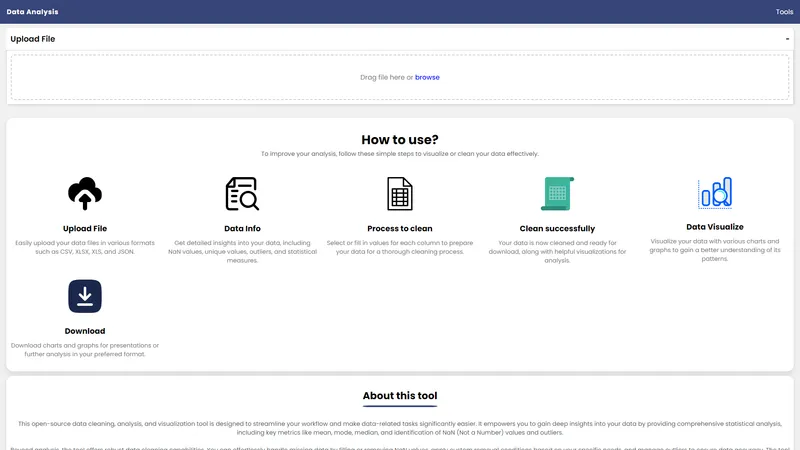
The Online Data Analysis Tool is a powerful, open-source web-based application designed to simplify the process of cleaning, analyzing, and visualizing data. It supports various file formats, including CSV, XLSX, XLS, and JSON, making it a versatile solution for data professionals and enthusiasts alike. The tool operates entirely within your browser, ensuring that your data remains secure and private, as it is never uploaded to external servers. With features like detailed statistical analysis, robust data cleaning capabilities, and comprehensive visualization options, this tool empowers users to gain deep insights into their data. Whether you're dealing with missing values, outliers, or simply need to visualize data patterns, this tool provides a seamless and efficient workflow. Its offline functionality further enhances its usability, allowing users to work without an internet connection once the page is loaded. The tool is completely free to use, with no limitations on file size or the number of uploads, making it an invaluable resource for anyone working with data.

Top Features

  1. Upload data files in CSV, XLSX, XLS, and JSON formats
  2. Detailed statistical analysis including mean, mode, median, NaN values, and outliers
  3. Robust data cleaning capabilities with options to fill or remove NaN values
  4. Custom removal conditions for specific data cleaning needs
  5. Comparison of data before and after cleaning
  6. Comprehensive data visualization with various charts and graphs
  7. Local data processing for enhanced privacy and security
  8. Offline functionality once the web page is loaded
  9. No limitations on file size or the number of uploads
  10. Free and open-source with no installation required

Simple Definition of Usecases

  1. A data scientist uploads a CSV file containing sales data to identify trends and outliers, using the tool's statistical analysis and visualization features to create a detailed report.
  2. A business analyst uses the tool to clean a dataset with missing values, filling in NaN values and removing outliers to prepare the data for a quarterly business review.
  3. A researcher uploads an XLSX file with experimental data, using the tool's visualization capabilities to create graphs that highlight key findings for a research paper.
  4. A student working on a data analysis project uses the tool to clean and visualize survey data, downloading the cleaned dataset and charts for their final presentation.
  5. A data enthusiast explores a JSON dataset, using the tool's cleaning and visualization features to gain insights and share their findings with an online community.

User Reviews

Aarav Patel

Data Scientist

★★★★★

"This tool has been a game-changer for my data analysis projects. The ability to clean and visualize data directly in the browser without any installation is incredibly convenient. The detailed statistical analysis and visualization options have helped me uncover insights that I would have missed otherwise. Highly recommend it to anyone working with data!"

Frequently Asked Questions

Q:

What is this data cleaner & analyzer tool?

A:

This is an open-source web-based tool designed to simplify data cleaning, analysis, and visualization. It helps you gain insights into your data, clean it effectively, and visualize the results.

Q:

What does this tool do?

A:

The tool allows you to upload data files, perform detailed statistical analysis, clean data by handling missing values and outliers, and visualize data with various charts and graphs.

Q:

What to do if my data is not in a supported format?

A:

You can convert your data to one of the supported formats (CSV, XLSX, XLS, or JSON) using other tools or software and then upload it to this tool.

Q:

How to use this tool offline?

A:

Once the web page is loaded, the tool works offline, allowing you to analyze and clean data even without an internet connection.

Q:

Is my data secure when using this tool?

A:

Yes, all data processing happens locally within your browser. Your data is never uploaded to any external servers, ensuring complete privacy and security.

Q:

What file formats are supported?

A:

The tool currently supports tabular data formats, including CSV, XLSX, XLS, and JSON.

Q:

Are there any limitations on file size or the number of uploads?

A:

No, there are no limits on file size or the number of times you can use the tool.

Q:

Do I need to install anything to use this tool?

A:

No, as a web-based tool, it runs directly in your web browser. No installation is required.

Q:

Is this tool free to use?

A:

Yes, this tool is open-source and free to use.

Q:

Can I download the cleaned data and visualizations?

A:

Yes, you can download the cleaned data and visualizations in your preferred format for further analysis or presentations.

Related AI Tools

AI STL Generator - AI STL generator turns prompts and images into watertight printable 3D models | Top 4 AI Tool loading
AI STL Generator is a specialized web platform built for makers, designers, educators, and small businesses that need to turn 2D images or text prompts into 3D printable STL files. Positioned as the fastest free AI STL maker, it focuses on a specific bottleneck in the 3D printing workflow: converting ideas into watertight, slicing-ready models without requiring CAD expertise. Instead of forcing users to learn Blender, Fusion 360, or Meshmixer, the site offers a ready to use AI workbench that generates geometry from natural language or reference images and then automatically repairs the mesh for 3D printing. For anyone tired of cleaning non-manifold edges, inverted normals, zero-thickness walls, or floating islands, this platform promises a more efficient path from concept to physical print. It is not a generic 3D asset generator; it is a print-first tool designed around the realities of FDM and resin printing, slicer compatibility, and the practical needs of people who actually run printers every day. Website Positioning: AI STL Generator positions itself as the number one AI STL generator for 3D printing and makers. The homepage emphasizes speed, print readiness, and compatibility with popular slicers such as Bambu Studio, Cura, PrusaSlicer, OrcaSlicer, Creality Print, and ideaMaker. Rather than competing as a broad 3D modeling suite, it owns the narrow but valuable niche of AI-powered STL creation. Its tagline and hero section make the value proposition clear: turn 2D images and prompts into 3D printable STL files. The site also includes auxiliary tools like a 3D viewer, 3D converter, printability checker, and STL repair, which together form a compact ecosystem for makers who want to go from idea to download without leaving the browser. This positioning is smart because the hardest part of AI 3D generation is not creating an attractive mesh; it is creating a mesh that survives a slicer without manual repair. AI STL Generator addresses that directly. Target Audience: The platform speaks to a wide range of users. FDM hobbyists who own Bambu Lab, Prusa, Creality, or similar printers are a core audience. They want functional parts, custom organizers, replacement pieces, and decorative models that print reliably. Tabletop gamers and Dungeon Masters are another key group. They need custom miniatures, monsters, terrain pieces, and character models from Midjourney art, character sketches, or text prompts. Etsy sellers and small-batch print shops use the tool to shorten turnaround times for personalized keychains, plaques, cake toppers, and gifts. STEM educators and FabLab coordinators use it to introduce 3D printing without a CAD learning curve. Product designers and mechanical engineers use it for rapid concept models and form studies. Cosplay makers and prop builders use it to turn reference images into printable armor pieces, props, and accessories. Finally, AI enthusiasts and hobbyist 3D artists use it to explore generative geometry without needing to master a traditional modeling package. For all these users, the promise is the same: reduce the friction between an idea and a printed object. Core Features: The feature set is built around a few powerful capabilities. Text-to-STL generation lets users type a description, such as a tabletop paladin, a mechanical rocker arm, or a minimalist rubber duck, and receive a 3D mesh ready for printing. Image-to-STL generation accepts JPG and PNG files, including photos, concept art, sketches, and logos, then reconstructs depth, volume, and topology. Multi-image support allows multiple angles for more accurate reconstruction. The printability check automatically detects non-manifold edges, inverted normals, and zero-thickness walls. The built-in STL repair then seals the mesh to create a watertight solid. Users can choose AI model detail levels such as Basic, Pro, and Ultra detail, with Ultra detail available on Pro and costing additional credits. Output formats include STL and 3MF. Character pose options include None, A-Pose, and T-Pose, which is helpful for miniature and character generation. Real-world size scaling allows users to scale to an estimated height with the origin at the base. The platform also includes a 3D viewer so users can inspect geometry in the browser, plus converters such as SVG to STL, STL to 3MF, and 3MF to STL. There is an AI miniature generator and a remesh and repair tool that acts as a lightweight STL editor. For 3D printing specifically, the system optimizes for flat-bottom geometry, bed adhesion, and minimal support requirements, which helps reduce warping and failed prints. Content Features: The website content is designed to educate and reassure. It uses clear, benefit-driven headlines, step-by-step workflow explanations, and real examples of generated models such as a knight paladin, a precision rocker arm, a Nefertiti bust, and a designer rubber duck. Each featured creation includes triangle counts, a 3D inspection link, and a prompt or description. This helps users understand what is possible and sets realistic expectations about detail levels. The FAQ section answers common questions about STL generation, image-to-STL conversion, watertightness, editing, and pricing. The homepage also highlights compatibility with major slicers and includes user testimonials from an FDM hobbyist, tabletop gamer, Etsy seller, and STEM educator. The content is concise, practical, and focused on outcomes rather than technical jargon. It also offers tips and tricks for getting better results, such as using clear reference images, choosing the right detail level, and checking printability before downloading. These tips and tricks are valuable for beginners and experienced makers alike. For users who want to push the tool further, the site includes tricks for combining text prompts with image references and for using multiple images to improve reconstruction. Overall, the content builds trust by showing real models, real users, and real print workflows. User Experience: The user experience is designed to be simple and fast. The workbench is the center of the product. Users choose Image to STL or Text to STL, upload images or enter a prompt, select an AI model, choose output format, set pose and size options, and click Generate 3D Model. A credit cost is shown next to the button, so there are no surprises. The 3D Model Preview pane lets users inspect the result before downloading. The workflow is split into three phases: input your idea, AI mesh generation and auto-watertight, and download STL and slice to print. This structure makes the process feel manageable even for first-time users. The site also offers a daily check-in for free credits, which encourages return visits and lowers the barrier to entry. Sign-in is available for account management, while Start Free leads directly into the workbench. The visual design is clean and modern, with a dark theme and bright accents that appeal to maker and tech audiences. The navigation includes STL Studio, 3D Viewer, 3D Converter, Pricing, Daily Check-in, Sign in, and Start Free. The overall experience is intuitive, and the platform avoids unnecessary complexity. For makers who value speed, this is one of the most efficient ways to go from an idea to a printable file. Many users will find it to be the most efficient option for quick, print-ready STL generation, especially when compared with manual modeling or repairing failed AI meshes. Technical Features: Under the hood, AI STL Generator uses advanced neural networks to analyze images and prompts, then generate 3D geometry. The system performs automatic topology repair, remeshing, and mesh closure. It checks for non-manifold edges, inverted normals, and zero-thickness walls, then fixes them. The output is a manifold, watertight solid suitable for slicing. The platform supports STL and 3MF export, with GLB mentioned for visualization. It is compatible with Bambu Studio, Cura, PrusaSlicer, OrcaSlicer, Creality Print, and ideaMaker. The AI model tiers allow users to trade credits for detail, with Pro and Ultra detail options for higher-fidelity meshes. The system also supports character pose settings, real-world scaling, and flat-base optimization. The 3D viewer provides interactive inspection, and the converter tools handle format changes. The printability checker is a critical technical differentiator because it catches problems before the slicer does. The STL repair tool can adjust mesh density, simplify polygon counts, and flatten the base. This combination of generative AI and mesh repair is what makes the platform practical for real 3D printing, not just visual rendering. The technical stack is oriented toward reliability, repeatability, and slicer compatibility, which are the metrics that matter most to makers. Workflow and Practical Benefits: The typical workflow is straightforward. A user starts with an idea, a sketch, a photo, or a text prompt. They upload or type it into the workbench. They select a detail level, output format, pose, and size. The AI generates a mesh, runs automatic repair, and presents a preview. The user inspects the model in 3D, then downloads the STL or 3MF. The file imports directly into their slicer without third-party repairs. This saves time, reduces failed prints, and lowers material waste. For Etsy sellers, it can cut turnaround from days to minutes. For educators, it removes the CAD barrier and lets students see their drawings become physical objects. For tabletop gamers, it enables custom miniatures that match a campaign or character concept. For engineers, it provides rapid concept validation. For cosplay makers, it accelerates prop development. The platform is especially useful for anyone who needs a ready to use output rather than a raw 3D asset. It is also a more efficient alternative to learning complex software for simple shapes and organic models. The site's focus on watertight geometry and printability means fewer failed prints, less wasted filament, and less time spent in repair tools. That is a practical, measurable benefit that matters to both hobbyists and businesses. Pricing and Accessibility: AI STL Generator uses a freemium model. Users can log in daily to claim free check-in credits and generate STL files without paying. There are also pay-as-you-go credit packs and subscription plans for regular creators. The Generate 3D Model button shows a credit cost, typically 5 credits for a standard generation, with Ultra detail costing additional credits and available on Pro. This makes the pricing transparent and flexible. Casual users can rely on daily free credits, while power users can buy credits or subscribe. The Start Free call to action emphasizes no credit card required and instant download. This lowers the barrier for first-time users and encourages experimentation. The pricing page likely contains more details, but the homepage already communicates that the tool is accessible to hobbyists, educators, and small businesses. The freemium approach is well suited to the maker market, where usage can be sporadic or project-based. It also allows users to test the quality before committing to a paid plan. For many, the free daily credits are enough for occasional projects, while professionals will find the paid options affordable compared with the time saved. Why It Matters for US Makers: In the United States, 3D printing has moved from a niche hobby to a mainstream tool for prototyping, education, small business, and creative expression. Makers expect fast results, clear pricing, and compatibility with the printers they already own. AI STL Generator fits that expectation by focusing on the most popular slicers and by promising watertight, print-ready files. American small businesses, especially Etsy sellers and custom gift shops, need to respond to customer requests quickly. A tool that turns a sketch into a printable STL in minutes can be a competitive advantage. Educators need low-barrier tools that work in a classroom without extensive training. Hobbyists want to spend time printing, not repairing meshes. Cosplayers and prop makers need to scale models accurately and avoid fragile walls. By addressing these needs, AI STL Generator aligns with the practical, outcome-oriented culture of the US maker community. It also fits the growing interest in AI-assisted design, where generative tools augment human creativity rather than replace it. The platform's emphasis on printability, repair, and slicer compatibility makes it more than a novelty; it is a workflow tool. Final Thoughts: AI STL Generator is a focused, practical, and accessible platform for turning ideas into 3D printable STL files. Its core strengths are image-to-STL and text-to-STL generation, automatic printability checking, watertight repair, slicer compatibility, and a simple three-step workflow. It serves hobbyists, tabletop gamers, Etsy sellers, educators, engineers, cosplay makers, and AI enthusiasts. The freemium pricing and daily free credits make it easy to try, while credit packs and subscriptions support regular use. For anyone who wants a ready to use solution that is more efficient than manual modeling and more reliable than generic AI 3D generators, AI STL Generator is worth exploring. With the right tips and tricks, users can get better results from prompts and images, and with a few advanced tricks, they can push detail and scale further. In a crowded field of AI 3D tools, this platform stands out by focusing on the essential requirement: a file that actually prints. That focus makes it one of the most efficient and practical tools available for makers today.
Image to 3D Model
Freemium
Video2Jpg - Convert videos to JPG, PNG, and WebP frames in your browser. | Top 4 AI Tool loading
Video2Jpg is a ready to use, free online video-to-image converter that turns video content into high-resolution JPG, PNG, or WebP stills directly in the browser. It is built for people who need reliable frame extraction without uploading sensitive media to a remote server. In a world where convenience often comes at the cost of privacy, Video2Jpg offers a refreshingly simple model: your video stays on your device, the conversion happens locally, and the result is a downloadable image or a full ZIP archive of frames. This makes it more efficient than traditional cloud converters because there is no waiting for uploads, no file size limits imposed by a server, and no need to trust a third party with your content. Website Positioning: Video2Jpg positions itself as the essential tool for converting video into image formats. It is neither a heavyweight desktop application nor a cloud service with hidden limits. Instead, it occupies a practical niche: a fast, browser-native utility that works on both desktop and mobile devices. The design focuses on a single job done exceptionally well. The interface strips away unnecessary complexity and guides users from file selection to frame extraction in three steps. This positioning is especially valuable for users who need a dependable solution for tasks such as generating video thumbnails, extracting stills from product demos, creating PNG sequences for VFX work, or building WebP assets for performance optimized websites. Target Audience: The audience for Video2Jpg is wide. Content creators and YouTubers need custom thumbnails and highlight frames. Social media managers repurpose video content into static posts and ads. Video editors, animators, and VFX artists need pixel-perfect PNG sequences for compositing, rotoscoping, and reference material. Educators and e-learning developers extract slides from recorded lectures to include in handouts and study guides. Web developers and designers use WebP output to optimize images for faster page loads. Photographers may need to grab still frames from client video sessions or convert motion clips to printable images. Journalists and archivists may need to preserve important moments from news footage. Because the tool is free and requires no account, it is also ideal for students, hobbyists, and small business owners who need occasional conversions without downloading software. Core Features: The core feature set is focused on format flexibility and batch extraction. Users can choose JPG for fast, compact snapshots; PNG for lossless quality; and WebP for modern web graphics. The JPG mode allows users to balance compression and quality, producing lightweight images that are easy to share, upload, and store. PNG mode is ideal for projects where compression artifacts are unacceptable, such as VFX plates, transparent graphics, or high-quality prints. WebP mode provides a modern alternative that can help reduce image file sizes while maintaining visual fidelity. The tool supports common video containers including MP4, WebM, MOV, AVI, and MKV. There is no arbitrary file size limit because the video is never uploaded. Users can extract a single frame by seeking to a precise timestamp, or they can set an interval to automatically capture a sequence of frames across the video. Multiple frames are compiled into a single downloadable ZIP file, simplifying storage and transfer. Content Features: The website’s content is organized to answer the most common user questions immediately. The homepage clearly explains the conversion capabilities, showing the three output formats and their ideal use cases. A three-step “How to Convert” section breaks the process into Upload Video, Set Format & Timing, and Download Frames. This structure reduces friction for first-time users. The FAQ section addresses practical concerns about privacy, mobile use, PNG sequences, and online conversion. The site also includes dedicated service pages for popular conversions such as MP4 to JPG, WebM to JPG, AVI to JPG, video to frames, and video to GIF. These pages help target search traffic from users who are looking for format-specific solutions. The language is clear, direct, and benefit-oriented, speaking to users who want to solve a problem quickly without reading lengthy manuals. User Experience: User experience is at the heart of Video2Jpg. The drag-and-drop area invites immediate interaction, and the browse button offers a familiar alternate path. Once a video is loaded, the user can select the output format, seek to a specific moment, or define a frame interval. This simple interaction model ensures that even users with no technical background can achieve professional results. The tool is optimized for mobile browsers as well. On an iPhone, for instance, users can open the site in Safari, tap Browse Files, select a clip from the photo library, choose JPG, and export full-resolution frames to the camera roll. This mobile workflow is particularly useful for creators who shoot video on their phones and need quick stills for social media. The interface avoids clutter, and the process gives immediate visual feedback. The lack of login, payment, or watermark requirements further enhances the experience. Users can move from start to finish in seconds. Technical Features: From a technical standpoint, Video2Jpg demonstrates the power of modern browser APIs. Everything runs client-side using local resources. Video data is decoded in the browser, frames are rendered through canvas-based imaging pipelines, and files are generated without leaving the device. This architecture provides strong privacy guarantees: no uploads, no intermediate servers, no privacy policy gray areas. It also means file size is limited only by the user’s device and browser capabilities, not by the website’s server. The native full-resolution extraction ensures stills retain the original pixel dimensions of the source video. The ability to create WebP assets leverages compression standards that benefit web performance. Because no infrastructure is needed to store or transfer video files, the service can remain free for all users. This technical approach is both scalable and sustainable. It also makes the tool extremely reliable for professionals who handle confidential client footage and cannot risk exposing it to third-party services. Workflow Benefits and Practical Applications: For video editors, one of the most efficient ways to review a sequence is to pull a contact sheet of frames. Video2Jpg allows that with a few clicks, converting a long clip into a storyboard-like grid of stills that can be quickly reviewed. Social media teams can build suites of branded stills from a single product video, using the interval feature to capture multiple angles in one pass. E-learning designers can transform a recorded webinar into slide images and reference screenshots, enhancing course materials. Web teams can generate WebP stills from a demonstration video and use those images for lazy-loaded hero sections, product cards, and documentation. Because the tool runs in the browser, it is also an excellent option for computers with restricted software installation policies. Many enterprise users cannot install third-party tools, but they can use a browser-based converter without administrative rights. Privacy and Security: Privacy is not an afterthought for Video2Jpg; it is a central design principle. The phrase “100% in-browser” is not a marketing exaggeration. By keeping the file on the local device, the tool eliminates a whole category of security risks associated with uploading videos to unknown servers. This is essential for lawyers, journalists, medical professionals, and creative teams working with non-public material. The website also includes clear links to Privacy Policy, Cookie Policy, and Terms of Service, offering additional transparency. SEO and Discoverability: The website is well-aligned with user intent. It offers service pages such as MP4 to JPG, WebM to JPG, AVI to JPG, Video to Frames, and Video to GIF. Each page is designed to capture high-intent search queries from users who already know exactly what conversion they need. The homepage also targets broader queries such as “free online video to image converter” and “video to jpg converter high quality.” By combining a concise interface with explainer content, the site serves both new users and returning professionals. This content structure helps the tool rank for a wide range of keywords while maintaining a clear user journey. Competitive Advantages: Compared to heavyweight software like Photoshop, Premiere Pro, or After Effects, Video2Jpg offers an immediate, lightweight solution without installation or licensing costs. Compared to cloud converters, it offers stronger privacy and faster turnaround because there is no upload. Compared to mobile apps, it works cross-platform without app store installation and offers more flexible batch extraction. These advantages make Video2Jpg particularly valuable to modern remote teams, freelance creators, and enterprise users who need a dependable conversion method in a browser. Customer Support and Documentation: Although Video2Jpg is intentionally simple, it still provides a clear path for users who need help. The site includes a direct contact email, support@video2jpg.com. Users can ask questions, report issues, or suggest improvements. The FAQ section acts as lightweight documentation for the most common workflows. The “How to Convert” steps provide a concise tutorial that covers the entire conversion process. This combination of minimal documentation and direct contact options is appropriate for a utility service with a low learning curve. Overall Value: Video2Jpg is a model of focused software design. It does one thing exceptionally well: converting videos into images. It is free, private, and fast. It works on a wide range of devices and formats. It generates outputs in JPG, PNG, and WebP, three formats that cover nearly every use case from casual sharing to professional production. For anyone tired of uploading sensitive videos to random websites or installing bloated software just to capture a frame, Video2Jpg is a practical, intuitive answer. It streamlines the conversion process, reduces friction, and saves time. In short, it is an essential free tool for the modern creator.
AI Thumbnail Maker
Free
Pixal3D - Generate pixel-perfect 3D assets in seconds with production-ready PBR textures. | Top 4 AI Tool loading
Pixal3D is a state-of-the-art image-to-3D generation platform developed by researchers at Tsinghua University and TencentARC. It transforms ordinary 2D images into high-fidelity, production-ready 3D assets in seconds. The platform was designed to solve one of the most frustrating problems in modern AI content creation: the loss of design detail. Most 3D-native generators approximate a shape in a generic canonical pose and use loose attention mechanisms, which often produces warped silhouettes, hallucinations, and blurry faces. Pixal3D rejects that approach. Instead, it explicitly lifts multi-scale image features into a 3D feature volume through pixel back-projection. This method establishes direct pixel-to-3D correspondence, meaning the output is aligned exactly to the source image. For 3D artists, game developers, spatial computing creators, and AI researchers, this is a significant shift. The generated objects are not just vaguely similar; they are reconstruction-level faithful. The work is grounded in rigorous academic research and accepted to SIGGRAPH 2026, making it one of the most credible systems in the field. These assets are ready to use in modern engines, with clean geometry, PBR textures, and standard GLB export. Web positioning: Pixal3D is positioned as the next evolution in image-to-3D generation. It is neither a toy demo nor a slow offline solver; it is a professional tool that sits between generative AI and photorealistic 3D reconstruction. The platform combines the speed and convenience of generative models with the visual precision of reconstruction. It is aimed at people who need real assets, not inspiration. Accepted to SIGGRAPH 2026, the project establishes academic credibility and signals that it is built on a reproducible, peer-reviewed foundation. The public website is structured to communicate this positioning clearly. The homepage speaks to concept artists who are tired of seeing their main view transformed by AI, technical artists who need usable mesh topology, and developers who want open-source access to the pipeline. The tagline captures the core promise: pixel-level accuracy, fast output, and production convenience. The platform does not market itself as a generic 3D generator; it positions itself as a precision tool for those who require visual faithfulness above all else. Target audience is broad but focused. The first and most obvious users are 3D artists and modelers. They benefit from a tool that can turn concept art into a base mesh in minutes, allowing them to focus on higher-level creative decisions. The second group is game developers and technical artists, who need game-ready models with PBR materials. They no longer need to model every prop from scratch or spend days on UV mapping and texture baking. The third group is indie developers and solo creators, who often lack the time and budget to hire a full art team. For them, Pixal3D provides an accessible way to populate games, VR worlds, and portfolio pieces. The fourth group is AI researchers and students. Because the code is open source and hosted on GitHub, they can reproduce the results, study the back-projection mechanism, and build new systems based on the Trellis.2 backbone. The fifth group is XR and VRChat creators, who need avatars, props, and environments that match their original illustrated designs. Finally, product designers and e-commerce teams can use the platform to create 3D product views from regular photos. This diversity makes Pixal3D useful for small independent projects and large production pipelines alike. Core features distinguish Pixal3D from older tools. The primary feature is pixel back-projection, which takes multi-scale 2D features and projects them into a 3D feature volume. This creates a direct correspondence that is absent from canonical-space generators. With this method, the visible side of the model matches the input image with one-to-one spatial accuracy. The system also supports multi-view aggregation. If a user supplies a character turnaround or multiple camera angles, Pixal3D combines the back-projected volumes and greatly improves 360-degree consistency. The Trellis.2 backbone powers the generation, providing optimized inference speed and high-quality feature extraction. The output uses standard GLB format with PBR maps for base color, normal, and roughness. This combination means the exported file can be dropped directly into Unity, Unreal, Blender, or web-based viewers. The system also supports modular scene synthesis, which can parse a complex 2D scene into object-separated 3D assets. That is useful for rapid environment prototyping and set dressing. Finally, the entire tool is accessible as an open-source research project. Users can try the Gradio demo on Hugging Face, run the code locally, or integrate the pipeline into custom tools. Content features are designed for both beginners and experts. The landing page explains the workflow in four simple stages: upload a reference image, perform pixel back-projection, generate geometry and textures, and download the GLB asset. Each step is supported by concise copy that describes the technical benefit. The site also includes a FAQ section that answers common questions about file formats, hardware requirements, multi-image support, and the research origin. The resources section includes model pages for Trellis.2, Hunyuan3D, Hi3DGen, Direct3D-S2, Sparc3D, InstantMesh, and Stable Fast 3D. This helps users understand the broader ecosystem and compare techniques. The GitHub repository contains documentation and inference scripts, which is essential for developers who want to run Pixal3D in a local environment. The Hugging Face demo gives immediate, browser-based access for people who do not have a powerful GPU. The site also includes testimonials from professionals in different roles: a senior tech artist, an indie developer, and an AI researcher. These testimonials reinforce the message that Pixal3D is not just a research experiment; it is a day-to-day production tool. The user experience is intentionally low friction. A user starts at the homepage, clicks Start For Free, and goes directly to the Playground. There is no registration wall, no email verification, and no complicated setup. The Playground allows the user to upload a single image or multiple views and receive a generated model quickly. This design is crucial for professional workflows where time is limited. Instead of spending hours learning a new tool, a creator can get a usable asset in minutes. The browser-based version is ideal for quick testing and concept validation. For users who need more control, local execution through the GitHub repository provides access to the full pipeline. The code examples, inference scripts, and open model weights make it easy to integrate Pixal3D into automated build processes. The overall user experience emphasizes speed, clarity, and results. The UI does not overwhelm users with technical jargon, even though the underlying method is sophisticated. Clear visual hierarchy, simple labels, and direct calls to action guide the user from image to 3D asset. On the technical side, Pixal3D is built around a fundamentally different architecture from the typical image-to-3D model. Traditional generators output shapes in a canonical space, which requires the network to learn an implicit correspondence between the image and a generic pose. This often produces incorrect depth, warped textures, and poor front-view fidelity. Pixal3D instead uses explicit back-projection, lifting image features into a 3D volume before synthesizing the final mesh. The Trellis.2 backbone is highly scalable and optimized for fast inference, making the system practical for real-world use. The output mesh is high-resolution and clean enough for immediate deployment. The PBR material generation adds standard maps that behave correctly under dynamic lighting. Multi-view aggregation allows the system to merge feature volumes from different angles, improving topological accuracy and filling in occluded areas. The system can handle a single rough sketch or a complete multi-view character sheet. Rendered from any angle, the result is more consistent than what canonical generators produce. Because the project is open source, the technical details are transparent, and researchers can verify, extend, and improve the method. This makes it a practical tool and a meaningful scientific contribution. Interoperability is one of the strongest aspects of Pixal3D. Many AI 3D generators produce OBJ files with only vertex colors or unoptimized geometry that still requires hours of cleanup. Pixal3D creates GLB files with standard PBR maps, so the asset can be used immediately in game engines, digital content creation tools, and web platforms. Game developers can import the model into Unity or Unreal without converting formats. Blender artists can retain the PBR material setup and start editing immediately. Web developers can drop the GLB into Three.js or React Three Fiber. Spatial computing developers can use the models in VRChat, Unity XR, and other immersive projects. The open-source nature of the project further improves interoperability. Developers can write custom scripts that call the inference pipeline, batch-generate assets, or connect the tool to internal production software. This flexibility reduces the friction between concept art and final implementation. It also supports more efficient asset pipelines because one artist can generate an entire prop library from simple concept sketches, freeing the rest of the team to focus on animation, gameplay, and composition. Pricing and accessibility are major advantages. Pixal3D is free to use in its current form. The browser playground is free, the Hugging Face Gradio demo is free, and the GitHub source code is freely available. This makes the tool inclusive for students, hobbyists, and small studios who cannot justify the cost of expensive 3D software or paid AI generation services. The open model weights and inference scripts allow users to run the tool on their own hardware, which is particularly important for companies with strict data privacy requirements. This accessibility does not compromise quality. The same technology that powers the public demo can be used in a private production environment. Users can avoid per-image fees and subscription plans, and they retain control over their assets. Open-source access also encourages community-driven improvements, so the system evolves faster than a closed proprietary tool likely would. For many teams, the most compelling value proposition is the combination of professional output and zero acquisition cost. Real-world use cases are numerous. In game development, a technical artist can upload a character concept, generate a base mesh with correct front-facing details, then import it into ZBrush or Blender for further sculpting. In virtual production, an art director can use multiple concept camera angles to generate a consistent 3D hero prop. In e-commerce, a product photographer can upload a single studio photo and create an interactive 3D product view for a web store. In VRChat and social VR, a creator can upload an illustrated avatar concept and receive a usable GLB with PBR textures. In education, a teacher can make 3D models from historical images or archaeological illustrations. In architecture, a designer can turn a hand-drawn perspective into a rough volumetric massing model. In robotics and simulation, researchers can generate synthetic assets from real photographs to train AI systems. In all of these examples, the central benefit remains the same: visual fidelity. The generated asset looks like the input image, not an AI's invented interpretation. Comparison with traditional pipelines makes the value clear. Manual modeling can take days, especially for complex props or stylized characters. Photogrammetry requires controlled lighting, multiple camera angles, and heavy cleanup. Older image-to-3D AI generators may produce impressive silhouettes but often fail under close inspection; the front view may be blurred, the eyes may be misaligned, or the texture may wrap around the model incorrectly. Pixal3D addresses these failure modes directly. The pixel-aligned generation ensures the front face of the model matches the source image with high accuracy. The PBR maps provide realistic material response, eliminating the need to spend hours repainting textures. The GLB export removes compatibility barriers, reducing the time between generation and deployment. The ability to accept one or multiple images makes the tool flexible. For users who need only a simple concept blockout, a single image is enough. For users who need a production-quality hero asset, multi-view input can dramatically improve the 360-degree result. This adaptability means Pixal3D can support a wide range of fidelity requirements. In summary, Pixal3D is a powerful new standard for image-to-3D generation. It combines the best of generative AI and 3D reconstruction, producing assets that are ready to use in professional pipelines. The platform is supported by serious academic research, open-source code, and an accessible browser demo. It is more efficient than manual modeling or older AI generators because it preserves the original design's pixel-level, practical details. It outputs lightweight GLB files with standard PBR maps, making it a practical addition to game engines, XR platforms, and web rendering stacks. For artists, developers, and researchers, Pixal3D offers a rare combination: state-of-the-art technology, production-ready results, and free access. Whether the task is a single character prop, a full multi-view hero asset, or a modular scene, Pixal3D turns a 2D image into a faithful 3D reality. This is the future of content creation, where the gap between artwork and engine-ready model finally disappears.
Image to 3D Model
Free
LogoAI - AI-powered logos in seconds: professional, customizable, print-ready brand identities. | Top 4 AI Tool loading
In a crowded digital landscape, a memorable brand identity is no longer a luxury but a necessity. LogoAI, available at brandlogoai.com, is a ready to use AI-powered logo design platform built for modern businesses that need professional branding without the traditional time, cost, or learning curve. By combining intelligent design automation with a clean, browser-based interface, LogoAI enables anyone to generate, customize, and download a complete visual identity in minutes. The platform is designed to make brand creation more efficient, replacing hours of manual design work with an automated process that delivers consistent, high-quality results every time. Website positioning is clear: LogoAI calls itself the most advanced AI logo generator for modern businesses. It is not merely a template-based tool but an intelligent online logo maker that uses a Smart Logo Architect to analyze brand details and produce tailored logo concepts. The service positions itself at the intersection of artificial intelligence and practical design, offering a solution that is both accessible to non-designers and useful to professionals who need fast, reliable outputs. LogoAI focuses on speed, quality, and scalability, ensuring that every generated logo is print-ready, vector-based, and adaptable across business cards, websites, social media, and large-format printing. The target audience is broad but well defined. Small business owners and startup founders are the primary users, especially those who need a professional logo immediately for launch, funding pitches, or local marketing. Freelance designers and agencies use LogoAI to streamline client concepting, quickly producing multiple directions before investing deeper design time. E-commerce sellers depend on it for storefront images, product packaging, and brand consistency across marketplaces. Marketing and social media managers leverage the tool to create campaign-specific branding assets without waiting on design queues. Nonprofit organizations, event planners, bloggers, podcasters, and content creators also benefit from the platform's straightforward workflow and professional output. In each case, LogoAI solves the same core problem: the need for a high-quality, customizable logo without advanced design skills or expensive software. The core features of LogoAI center on AI-powered design and complete brand asset generation. The AI Logo Generator analyzes the user's brand name, industry, and design preferences, then creates six unique concepts in under 60 seconds. This automated approach removes the blank-canvas anxiety and gives users immediate, relevant options. The Complete Brand Kit extends the logo into a broader identity system with a Logo Font Generator, Brand Color Palette AI, and Typography Designer, helping users maintain visual consistency beyond the logo itself. Instant Downloads provide multiple formats including SVG Logo Export, transparent PNG, and high-resolution vector files, ensuring the logo works everywhere from favicon to billboard. The platform is fully customizable: colors, fonts, icons, and layout can all be edited using the built-in AI Image Editor, so the final result feels personal rather than generic. Professional quality is guaranteed through industry-standard vector output, making the logos suitable for commercial printing and digital use alike. The user experience is intentionally intuitive and streamlined. LogoAI follows a three-step process that is easy to understand even for first-time users. Step one asks the user to enter brand details such as name, industry, and style preferences. Step two presents six generated concepts for selection, with the chosen design becoming the foundation for further refinement. Step three allows the user to customize and download the final logo in multiple formats. There is no software installation, no account setup barrier for basic generation, and no design jargon. The interface uses clear labels, visual prompts, and a logical flow that keeps every action focused on moving toward a finished logo. This ease of use makes the tool feel effortless while still delivering professional results. Content features enrich the platform beyond the generator itself. The Style Inspiration section showcases curated logo styles including Minimalist, Tech, Luxury, Retro, Abstract, and Geometric. Each style is presented with a short descriptor, helping users articulate the mood they want before generating concepts. A detailed FAQ section answers common questions about pricing, design skills, vector formats, speed, and editing after download, reducing hesitation and clarifying the value proposition. The How It Works section breaks the process into simple, actionable steps. Together, these content resources serve as a lightweight, built-in guide that educates users and supports confident decision-making, further demonstrating the practical nature of the platform. Technical features emphasize scalability and compatibility. All logos are generated as vector graphics, meaning they can be resized infinitely without loss of quality. SVG Logo Export delivers clean, editable source files for professional design software, while transparent PNG files are ready to use for web and social media. The platform's automated branding engine runs in the browser, providing instant results without downloads or installations. The Smart Logo Architect applies design principles such as balance, contrast, and typography hierarchy to each output, ensuring that the generated logos are not just random marks but thoughtfully composed brand identities. High-resolution output meets print standards, so users can confidently use their logos for physical products, signage, and promotional materials. LogoAI operates on a freemium pricing model. Basic logo generation is completely free, allowing users to create and download high-quality logos with no upfront cost. Premium upgrades unlock additional features such as advanced editing tools and complete brand kit downloads. This pricing structure lowers the barrier to entry and allows users to test the platform before committing financially. The free tier delivers real value, not just a watermarked preview, while the premium tier provides expanded capabilities for users who need deeper customization and full brand assets. This model aligns well with the needs of cost-conscious small businesses and startups. The overall benefit of LogoAI is its ability to reduce the time, cost, and complexity of brand creation. Instead of spending days or weeks on logo design, users can go from idea to finished asset in minutes. The automated generator removes the need for back-and-forth with designers, while the customizable editor preserves creative control. This makes brand building more efficient for solo entrepreneurs, lean teams, and anyone who needs a professional logo fast. The platform's intuitive interface, combined with its powerful AI and vector-ready output, creates a seamless experience from start to finish. For modern businesses that demand speed without sacrificing quality, LogoAI is a practical, reliable, and immediately actionable tool. In summary, LogoAI is a ready to use online logo maker that makes professional brand identity accessible to everyone. Its automated AI design engine, complete brand kit, and high-quality downloads streamline the entire branding process. The platform is more efficient than traditional design methods, more intuitive than complex design software, and more affordable than hiring a professional agency. Whether you are launching a startup, refreshing an existing brand, or creating client assets, LogoAI delivers the essential tools and outputs needed to build a cohesive, professional identity in seconds.
AI Design Generator
Freemium
Merge Two Photos - Merge two photos side by side, stacked, overlay, or AI. | Top 4 AI Tool loading
Merge Two Photos is a ready to use, convenient, and intuitive browser-based tool that lets anyone combine two images into a single clean PNG without installing software or creating an account. Designed for speed, privacy, and simplicity, the platform offers four clearly defined merge modes: side by side, top/bottom, overlay, and AI fusion. Each mode solves a specific visual problem, and the tool is practical enough for casual users while still being useful for professionals who need fast, no-fuss image merging. The entire experience is seamless, from upload to download, with no watermarks, no mandatory sign-ups, and no hidden costs. This introduction explores the website's positioning, target audience, core features, content features, user experience, technical features, and why it stands out as a reliable free alternative to complex editing suites. Website Positioning: Merge Two Photos positions itself as the essential free merge utility for anyone who needs to put two pictures into one frame. Unlike full-featured design platforms such as Canva or Adobe Photoshop, which often require accounts, subscriptions, or a learning curve, this tool focuses exclusively on merging two photos and does it exceptionally well. It is lightweight and streamlined, with three local collage modes that run entirely inside the browser and an optional AI mode for creative blends. The positioning emphasizes privacy: local side-by-side, top/bottom, and overlay merges never upload photos to any server. Even AI fusion is clearly disclosed as an upload-based process, and users can opt out by choosing a local mode. This privacy-first approach appeals to individuals handling personal memories, business assets, or sensitive comparisons. The tool does not try to be a full design suite; instead, it is a specialized, practical solution for a single task. As a result, it becomes the essential shortcut for anyone who has ever struggled to place two images in one document or social media post. Target Audience: The target audience is broad but can be segmented into several distinct groups. Social media managers and influencers use the side-by-side and top/bottom modes to create before-and-after posts, comparison graphics, and multi-image stories. E-commerce sellers and small business owners use overlay mode to add logos, badges, or product labels to photos without resorting to complex software. Teachers and educators merge worksheets, diagrams, and answer keys into single documents for handouts and presentations. Travel bloggers and photographers combine landscape and portrait shots into diptychs for blogs, Instagram, and portfolios. Students use the tool for assignment visuals, while real estate agents compare property photos or create single listing images. The simplicity of the interface also makes it suitable for older adults and non-designers who want a no-fuss way to combine images. Because no account is required and local processing keeps files private, even privacy-conscious users feel comfortable using the tool for personal projects. The daily free AI merges also attract creative users who want to experiment with prompt-driven blends without paying for a subscription. Core Features: The platform provides four merge modes, each with a visual preview card so users know exactly how the final frame will look. The side-by-side mode places two photos left and right into one wide image, with heights matched and no crop by default. This is great for comparisons, portraits, travel diptychs, and product shots. The top/bottom mode stacks two photos vertically into one tall image, aligning widths so both stay visible. It is ideal for before-and-after strips and vertical collages. The overlay mode creates a collage by placing a smaller foreground image on a larger base image, with the foreground positioned bottom-left by default. This is useful for stickers, logos, or picture-in-picture inserts. The AI merge mode goes beyond hard cuts by using a short text prompt to blend two pictures into one seamless scene. Users can describe who should move, what should stay, and the mood, then regenerate if the result is not what they expected. All modes support drag-and-drop or click-to-browse uploads for JPG, PNG, WEBP, and HEIC files up to 10 MB each. A swap button lets users instantly switch the left and right images without re-uploading. Successful downloads are clean PNG files with no watermark for both local and AI modes. The tool is free, with fair-use daily limits of five AI merges per day, while local merges remain unlimited. Content Features: Beyond the core merging tool, the website offers a growing library of guides and tutorials that help users get the most out of the platform. Current guides cover merging photos on mobile for Android and iPhone, combining photos in one frame, merging into one background, using the tool as a Canva alternative, and getting better AI merge results with prompt tips. These articles are written in clear, instructional language and include step-by-step instructions. The site also includes an about page, contact information, privacy policy, terms of service, and refund policy, which builds trust and transparency. A comparison table on the homepage clearly explains the differences between local collage modes and AI fusion, including upload behavior, privacy and retention, best use cases, and watermark policies. This educational content helps users choose the right mode for their needs and understand exactly what happens to their images. The blog guides are search-optimized to answer common questions such as how to merge photos on mobile, how to combine photos in one frame, and how to use AI merge effectively. User Experience: The user experience is designed to be as frictionless as possible. The homepage presents four visual mode cards immediately, so users can choose a layout in seconds. There is no account creation requirement, no pop-up modal blocking the tool, and no confusing navigation. After selecting a mode, the interface shows two upload areas labeled Left and Right, with clear file type and size limits. Drag-and-drop works smoothly, and the swap button is conveniently placed. For local modes, a single click on Merge processes the images instantly in the browser, and the preview appears quickly. For AI mode, a text prompt field appears, and the user can generate a fusion with one click. The download button produces a PNG immediately. The entire process from landing on the page to downloading a merged image can take less than a minute for local modes. The responsive design means the same tool works on phones, tablets, and desktops, which is crucial for mobile-first users. The interface uses minimal text and large visual previews, making it accessible even to people who are not tech-savvy. Error messages are rare because the tool validates file types and sizes before processing. Technical Features: Under the hood, the tool leverages modern browser capabilities to process images locally for side-by-side, top/bottom, and overlay modes. This means no server upload, no waiting for cloud processing, and no privacy risk for those modes. The supported formats include JPG, PNG, WEBP, and HEIC, covering most common image types from phones and cameras. HEIC support is particularly valuable for iPhone users, as many online tools do not accept this format. The file size limit of 10 MB per image is generous enough for high-resolution photos while keeping browser performance stable. The AI fusion mode, when selected, uploads images to a processing endpoint. The privacy policy states that guest AI files are retained for about 24 hours, while signed-in history is retained for about 30 days. This transparency is a strong technical and ethical practice. The site uses responsive HTML and CSS to ensure a consistent experience across devices, and the download function generates a clean PNG without watermarks. Privacy and Security: Privacy is a core differentiator. For local modes, photos never leave the user's device, which is explicitly stated on the homepage and in the comparison table. This is crucial for users handling sensitive images such as ID photos, medical comparisons, or private family pictures. The AI mode is optional and clearly labeled as uploading images for processing. Users who prefer not to upload can simply choose a local mode. The absence of mandatory sign-ups further reduces the data footprint. The privacy policy documents retention rules, and the site does not appear to use aggressive advertising or tracking. This privacy-first design makes the tool trustworthy for personal and professional use alike. Additional Use Cases and Scenarios: The tool is versatile enough to handle a wide range of everyday tasks. A parent might combine two school event photos into one frame for a family album. A fitness coach might merge a client's before and after photos side by side to show progress. A blogger might overlay a small watermark logo on a base image before publishing. A developer might merge two screenshots into one image for documentation. A marketer might create a quick social media ad by combining a product photo with a lifestyle shot. The AI mode can be used to create artistic blends, such as merging a portrait with a landscape to produce a surreal composite. Because the tool works without an account, users can perform one-off merges without committing to a platform. The daily free AI limit encourages experimentation without pressure. Accessibility and Device Compatibility: The website is designed with mobile users in mind. The upload areas are large enough to tap on a phone screen, and the visual mode cards adjust to smaller widths. The tool works in any modern browser, including Chrome, Safari, Firefox, and Edge. Since processing happens locally for most modes, users do not need a fast internet connection to merge side-by-side, top/bottom, or overlay images. This makes it practical for travelers, field researchers, or anyone with limited bandwidth. The AI mode does require an internet connection, but the prompt field is simple and the result downloads quickly. The absence of pop-up ads and intrusive sign-up prompts makes the mobile experience particularly pleasant. Why Choose Merge Two Photos: Compared to other photo merging tools, Merge Two Photos stands out because it is ready to use immediately, convenient for quick tasks, and intuitive enough for anyone to understand. It eliminates the need for accounts, watermarks, or complex editing. The practical nature of its four layouts means users get exactly what they need without extra steps. The seamless download experience ensures high-quality PNG output every time. Whether someone needs a simple side-by-side comparison, a vertical before-and-after strip, a logo overlay, or a prompt-driven AI blend, the tool delivers quickly and privately. Its free pricing model with fair-use limits makes it accessible to everyone, from students to small business owners. The combination of local processing, mobile responsiveness, and clear documentation makes it a top choice for anyone searching for a fast, free, and reliable way to merge two photos. Conclusion: Merge Two Photos is a focused, efficient, and transparent web application that solves a very specific problem with excellence. It does not try to replace full design suites but instead offers a streamlined, ready to use solution for combining two images. The tool is convenient, intuitive, practical, and seamless, with a strong emphasis on privacy and simplicity. Whether you are a social media manager, a teacher, a seller, a blogger, or just someone who needs to put two pictures together, this website provides everything you need without cost or complexity.
Photo & Image Editor
Free
Kirkify - Turn any face into Charlie Kirk in seconds | Top 4 AI Tool loading
Kirkify is a web-based AI face swap platform that has rapidly become the definitive tool for creating Charlie Kirk-themed memes. The service allows anyone to upload a photo and transform every face into the instantly recognizable likeness of Charlie Kirk, a process known as Kirkification. Built on Replicate-hosted face-swap models, Kirkify delivers consistent, share-ready results in typically under 30 seconds. The platform is designed to be ready to use from the moment a visitor lands on the homepage: no account creation, no credit card, and no desktop software are required for the first free Kirkification. This low-friction approach has helped Kirkify ride the viral wave on TikTok, X, Reddit, and Threads, where the Kirkification trend has generated millions of impressions. Website Positioning Kirkify positions itself as the most accessible and focused Charlie Kirk face swap tool on the internet. Unlike general-purpose face swap apps that require complex settings or manual masking, Kirkify does one thing exceptionally well: it detects all faces in an uploaded image and applies a single consistent Charlie Kirk reference look. This focus makes Kirkify more efficient for meme creators who need instantly recognizable results without learning a full editing suite. The site emphasizes speed, simplicity, and virality. Headlines such as Free to try, no sign-up required and Join millions creating viral Kirkified memes underline its ambition to be the default choice for anyone participating in the Kirkification trend. The brand voice is playful, direct, and tailored to internet culture, which resonates with its core audience of social media users. Target Audience Kirkify's primary audience includes meme creators, TikTok and X influencers, political satire enthusiasts, and everyday users who want to prank friends. The tool also appeals to content marketers looking to jump on viral trends, small social media teams, and bloggers who need quick visual gags. Because Kirkify requires no technical skill, its audience ranges from teenagers sharing group chat jokes to professional content creators producing daily posts. The free first credit and free queue option lower the barrier for casual users, while the credit-based paid model supports power users who need faster processing and batch output. The site's blog and how-to guides further serve beginners who are discovering the Kirkification trend for the first time. Students, office workers, and meme page administrators all find Kirkify accessible because it strips away the complexity of traditional photo editing. Core Features Kirkify's feature set is deliberately streamlined but effective. The main workspace is a drag-and-drop upload area that accepts JPG, PNG, and WEBP files up to 8MB. Once an image is uploaded, the automated AI detects every face, regardless of whether the user selects single face or multiple faces mode. GIF support is listed as coming soon, which would extend the tool to animated memes. The face swap engine uses facial landmark mapping and style transfer to impose a consistent Charlie Kirk look. Most jobs complete in under 30 seconds, and the output is delivered as a downloadable PNG or shareable link. The platform also offers a free queue option that processes images without consuming credits, albeit at a slower pace. A built-in showcase gallery displays community-created Kirkified images, providing inspiration and demonstrating the tool's capabilities. An AI Video generator is linked as a secondary tool for creating videos from text or images, extending the brand's utility. The consistency of the output is a key technical advantage. Kirkify uses one reference image for all renders, which ensures that every Kirkified face looks exactly the same across selfies, group shots, and different lighting conditions. This single-source policy is what makes Kirkify memes instantly recognizable and highly shareable. The platform's dependence on Replicate-hosted models means that processing is handled on robust cloud infrastructure, allowing users to get results without installing anything. The site maintains transparency by linking to Replicate's documentation, signaling a commitment to technical reliability. Content Features Beyond the core face swap tool, Kirkify offers a growing content ecosystem. The Showcase page is a gallery of user-generated Kirkified images that serves as social proof and inspiration. The Blog contains articles, tips and tricks, and step-by-step tutorials on how to make the most of Kirkification. Topics likely include best practices for choosing source photos, optimizing memes for different platforms, and staying within satire and fair use boundaries. The site also provides dedicated landing pages for related tools, such as Kirkify AI Free, Kirkify AI Online, and Kirkify AI Generator, each targeting specific search intents. The footer includes a link to an About page, Contact, Pricing, Privacy Policy, Terms of Service, Refund Policy, and Refund Application, indicating a commitment to transparency and user trust. This content depth helps Kirkify rank in search engines and establishes it as an authoritative resource for the Kirkification trend. The existence of a How to Kirkify tutorial page and multiple guides demonstrates the platform's investment in user education. User Experience Kirkify's user experience is intentionally intuitive and frictionless. The homepage immediately presents the workspace with a clear call to action: Start Kirkifying Free. Users can drag and drop an image without creating an account, which is rare among AI tools. The interface uses simple language, large buttons, and visual cues to guide users through the three-step process: upload, AI transformation, download and share. The free first credit is prominently advertised, and the free queue option ensures that even users who run out of credits can still use the service. The automated nature of the face swap means users never need to manually select facial landmarks or adjust settings. This level of simplicity makes Kirkify accessible to non-technical users while still delivering professional-quality memes. The inclusion of a 2 Credits indicator for signed-in users suggests a lightweight dashboard for tracking usage, though the full account features are not detailed in the homepage content. The overall user experience is designed for speed. From landing on the page to downloading a finished meme, the entire workflow can take under a minute. This aligns with the needs of social media users who want to post timely reactions to news events or trending topics. The absence of a mandatory signup eliminates a major drop-off point, and the promise of no credit card required reduces risk perception. For users who do create an account, the credit system likely provides a history of generated images and faster access to premium features. Kirkify's seamless transition from upload to result makes it a favorite among users who value convenience over complexity. Technical Features Technically, Kirkify leverages Replicate's face-swap model, which is a hosted machine learning API. This architecture allows the site to offload GPU-intensive processing to Replicate's servers, ensuring consistent performance regardless of the user's device. The model is specifically tuned to replace all faces in an image with a single Charlie Kirk reference look. The output format is PNG, which supports high-quality downloads suitable for sharing on social platforms. The input size limit of 8MB covers most smartphone photos and web images, and the supported formats (JPG, PNG, WEBP) align with common web standards. The automated face detection uses facial landmark mapping, a technique that identifies key points on each face to ensure accurate alignment and blending. This results in natural-looking swaps that preserve the original photo's lighting and proportions, which is essential for the meme to be both recognizable and funny. The site's technical implementation also includes a queue system. Free users can either spend a credit for rapid processing or join a free queue that processes images when server capacity allows. This dual-track system enables Kirkify to offer free access while incentivizing paid credits for priority processing. The Replicate integration likely includes webhook callbacks or polling to update users when their image is ready, as indicated by the Queue status updates show progress feature. This transparent feedback loop keeps users informed and reduces frustration. The API model codeplugtech/face-swap is mentioned openly, giving technically inclined users confidence in the underlying technology. Pricing and Accessibility Kirkify uses a freemium pricing model. New users receive one free Kirkification credit with no credit card required, which serves as a trial. Additional swaps can be obtained either by waiting in the free queue or by purchasing credit packs. The exact pricing tiers are available on the Pricing page, but the homepage emphasizes the free entry point and the optional paid credits for faster processing. This model is well-suited to a viral tool because it allows massive adoption without upfront cost while monetizing power users who need volume or speed. The 2 Credits indicator suggests that signed-in users can see their balance, and the presence of a Refund Policy and Refund Application page indicates a mature billing system. For casual users, the free queue is a practical option that keeps the tool accessible even after the initial free credit is spent. The intuitive credit system is easy to understand and aligns with the pay-per-use expectations of internet users. Value Proposition Kirkify's value proposition is straightforward: it offers the simplest and fastest way to create Charlie Kirk face swaps for social media. Compared to general-purpose image editors or other face swap tools, Kirkify saves time, removes technical barriers, and produces consistent results that are optimized for virality. The ready to use nature of the platform means users can create a meme in seconds, not minutes. The automated face detection eliminates manual work, making it more efficient than manual Photoshop alternatives. The intuitive interface ensures that even first-time visitors can succeed, while the tips and tricks on the blog help users refine their meme-making skills. The seamless integration with Replicate's cloud infrastructure guarantees reliable processing on any device, and the single reference image policy ensures that every Kirkified face is instantly recognizable. For content creators, marketers, and casual pranksters alike, Kirkify delivers a unique combination of speed, consistency, and fun. It is not merely a face swap tool; it is a social media trend enabler that turns ordinary photos into shareable cultural moments. Conclusion In summary, Kirkify is a focused, ready to use AI face swap tool that has captured the viral Kirkification trend. Its automated, intuitive, and seamless workflow transforms any photo into a Charlie Kirk meme in under 30 seconds, with no signup required for the first use. The freemium model, free queue, and credit-based paid options make it accessible to casual users and power users alike. The site's content ecosystem, including showcase gallery, blog, and dedicated guides, provides added value and SEO strength. With robust technical underpinnings from Replicate and a clear understanding of internet culture, Kirkify is poised to remain the definitive platform for Charlie Kirk transformations. Whether you are a meme creator, a marketer, or just someone who wants to prank friends, Kirkify offers a practical, efficient, and genuinely entertaining way to join the trend.
Photo & Image Editor
Freemium
Picture Enhancer - Free online AI deblur, upscale, and restore for clearer photos. | Top 4 AI Tool loading
Picture Enhancer is a focused, web-based AI image enhancement platform designed for anyone who needs sharper, cleaner, and higher-quality photos without learning complex desktop software. The service positions itself as a ready to use online workspace that combines deblurring, smart upscaling, and old photo restoration in one place. Unlike broad graphic editors that overwhelm users with layers, filters, and steep learning curves, Picture Enhancer reduces the process to three clear steps: upload an image, choose a mode and intensity, and download a watermark-free result. This practical approach makes the platform suitable for technical writers, e-commerce sellers, content creators, family historians, UI designers, and everyday users who want a more efficient way to improve image clarity. From the moment a visitor lands on the homepage, the value proposition is direct. The site offers a free, no-signup trial with three lifetime guest attempts per IP address. Users can test the tool on their own files before committing to credits or a subscription. The workspace itself is laid out like a professional comparison tool: the preview is on the left and the upload controls are on the right, with a draggable before-and-after slider for immediate inspection. This design is both intuitive and familiar to anyone who has used photo editing software, yet it avoids the clutter that often makes such tools intimidating. The core functionality is organized around three focused modes. The first is AI deblur, which rebuilds edges and texture from camera shake, soft focus, and mild motion blur. Users can choose Standard, Strong, or Super intensity depending on the severity of the blur and the amount of credits they are willing to spend. The second is smart upscale, which supports 2× and 4× enlargement while adding detail for social covers, product hero shots, or print previews when starting from a small file. The third is old photo and damage restore, which reduces scratches, fade, and compression artifacts, with Strong and Super restore handling heavier damage on scanned family prints. Each mode is integrated into a single workspace, so users do not need to switch between separate applications or tabs. For many users, the most important benefit is that the tool is genuinely ready to use. There is no installation package, no plugin, and no desktop application to maintain. A modern browser is the only requirement. Uploads support JPG, PNG, and WebP formats, covering the most common image types for screenshots, product photos, portraits, and scanned prints. The free guest experience processes one image at a time, while subscribers and pack buyers can batch up to ten images. This balance makes the free tier useful for quick tests and simple tasks, while the paid options provide a more efficient route for users who regularly need to process multiple files. The billing model is transparent and success-based. Standard deblur costs 2 credits, Strong deblur costs 4 credits, and Super deblur, 4× upscale, or Super restore costs 6 credits. Failed runs are not charged, which reduces the risk of wasting credits on an unsuccessful attempt. New users receive 10 credits upon signing in, and the free guest tier offers three lifetime tries per IP without requiring an account. Monthly subscriptions grant credits each month, with examples listed at $8 for 200 credits, $25 for 1,000 credits, and $45 for 2,000 credits. Permanent credit packs never expire and are ideal for flexible top-ups. Both subscriptions and permanent packs unlock Super tiers and batch processing. Picture Enhancer also pays careful attention to privacy and output quality. Uploads are used only to fulfill the enhancement request. Successful results download as watermark-free original files, which is a meaningful advantage for professionals who need clean assets for documentation, listings, or archives. Signed-in users can revisit their results in My Assets and check their balance and transactions in My Credits. This gives the platform a lightweight account system that supports practical workflows without forcing users to manage complex projects or cloud libraries. The target audience is broad but clearly defined. Technical writers and support specialists can sharpen screenshots so UI text becomes readable again in help center embeds and tutorial articles. E-commerce sellers can upscale product detail and tame compression noise so listings stand out in crowded marketplaces. Genealogy hobbyists and family archivists can restore faded, scratched scans of old wedding photos and family portraits. UI/UX designers and developers can capture interface screenshots and improve edge clarity for documentation or presentation decks. Social media managers and content creators can reduce mild blur in portraits and enlarge small images for cover formats. Print and marketing professionals can upscale files for print previews and promotional materials. Each of these groups benefits from a tool that does not require advanced image editing skills. The content features on the website reinforce this practical orientation. The homepage includes a comparison slider, clear intensity descriptions, and a step-by-step workflow explanation. There is also a section called Why clearer photos matter, which references super-resolution imaging and links to Wikipedia articles on image scaling and deblurring. This is a subtle but effective way to build credibility without overwhelming the reader with technical jargon. The FAQ section addresses the most common concerns: free trials, credit billing, modes and intensity tiers, member benefits, privacy, and downloads. The language is concise and direct, which fits the overall brand voice. From a user experience perspective, Picture Enhancer succeeds by removing unnecessary friction. The three-step workflow is repeated consistently across the site. Users upload a photo, choose a mode and intensity, then compare and download. The free guest tries are generous enough to let a first-time visitor understand the value of the service. The before-after slider provides immediate visual feedback, which is more persuasive than a written description. The credit system is explained in plain terms, and the pricing page links from multiple locations, including the main navigation and the call-to-action buttons. The My Assets and My Credits pages give signed-in users a sense of continuity and control without forcing them to manage a complex account. Technical features also support the product promise. The platform performs AI-based processing on the server side, so the user's device does not need powerful hardware. The interface is responsive and clean, using clear labels for upload, intensity, and download actions. The use of one image at a time for free users keeps the system simple and predictable, while batch processing for paid users shows that the architecture can scale to more demanding tasks. The support for JPG, PNG, and WebP means most common web images and screenshots will work without conversion. The private processing statement and the absence of watermarks on successful results reflect a user-first approach to data handling. For anyone evaluating an online photo enhancer, Picture Enhancer offers a compelling combination of accessibility, transparency, and focused functionality. It does not attempt to replace full-featured photo editors, and that is precisely its strength. By concentrating on deblur, upscale, and restore, the platform can optimize each mode and keep the interface streamlined. The free tier lowers the barrier to entry, while the credit and subscription options provide a fair upgrade path for regular users. The practical emphasis on screenshots, product photos, portraits, and old family scans means the tool addresses real, high-frequency image problems rather than niche or theoretical ones. In summary, Picture Enhancer is a streamlined online AI image enhancer that makes deblurring, upscaling, and restoration more efficient and accessible. Its ready to use design, practical three-step workflow, and intuitive before-after comparison make it a strong choice for professionals and everyday users alike. Whether you need to sharpen a screenshot for documentation, enlarge a product photo for an online listing, or restore a faded family memory, the platform provides a concise, effective, and transparent way to get clearer photos in a few clicks.
Photo & Image Editor
Freemium
Meme Picture - Put your face in classic memes free, no login. | Top 4 AI Tool loading
Meme Picture is a free, ready to use AI face meme generator that turns a selfie, a friend's photo, or a pet picture into a classic meme template in seconds. The site requires no login for its free tier, offers three generations per day, and delivers two to four candidates per run. This makes it one of the most efficient ways to join meme culture without learning Photoshop, GIMP, or any layered design software. The core workflow is simple: upload a photo, pick a Meme Picture template, add an optional caption, choose a visual style, and generate. About thirty seconds later, you can download a share-ready PNG optimized for WhatsApp, iMessage, Discord, Telegram, or WeChat. Website positioning. Meme Picture positions itself as a no-login, free face meme generator. The homepage immediately presents the value proposition with the heading Free Face Meme Generator Put Your Face in Memes. It emphasizes free access, classic templates, AI-generated candidates, and a fast workflow. Unlike general-purpose image editors, Meme Picture is focused on one job: placing your face or pet into recognizable meme formats. This narrow focus allows the tool to be more efficient than manual editing while remaining approachable for people who have never made a meme before. Target audience. The primary audience includes social media users, group chat participants, Discord and Reddit community members, pet owners, students, and content creators. These users often need quick, relatable visual reactions for conversations and posts. They may not have design experience, may be on mobile devices, and may not want to create an account just to make one image. Meme Picture addresses this by offering a lightweight, automated workflow that works in a browser without registration. Secondary audiences include small business social media managers and streamers who want branded or personalized meme content without hiring a designer. Core features. The generator includes fifteen hand-picked classic templates, including Distracted Boyfriend, Woman Yelling at Cat, Drake Hotline Bling, Surprised Pikachu, This Is Fine, Change My Mind, One Does Not Simply, Success Kid, Hide the Pain Harold, Stonks, Expanding Brain, Two Buttons, Unsettled Tom, Doge, and Grumpy Cat. Users can select from four visual styles: Cartoon, Pixel Art, Hand-drawn, and Realistic. The AI handles face placement and stylization automatically, so no manual cutting or color matching is needed. Each run produces two to four candidates, allowing users to choose the funniest result. The free plan includes three generations per day and two candidates per request. Pro plans increase this to thirty generations per day and four candidates per request, with no watermark, GIF memes, HD export, and cloud history. One-time packs of ten or thirty permanent generations are also available for users who want extra runs after the daily quota is used. Content features. The site includes a dedicated Templates page with links to individual template pages. Each template page provides captions, history, and FAQ for that specific format. The homepage also contains a picture-to-meme guide, a how-to section, and a comparison with Imgflip and Canva. This content is practical and focused on helping users understand how to get the best results. The site answers common questions such as whether the tool is free, whether an account is required, what photos work best, and how long generation takes. Because the content is organized around clear user tasks, it acts as a practical tutorial without requiring a separate manual. Detailed template guidance. The homepage lists eight template links and a full catalog. Distracted Boyfriend is ideal for showing divided attention. Woman Yelling at Cat works for arguments or callouts. Drake Hotline Bling is perfect for comparing two options. Surprised Pikachu expresses shock at predictable outcomes. This Is Fine suits moments when everything is falling apart but you pretend otherwise. Change My Mind invites debate. One Does Not Simply adds dramatic flair. Success Kid celebrates small victories. Hide the Pain Harold is for forced smiles. Stonks represents absurd financial or logical reasoning. Expanding Brain shows escalating ideas. Two Buttons presents a difficult choice. Unsettled Tom captures discomfort. Doge and Grumpy Cat add animal humor. Each template remains recognizable, which is essential for meme communication. User experience. The interface is intuitive and streamlined. The hero section includes two clear calls to action: Create from your photo and Browse Templates. Below that, the page shows a three-step process: upload photo, pick template, download and share. The generator section includes a file upload area that accepts JPEG, PNG, or WebP files up to 4 MB, with automatic compression for large photos. Users can also try a sample portrait or sample pet photo. The template picker is organized into All, Reaction, Comparison, Animals, and Classic categories. The style selector, caption field, and optional extra instructions are all on the same page, so users do not need to navigate between steps. Results appear on the same page after generation. This single-page design creates a seamless experience from upload to download. Technical features. Meme Picture is powered by GPT Image 2 and operates as an independent product, not affiliated with OpenAI. The site's browser-based workflow supports both phone and desktop uploads. Original photos are deleted right after generation, and signed-in users only keep finished meme images. The site states that it does not train on or sell user photos, which is a strong privacy commitment. PNG export is optimized for instant sharing, and Pro users gain access to HD export and GIF generation. The service uses an automated pipeline for face swapping and style transfer, reducing the need for manual intervention. Accessibility and mobile. Because Meme Picture is browser-based, it requires no installation. The upload control works with drag and drop on desktop and file selection on phones. Large photos are automatically compressed to fit the 4 MB limit, which keeps mobile data usage reasonable. The interface scales to small screens, and the single-page workflow avoids confusing multi-step navigation. This makes the tool accessible to users who only have a phone and want to create memes during a conversation. The automatic compression also ensures that uploads do not fail on slower connections. Privacy and trust. The site's privacy-first approach is a differentiator. Many free tools monetize user uploads or require account creation, but Meme Picture deletes original photos immediately after generation. This matters for people who want to use personal selfies or pet photos without worrying about data retention. The homepage clearly states this policy in the why people love section and in the FAQ. The lack of mandatory login lowers the barrier to entry and reduces friction for first-time visitors. The site also maintains standard pages for Privacy, Terms, Refund Policy, About, and Guides, which builds credibility. Community and cultural relevance. Internet memes are a shared language, and communities such as Know Your Meme have documented these formats for years. Meme Picture builds on that familiarity by keeping iconic layouts intact. When a user sees a Distracted Boyfriend image with a friend's face, the joke is immediate because the format is already understood. This cultural relevance is part of the product's effectiveness. The tool does not attempt to invent new formats; it personalizes existing ones. This approach reduces the learning curve and makes the output instantly useful in groups. How to get the most out of Meme Picture. To achieve the best results, users should upload a clear, well-lit selfie or pet photo. The site recommends trying sample photos if you do not have a suitable image. Choosing the right template for the intended joke matters: Distracted Boyfriend works for distractions, Woman Yelling at Cat for arguments, Drake Hotline Bling for comparisons, Surprised Pikachu for predictable surprises, This Is Fine for chaotic acceptance, and Change My Mind for bold opinions. Adding a caption or selecting an example joke improves the meme. Users can also use the Extra instructions field to request specific expressions or framing. Because the generator produces two to four candidates, users should review all outputs and pick the funniest one. For multiple memes, the Pro plan's higher quota and no watermark are useful. Comparison with alternatives. Imgflip and Canva are strong tools for text overlays on stock templates, but Meme Picture specializes in face-insertion memes. In Photoshop, placing a face into a meme can take twenty to forty-five minutes of layer work, masking, and color adjustment. Meme Picture reduces that to roughly thirty seconds per run. The free daily quota makes it easy to try without commitment, and the one-time packs offer a pay-per-use supplement for occasional bursts of activity. This makes the tool both more efficient and more accessible than traditional editing. Potential use cases. The tool suits reaction memes for Discord, funny pet images for family groups, custom visuals for social posts, student humor for group projects, and streamer engagement content. Because the output is a PNG, it can be dropped into almost any chat app or social platform. The picture-to-meme page provides a dedicated workflow for users who already have an image in mind. This flexibility supports both spontaneous and planned meme creation. SEO and discoverability. Meme Picture targets keywords around free face meme generator, put my face in a meme, no login meme maker, AI face swap, and classic meme templates. The site's template pages create additional entry points for specific formats such as Distracted Boyfriend or Woman Yelling at Cat. The homepage includes internal links to these template pages, which helps visitors explore the catalog and improves search visibility. Conclusion. Meme Picture is a focused, automated, and intuitive tool for creating personalized memes. Its ready to use interface, free daily tier, and privacy-first upload policy make it an attractive option for casual users. The Pro and one-time pack pricing offer flexible upgrades for power users. By removing the complexity of traditional editing and delivering share-ready results in seconds, Meme Picture delivers a seamless experience from photo to meme. Whether you need a single reaction image for a group chat or a daily stream of custom memes, the service provides a practical, lightweight solution that respects your time and privacy.
AI Face Swap Generator
Freemium

Frequently Asked Questions

What is MaoMaoYu Top4 AI Tools Directory?

Top 4 AI — '4' means 'For', MaoMaoYu Top For AI Tools Directory - top4ai.com is building an ai tools directory that helps you get your favorite ai tools, free ai tools list. It can get best ai writing tools, best free ai tools for writing articles, content at scale ai detector, best ai email marketing tools, ai paraphrasing tools, best ai seo tools, ai study tools, 'pearson' and 'ai' and 'study tools', ai generator tools, ai hashtags generator tools, best ai tools for research, ai art tools, ai music tools, ai video editing tools, ai pair coding tools, ai photo tools, ai tools for detecting photoshopped imagers, best ai tools for start up companies who are researching their market and more here.

How to found your ai tools in MaoMaoYu Top4 AI tools directory?

1. Open top4ai.com.

2. Explore the ai tools in the MaoMaoYu Top4 AI tools directory.

3. Click the ai tools that you need to get the detail and visit it.

What are the main features of MaoMaoYu Top4 AI Tools Directory?

1. Explore a simple definition of AI tools and discover how to fast find the perfect one for your needs. Streamline your workflow with the right AI solution.

2. Intelligent Search Engine: Thinking of what you think, saving you time, saving you trouble

Is it free to submit ai tools to MaoMaoYu Top4 AI Tools Directory?

Yes, it's free currently.

What's the categories list of AI Tools that MaoMaoYu Top4 AI Tools Directory support?

We will support all kinds of AI Tools later. Please wait for a few days.

What's the frequency for the up of AI tools in MaoMaoYu Top4 AI Directory?

The list of AI tools will be updated daily.

Is it support QuillBot, GPT-4o or Sora AI here?

You can get the QuillBot, GPT-4o or Sora AI tool here. Here is the introduction of GPT-4o and Sora video, and you can visit the website of the tools.

Troubleshooting

If the content aren't appearing, try a different browser, clear your cache. If issues persist, contact us at support@top4ai.com | support@maomaoyu.coffee.

What are the usage rights of the AI tools?

MaoMaoYu Top4 AI Tools Directory is just the AI Directory for AI tools. The usage rights of the AI tools are based on the AI tools' website.