2024-12-08 05:31:40
Reforged Labs | AI-Powered Video Ads for Mobile Game Studios
Categories
AI Video GeneratorAI Ad GeneratorAI Advertising Assistant
Users of this tool
Mobile Game DevelopersIndie Game StudiosMarketing ManagersAdvertising AgenciesGame Publishers
PricingType
Pay-per-use

Links

  1. Login: https://studio.reforgedlabs.com/login
  2. Register: https://studio.reforgedlabs.com/register
  3. Pricing: https://reforgedlabs.com/pricing

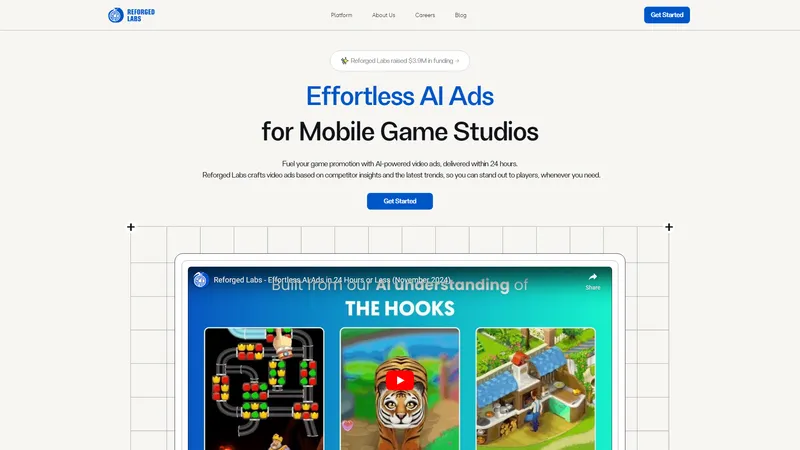
Reforged Labs is a cutting-edge platform that leverages AI technology to create high-impact video ads tailored for mobile game studios. Our AI-driven insights and proven ad formats ensure that your game stands out in a crowded market, delivering results within 24 hours. Whether you're an indie developer or a small studio, Reforged Labs simplifies and accelerates your video marketing efforts, helping you reach your target audience effectively.

Top Features

  1. AI-Powered Ad Creation
  2. Competitor Insights
  3. Trending Ad Formats
  4. 24-Hour Delivery
  5. User-Friendly Interface

Simple Definition of Usecases

  1. A mobile game developer wants to create engaging video ads to promote their new game release. Using Reforged Labs, they select a template, upload their game assets, and receive AI-generated ads within 24 hours, tailored to the latest market trends.
  2. An indie game studio needs cost-effective marketing solutions. Reforged Labs provides AI-powered video ads that are both affordable and high-impact, helping the studio reach a broader audience without breaking the bank.
  3. A marketing manager at a game publisher seeks to boost ad performance. By leveraging Reforged Labs' competitor insights, they create ads that outperform competitors, driving more downloads and engagement.
  4. An advertising agency wants to offer innovative ad solutions to their clients. Reforged Labs' AI-driven platform allows them to quickly generate high-quality video ads, enhancing their service offerings.
  5. A game publisher needs to create multiple ad variations for A/B testing. Reforged Labs' platform enables the rapid creation of different ad formats, allowing for comprehensive testing and optimization.

Frequently Asked Questions

Q:

How quickly can I get my video ads created?

A:

Reforged Labs delivers AI-generated video ads within 24 hours, ensuring you can start promoting your game as soon as possible.

Q:

What types of ad formats does Reforged Labs support?

A:

Reforged Labs supports a variety of proven and trending ad formats, including UGC content, feature showcases, and challenge-based hooks.

Q:

Can Reforged Labs help me compete with larger studios?

A:

Yes, our AI-powered insights analyze top-performing ads in your genre, helping you create ads that can compete with larger studios.

Q:

Is Reforged Labs suitable for indie developers?

A:

Absolutely. Reforged Labs is designed to be user-friendly and cost-effective, making it an ideal solution for indie developers and small game studios.

Q:

How do I get started with Reforged Labs?

A:

Getting started is easy. Simply visit our website, select a template, upload your game assets, and let our AI do the rest. You'll receive your ads within 24 hours.

Related AI Tools

VidRush AI - All-in-one AI studio for cinematic videos, images, and music | Top 4 AI Tool loading
VidRush AI is an all-in-one generative AI creation platform built for modern creators who need video, image, and music production tools without the overhead of managing five different subscriptions. The platform combines some of the world's most advanced foundation models, including Google Veo 3.1, Seedance 2.5, Kling 3.0, Wan 2.6, Nano Banana Pro, Seedream 5.0, GPT Image 2, and Suno AI, inside a single streamlined workspace. It is designed for both independent storytellers and professional production teams who want to transform text prompts, still photos, existing footage, or simple musical ideas into finished creative assets in minutes. Website Positioning VidRush AI positions itself as the definitive all-in-one alternative to fragmented creative AI workflows. In a market where powerful video tools are often separated from image tools, and music generation remains a separate platform, VidRush AI brings the entire production chain into one place. The site emphasizes broad accessibility: beginners can describe an idea in natural language, while professionals can fine-tune outputs with model selection, resolution, aspect ratio, camera motion, and multi-reference controls. The value proposition is straightforward: instead of learning many different interfaces, users can switch between cinematic text-to-video generation, photo animation, image editing, and AI music creation without leaving the workspace. Target Audience The platform is especially relevant for creators in the United States and other major media markets who want outputs that are ready to use for commercial publishing. YouTube creators and vloggers can build complete videos using Veo 3.1 footage, Nano Banana thumbnails, and Suno background music inside one dashboard. Social media marketers serving TikTok, Instagram Reels, and YouTube Shorts need fast turnaround for vertical ad formats, and VidRush AI responds with 9:16 aspect ratio support, native audio, and commercial licensing clarity. E-commerce brands can animate product photos into lifestyle videos and produce professional product shots from text descriptions. Independent filmmakers, video editors, and digital studios rely on the integrated model suite for previsualization, style transfer, and scene extension. Game developers use image generation for concept art, video-to-video for cinematic in-engine capture, and AI music for original soundtracks without expensive licensing fees. Musicians and audio producers can also create full vocal tracks, instrumental beds, and dynamic song variations from simple lyric prompts. Core Features VidRush AI provides six main creative modes: Text to Video, Image to Video, Video to Video, Text to Image, Image to Image, and AI Music Generation. The Text to Video mode lets users turn narrative scripts into cinematic clips with realistic physics, complex camera movement, and synchronized native audio. Image to Video is optimized for animating photographs, artwork, and product images while preserving identity and minimizing the character drift that often appears in earlier AI tools. Video to Video offers style transformation, motion replication, and footage extension based on user-provided reference clips. The Text to Image tool creates photorealistic portraits, commercial product visuals, concept art, and illustrations from descriptive words, while Image to Image supports remixing, restyling, and upscaling with identity retention. The AI Music Generator, powered by Suno 5.5 and previous Suno versions, turns text prompts and lyrics into complete songs with natural vocals, expressive instrumentation, and full dynamic range. Foundation AI Model Integration A major technical advantage offered by VidRush AI is its direct access to multiple state-of-the-art models. For video creation, users can choose Google Veo 3.1 for its impressive native audio and physics, Seedance 2.5 for multi-modal referencing and character consistency, Kling 3.0 for lifelike human motion, or Wan 2.6 for cinematic camera movement. For image generation, the platform includes Nano Banana Pro for photorealistic skin tones and lighting, Seedream 5.0 for high-resolution artistic texture, GPT Image 2 for complex typography and visual reasoning, and Flux 2 for rapid texture synthesis. Music generation is handled through Suno 5.5, 5.0, and 4.5, giving users access to the latest developments in AI vocal synthesis and arrangement. By offering a menu of excellent models rather than a single proprietary engine, VidRush AI lets users select the right tool for each specific job. User Experience and Workflow VidRush AI turns complex production tasks into a direct four-step process. First, users choose a media type and preferred model. Second, they write a prompt in natural language or upload reference assets such as start and end frames, existing images, or audio clips. Third, they configure output parameters such as aspect ratio, duration, camera behavior, lyrics, and instrumental preferences. Fourth, they generate, preview, iterate, and export high-resolution files ready for publishing. This workflow removes the friction commonly associated with installing open-source models, managing GPU hardware, or jumping between multiple web apps. For creators who have struggled with technical setup, the platform offers a convenient, simplified path forward. Even with no prior machine learning experience, users can produce compelling results because the interface highlights intuitive presets and model guidance. Content Quality and Media Capabilities VidRush AI supports a broad range of content creation needs. Text-to-video results can include cinematic sci-fi cityscapes, product-focused luxury advertising, documentary-style nature footage, and narrative action scenes. Image-to-video examples demonstrate animated character sequences, clothing physics, hair motion, and environmental effects that match the photographic source. Image generation covers futuristic portraits, commercial packaging, e-commerce product images, and stylized digital art. Music tracks are suitable for YouTube backgrounds, social media ads, game audio, podcasts, and full streaming releases. This breadth makes VidRush AI unusually practical for creators who produce in multiple formats. The same team can generate a product hero image, turn it into an engaging animation, and add an original soundtrack before publishing a coordinated campaign from one workspace. Commercial Rights and Licensing For many creators, especially those operating in the United States, commercial rights are among the most important considerations when selecting an AI tool. VidRush AI states that content created under active paid subscription plans or purchased credit packages includes full commercial licensing rights. Users can monetize videos on YouTube and TikTok, run client advertising campaigns, publish game assets, sell generated images, distribute music through streaming platforms, and deliver content for commercial television or film projects. This removes the uncertainty and legal friction that often come with open-source weights or free-tier restrictions. For agencies and small studios, that licensing clarity is a major reason to move beyond fragmented free tools and centralize production on a platform with transparent terms. Performance and Technical Infrastructure VidRush AI uses distributed, high-throughput GPU clusters to accelerate rendering. According to the platform's published workflow information, images typically render in 5 to 15 seconds, full-length or cinematic video clips complete in one to three minutes, and song generation typically produces two variations in one to two minutes. This speed matters enormously for content teams working on tight deadlines. In addition to speed, the technical backend supports up to 4K upscaling and flexible aspect ratios including 16:9 widescreen, 9:16 vertical shorts, and 1:1 square content. The platform's architecture is designed to balance high-volume user demand and priority processing through different tier plans. Optimization and Community Resources The site includes a community and showcase area where creators can examine authentic video and image outputs, including cinematic science fiction scenes, stylized anime-inspired visuals, e-commerce animations, and realistic wildlife footage. These examples serve as creative references and offer practical tips and tricks for users who are still learning prompt design or model selection. The showcase also helps users understand the stylistic differences between models such as Veo 3.1, Seedance, Kling, and Nano Banana. By seeing how different models handle color, motion, lighting, and character consistency, users can make more informed choices before spending credits. This educational layer makes the platform more accessible to newcomers and helps experienced users optimize their workflows. Productivity and Business Value For a production team, the ability to handle video, image, and music in one tool is a major cost saver. A creator who previously paid separately for a text-to-video service, an image model subscription, a background music license, and a standalone image animation platform can replace these fragmented tools with one subscription. This consolidation lowers monthly expenses, reduces time spent copying files between platforms, and simplifies account administration. The integrated environment allows creators to keep their entire content pipeline in one place, which is especially important for teams that produce daily content. Workflows become more efficient when creators are not forced to leave their editing context to generate a thumbnail or a music bed. The Essential Creative Controls Although VidRush AI is designed to be simple enough for beginners, it also delivers the essential creative controls required by advanced users. Model choice gives users control over aesthetic style and motion handles. The multi-reference feature allows image inputs to guide character appearance, composition, and product detail, which is extremely useful for branded content. Output controls include resolution, aspect ratio, duration, camera motion, and lyric inputs for music generation. Advanced users can enter the same visual prompt into different models, compare results, and choose the most effective output. This makes the platform a serious tool for art directors and production designers who need predictable visual outcomes rather than random generations. Getting Started and Pricing Flexibility VidRush AI invites new users to start with free starter credits, meaning individuals can test video, image, and music generation without immediately making a financial commitment. After testing, users can choose between monthly subscription plans for recurring creation needs or on-demand credit packs for occasional bursts of work. The credit system is based on model complexity, output length, and resolution, giving fair and transparent usage expectations. The platform also runs promotional discounts, including limited-time offers such as 20% off, which add additional value for early adopters. Because free credits, subscriptions, and pay-as-you-go packs are all available, VidRush AI can suit hobbyists, professional creators, and large production companies at different stages of growth. Conclusion VidRush AI is much more than a simple text-to-video generator. It is a serious unified creative studio that responds to the real production needs of a generation of creators working across YouTube, social media, e-commerce, film, games, and music. By integrating powerful models, prioritizing commercial usability, emphasizing fast rendering, and providing flexible pricing, it gives modern creators the most efficient route from an idea to a polished asset. For those who want professional output without the overwhelming complexity of running separate AI tools, VidRush AI offers a ready to use creative environment that feels both familiar and groundbreaking. It respects the craft of content creation while removing unnecessary technical barriers, making it one of the most compelling all-in-one AI platforms for the United States market and beyond.
AI Music Generator
Freemium

AI Facefy | Top 4 AI Tool loading
AI Facefy is a cutting-edge platform that offers free and secure online face swapping services. Utilizing advanced artificial intelligence, AI Facefy enables users to seamlessly swap faces in photos and videos, creating realistic and entertaining content. Whether you're looking to create fun memes, engage in cosplay, or enhance your social media presence, AI Facefy provides a user-friendly interface and quick processing times. The platform ensures privacy by deleting uploaded photos within 24 hours and offers high-quality output with natural facial expressions. With features like seamless face replacement, creative possibilities, and support for various media formats, AI Facefy is a versatile tool for both casual users and content creators. Discover the endless creative opportunities and transform your images and videos with AI Facefy today.
AI Face Swap Generator
Freemium
Kirkify - Turn any face into Charlie Kirk in seconds | Top 4 AI Tool loading
Kirkify is a web-based AI face swap platform that has rapidly become the definitive tool for creating Charlie Kirk-themed memes. The service allows anyone to upload a photo and transform every face into the instantly recognizable likeness of Charlie Kirk, a process known as Kirkification. Built on Replicate-hosted face-swap models, Kirkify delivers consistent, share-ready results in typically under 30 seconds. The platform is designed to be ready to use from the moment a visitor lands on the homepage: no account creation, no credit card, and no desktop software are required for the first free Kirkification. This low-friction approach has helped Kirkify ride the viral wave on TikTok, X, Reddit, and Threads, where the Kirkification trend has generated millions of impressions. Website Positioning Kirkify positions itself as the most accessible and focused Charlie Kirk face swap tool on the internet. Unlike general-purpose face swap apps that require complex settings or manual masking, Kirkify does one thing exceptionally well: it detects all faces in an uploaded image and applies a single consistent Charlie Kirk reference look. This focus makes Kirkify more efficient for meme creators who need instantly recognizable results without learning a full editing suite. The site emphasizes speed, simplicity, and virality. Headlines such as Free to try, no sign-up required and Join millions creating viral Kirkified memes underline its ambition to be the default choice for anyone participating in the Kirkification trend. The brand voice is playful, direct, and tailored to internet culture, which resonates with its core audience of social media users. Target Audience Kirkify's primary audience includes meme creators, TikTok and X influencers, political satire enthusiasts, and everyday users who want to prank friends. The tool also appeals to content marketers looking to jump on viral trends, small social media teams, and bloggers who need quick visual gags. Because Kirkify requires no technical skill, its audience ranges from teenagers sharing group chat jokes to professional content creators producing daily posts. The free first credit and free queue option lower the barrier for casual users, while the credit-based paid model supports power users who need faster processing and batch output. The site's blog and how-to guides further serve beginners who are discovering the Kirkification trend for the first time. Students, office workers, and meme page administrators all find Kirkify accessible because it strips away the complexity of traditional photo editing. Core Features Kirkify's feature set is deliberately streamlined but effective. The main workspace is a drag-and-drop upload area that accepts JPG, PNG, and WEBP files up to 8MB. Once an image is uploaded, the automated AI detects every face, regardless of whether the user selects single face or multiple faces mode. GIF support is listed as coming soon, which would extend the tool to animated memes. The face swap engine uses facial landmark mapping and style transfer to impose a consistent Charlie Kirk look. Most jobs complete in under 30 seconds, and the output is delivered as a downloadable PNG or shareable link. The platform also offers a free queue option that processes images without consuming credits, albeit at a slower pace. A built-in showcase gallery displays community-created Kirkified images, providing inspiration and demonstrating the tool's capabilities. An AI Video generator is linked as a secondary tool for creating videos from text or images, extending the brand's utility. The consistency of the output is a key technical advantage. Kirkify uses one reference image for all renders, which ensures that every Kirkified face looks exactly the same across selfies, group shots, and different lighting conditions. This single-source policy is what makes Kirkify memes instantly recognizable and highly shareable. The platform's dependence on Replicate-hosted models means that processing is handled on robust cloud infrastructure, allowing users to get results without installing anything. The site maintains transparency by linking to Replicate's documentation, signaling a commitment to technical reliability. Content Features Beyond the core face swap tool, Kirkify offers a growing content ecosystem. The Showcase page is a gallery of user-generated Kirkified images that serves as social proof and inspiration. The Blog contains articles, tips and tricks, and step-by-step tutorials on how to make the most of Kirkification. Topics likely include best practices for choosing source photos, optimizing memes for different platforms, and staying within satire and fair use boundaries. The site also provides dedicated landing pages for related tools, such as Kirkify AI Free, Kirkify AI Online, and Kirkify AI Generator, each targeting specific search intents. The footer includes a link to an About page, Contact, Pricing, Privacy Policy, Terms of Service, Refund Policy, and Refund Application, indicating a commitment to transparency and user trust. This content depth helps Kirkify rank in search engines and establishes it as an authoritative resource for the Kirkification trend. The existence of a How to Kirkify tutorial page and multiple guides demonstrates the platform's investment in user education. User Experience Kirkify's user experience is intentionally intuitive and frictionless. The homepage immediately presents the workspace with a clear call to action: Start Kirkifying Free. Users can drag and drop an image without creating an account, which is rare among AI tools. The interface uses simple language, large buttons, and visual cues to guide users through the three-step process: upload, AI transformation, download and share. The free first credit is prominently advertised, and the free queue option ensures that even users who run out of credits can still use the service. The automated nature of the face swap means users never need to manually select facial landmarks or adjust settings. This level of simplicity makes Kirkify accessible to non-technical users while still delivering professional-quality memes. The inclusion of a 2 Credits indicator for signed-in users suggests a lightweight dashboard for tracking usage, though the full account features are not detailed in the homepage content. The overall user experience is designed for speed. From landing on the page to downloading a finished meme, the entire workflow can take under a minute. This aligns with the needs of social media users who want to post timely reactions to news events or trending topics. The absence of a mandatory signup eliminates a major drop-off point, and the promise of no credit card required reduces risk perception. For users who do create an account, the credit system likely provides a history of generated images and faster access to premium features. Kirkify's seamless transition from upload to result makes it a favorite among users who value convenience over complexity. Technical Features Technically, Kirkify leverages Replicate's face-swap model, which is a hosted machine learning API. This architecture allows the site to offload GPU-intensive processing to Replicate's servers, ensuring consistent performance regardless of the user's device. The model is specifically tuned to replace all faces in an image with a single Charlie Kirk reference look. The output format is PNG, which supports high-quality downloads suitable for sharing on social platforms. The input size limit of 8MB covers most smartphone photos and web images, and the supported formats (JPG, PNG, WEBP) align with common web standards. The automated face detection uses facial landmark mapping, a technique that identifies key points on each face to ensure accurate alignment and blending. This results in natural-looking swaps that preserve the original photo's lighting and proportions, which is essential for the meme to be both recognizable and funny. The site's technical implementation also includes a queue system. Free users can either spend a credit for rapid processing or join a free queue that processes images when server capacity allows. This dual-track system enables Kirkify to offer free access while incentivizing paid credits for priority processing. The Replicate integration likely includes webhook callbacks or polling to update users when their image is ready, as indicated by the Queue status updates show progress feature. This transparent feedback loop keeps users informed and reduces frustration. The API model codeplugtech/face-swap is mentioned openly, giving technically inclined users confidence in the underlying technology. Pricing and Accessibility Kirkify uses a freemium pricing model. New users receive one free Kirkification credit with no credit card required, which serves as a trial. Additional swaps can be obtained either by waiting in the free queue or by purchasing credit packs. The exact pricing tiers are available on the Pricing page, but the homepage emphasizes the free entry point and the optional paid credits for faster processing. This model is well-suited to a viral tool because it allows massive adoption without upfront cost while monetizing power users who need volume or speed. The 2 Credits indicator suggests that signed-in users can see their balance, and the presence of a Refund Policy and Refund Application page indicates a mature billing system. For casual users, the free queue is a practical option that keeps the tool accessible even after the initial free credit is spent. The intuitive credit system is easy to understand and aligns with the pay-per-use expectations of internet users. Value Proposition Kirkify's value proposition is straightforward: it offers the simplest and fastest way to create Charlie Kirk face swaps for social media. Compared to general-purpose image editors or other face swap tools, Kirkify saves time, removes technical barriers, and produces consistent results that are optimized for virality. The ready to use nature of the platform means users can create a meme in seconds, not minutes. The automated face detection eliminates manual work, making it more efficient than manual Photoshop alternatives. The intuitive interface ensures that even first-time visitors can succeed, while the tips and tricks on the blog help users refine their meme-making skills. The seamless integration with Replicate's cloud infrastructure guarantees reliable processing on any device, and the single reference image policy ensures that every Kirkified face is instantly recognizable. For content creators, marketers, and casual pranksters alike, Kirkify delivers a unique combination of speed, consistency, and fun. It is not merely a face swap tool; it is a social media trend enabler that turns ordinary photos into shareable cultural moments. Conclusion In summary, Kirkify is a focused, ready to use AI face swap tool that has captured the viral Kirkification trend. Its automated, intuitive, and seamless workflow transforms any photo into a Charlie Kirk meme in under 30 seconds, with no signup required for the first use. The freemium model, free queue, and credit-based paid options make it accessible to casual users and power users alike. The site's content ecosystem, including showcase gallery, blog, and dedicated guides, provides added value and SEO strength. With robust technical underpinnings from Replicate and a clear understanding of internet culture, Kirkify is poised to remain the definitive platform for Charlie Kirk transformations. Whether you are a meme creator, a marketer, or just someone who wants to prank friends, Kirkify offers a practical, efficient, and genuinely entertaining way to join the trend.
Photo & Image Editor
Freemium
Merge Two Photos - Merge two photos side by side, stacked, overlay, or AI. | Top 4 AI Tool loading
Merge Two Photos is a ready to use, convenient, and intuitive browser-based tool that lets anyone combine two images into a single clean PNG without installing software or creating an account. Designed for speed, privacy, and simplicity, the platform offers four clearly defined merge modes: side by side, top/bottom, overlay, and AI fusion. Each mode solves a specific visual problem, and the tool is practical enough for casual users while still being useful for professionals who need fast, no-fuss image merging. The entire experience is seamless, from upload to download, with no watermarks, no mandatory sign-ups, and no hidden costs. This introduction explores the website's positioning, target audience, core features, content features, user experience, technical features, and why it stands out as a reliable free alternative to complex editing suites. Website Positioning: Merge Two Photos positions itself as the essential free merge utility for anyone who needs to put two pictures into one frame. Unlike full-featured design platforms such as Canva or Adobe Photoshop, which often require accounts, subscriptions, or a learning curve, this tool focuses exclusively on merging two photos and does it exceptionally well. It is lightweight and streamlined, with three local collage modes that run entirely inside the browser and an optional AI mode for creative blends. The positioning emphasizes privacy: local side-by-side, top/bottom, and overlay merges never upload photos to any server. Even AI fusion is clearly disclosed as an upload-based process, and users can opt out by choosing a local mode. This privacy-first approach appeals to individuals handling personal memories, business assets, or sensitive comparisons. The tool does not try to be a full design suite; instead, it is a specialized, practical solution for a single task. As a result, it becomes the essential shortcut for anyone who has ever struggled to place two images in one document or social media post. Target Audience: The target audience is broad but can be segmented into several distinct groups. Social media managers and influencers use the side-by-side and top/bottom modes to create before-and-after posts, comparison graphics, and multi-image stories. E-commerce sellers and small business owners use overlay mode to add logos, badges, or product labels to photos without resorting to complex software. Teachers and educators merge worksheets, diagrams, and answer keys into single documents for handouts and presentations. Travel bloggers and photographers combine landscape and portrait shots into diptychs for blogs, Instagram, and portfolios. Students use the tool for assignment visuals, while real estate agents compare property photos or create single listing images. The simplicity of the interface also makes it suitable for older adults and non-designers who want a no-fuss way to combine images. Because no account is required and local processing keeps files private, even privacy-conscious users feel comfortable using the tool for personal projects. The daily free AI merges also attract creative users who want to experiment with prompt-driven blends without paying for a subscription. Core Features: The platform provides four merge modes, each with a visual preview card so users know exactly how the final frame will look. The side-by-side mode places two photos left and right into one wide image, with heights matched and no crop by default. This is great for comparisons, portraits, travel diptychs, and product shots. The top/bottom mode stacks two photos vertically into one tall image, aligning widths so both stay visible. It is ideal for before-and-after strips and vertical collages. The overlay mode creates a collage by placing a smaller foreground image on a larger base image, with the foreground positioned bottom-left by default. This is useful for stickers, logos, or picture-in-picture inserts. The AI merge mode goes beyond hard cuts by using a short text prompt to blend two pictures into one seamless scene. Users can describe who should move, what should stay, and the mood, then regenerate if the result is not what they expected. All modes support drag-and-drop or click-to-browse uploads for JPG, PNG, WEBP, and HEIC files up to 10 MB each. A swap button lets users instantly switch the left and right images without re-uploading. Successful downloads are clean PNG files with no watermark for both local and AI modes. The tool is free, with fair-use daily limits of five AI merges per day, while local merges remain unlimited. Content Features: Beyond the core merging tool, the website offers a growing library of guides and tutorials that help users get the most out of the platform. Current guides cover merging photos on mobile for Android and iPhone, combining photos in one frame, merging into one background, using the tool as a Canva alternative, and getting better AI merge results with prompt tips. These articles are written in clear, instructional language and include step-by-step instructions. The site also includes an about page, contact information, privacy policy, terms of service, and refund policy, which builds trust and transparency. A comparison table on the homepage clearly explains the differences between local collage modes and AI fusion, including upload behavior, privacy and retention, best use cases, and watermark policies. This educational content helps users choose the right mode for their needs and understand exactly what happens to their images. The blog guides are search-optimized to answer common questions such as how to merge photos on mobile, how to combine photos in one frame, and how to use AI merge effectively. User Experience: The user experience is designed to be as frictionless as possible. The homepage presents four visual mode cards immediately, so users can choose a layout in seconds. There is no account creation requirement, no pop-up modal blocking the tool, and no confusing navigation. After selecting a mode, the interface shows two upload areas labeled Left and Right, with clear file type and size limits. Drag-and-drop works smoothly, and the swap button is conveniently placed. For local modes, a single click on Merge processes the images instantly in the browser, and the preview appears quickly. For AI mode, a text prompt field appears, and the user can generate a fusion with one click. The download button produces a PNG immediately. The entire process from landing on the page to downloading a merged image can take less than a minute for local modes. The responsive design means the same tool works on phones, tablets, and desktops, which is crucial for mobile-first users. The interface uses minimal text and large visual previews, making it accessible even to people who are not tech-savvy. Error messages are rare because the tool validates file types and sizes before processing. Technical Features: Under the hood, the tool leverages modern browser capabilities to process images locally for side-by-side, top/bottom, and overlay modes. This means no server upload, no waiting for cloud processing, and no privacy risk for those modes. The supported formats include JPG, PNG, WEBP, and HEIC, covering most common image types from phones and cameras. HEIC support is particularly valuable for iPhone users, as many online tools do not accept this format. The file size limit of 10 MB per image is generous enough for high-resolution photos while keeping browser performance stable. The AI fusion mode, when selected, uploads images to a processing endpoint. The privacy policy states that guest AI files are retained for about 24 hours, while signed-in history is retained for about 30 days. This transparency is a strong technical and ethical practice. The site uses responsive HTML and CSS to ensure a consistent experience across devices, and the download function generates a clean PNG without watermarks. Privacy and Security: Privacy is a core differentiator. For local modes, photos never leave the user's device, which is explicitly stated on the homepage and in the comparison table. This is crucial for users handling sensitive images such as ID photos, medical comparisons, or private family pictures. The AI mode is optional and clearly labeled as uploading images for processing. Users who prefer not to upload can simply choose a local mode. The absence of mandatory sign-ups further reduces the data footprint. The privacy policy documents retention rules, and the site does not appear to use aggressive advertising or tracking. This privacy-first design makes the tool trustworthy for personal and professional use alike. Additional Use Cases and Scenarios: The tool is versatile enough to handle a wide range of everyday tasks. A parent might combine two school event photos into one frame for a family album. A fitness coach might merge a client's before and after photos side by side to show progress. A blogger might overlay a small watermark logo on a base image before publishing. A developer might merge two screenshots into one image for documentation. A marketer might create a quick social media ad by combining a product photo with a lifestyle shot. The AI mode can be used to create artistic blends, such as merging a portrait with a landscape to produce a surreal composite. Because the tool works without an account, users can perform one-off merges without committing to a platform. The daily free AI limit encourages experimentation without pressure. Accessibility and Device Compatibility: The website is designed with mobile users in mind. The upload areas are large enough to tap on a phone screen, and the visual mode cards adjust to smaller widths. The tool works in any modern browser, including Chrome, Safari, Firefox, and Edge. Since processing happens locally for most modes, users do not need a fast internet connection to merge side-by-side, top/bottom, or overlay images. This makes it practical for travelers, field researchers, or anyone with limited bandwidth. The AI mode does require an internet connection, but the prompt field is simple and the result downloads quickly. The absence of pop-up ads and intrusive sign-up prompts makes the mobile experience particularly pleasant. Why Choose Merge Two Photos: Compared to other photo merging tools, Merge Two Photos stands out because it is ready to use immediately, convenient for quick tasks, and intuitive enough for anyone to understand. It eliminates the need for accounts, watermarks, or complex editing. The practical nature of its four layouts means users get exactly what they need without extra steps. The seamless download experience ensures high-quality PNG output every time. Whether someone needs a simple side-by-side comparison, a vertical before-and-after strip, a logo overlay, or a prompt-driven AI blend, the tool delivers quickly and privately. Its free pricing model with fair-use limits makes it accessible to everyone, from students to small business owners. The combination of local processing, mobile responsiveness, and clear documentation makes it a top choice for anyone searching for a fast, free, and reliable way to merge two photos. Conclusion: Merge Two Photos is a focused, efficient, and transparent web application that solves a very specific problem with excellence. It does not try to replace full design suites but instead offers a streamlined, ready to use solution for combining two images. The tool is convenient, intuitive, practical, and seamless, with a strong emphasis on privacy and simplicity. Whether you are a social media manager, a teacher, a seller, a blogger, or just someone who needs to put two pictures together, this website provides everything you need without cost or complexity.
Photo & Image Editor
Free
Pixal3D - Generate pixel-perfect 3D assets in seconds with production-ready PBR textures. | Top 4 AI Tool loading
Pixal3D is a state-of-the-art image-to-3D generation platform developed by researchers at Tsinghua University and TencentARC. It transforms ordinary 2D images into high-fidelity, production-ready 3D assets in seconds. The platform was designed to solve one of the most frustrating problems in modern AI content creation: the loss of design detail. Most 3D-native generators approximate a shape in a generic canonical pose and use loose attention mechanisms, which often produces warped silhouettes, hallucinations, and blurry faces. Pixal3D rejects that approach. Instead, it explicitly lifts multi-scale image features into a 3D feature volume through pixel back-projection. This method establishes direct pixel-to-3D correspondence, meaning the output is aligned exactly to the source image. For 3D artists, game developers, spatial computing creators, and AI researchers, this is a significant shift. The generated objects are not just vaguely similar; they are reconstruction-level faithful. The work is grounded in rigorous academic research and accepted to SIGGRAPH 2026, making it one of the most credible systems in the field. These assets are ready to use in modern engines, with clean geometry, PBR textures, and standard GLB export. Web positioning: Pixal3D is positioned as the next evolution in image-to-3D generation. It is neither a toy demo nor a slow offline solver; it is a professional tool that sits between generative AI and photorealistic 3D reconstruction. The platform combines the speed and convenience of generative models with the visual precision of reconstruction. It is aimed at people who need real assets, not inspiration. Accepted to SIGGRAPH 2026, the project establishes academic credibility and signals that it is built on a reproducible, peer-reviewed foundation. The public website is structured to communicate this positioning clearly. The homepage speaks to concept artists who are tired of seeing their main view transformed by AI, technical artists who need usable mesh topology, and developers who want open-source access to the pipeline. The tagline captures the core promise: pixel-level accuracy, fast output, and production convenience. The platform does not market itself as a generic 3D generator; it positions itself as a precision tool for those who require visual faithfulness above all else. Target audience is broad but focused. The first and most obvious users are 3D artists and modelers. They benefit from a tool that can turn concept art into a base mesh in minutes, allowing them to focus on higher-level creative decisions. The second group is game developers and technical artists, who need game-ready models with PBR materials. They no longer need to model every prop from scratch or spend days on UV mapping and texture baking. The third group is indie developers and solo creators, who often lack the time and budget to hire a full art team. For them, Pixal3D provides an accessible way to populate games, VR worlds, and portfolio pieces. The fourth group is AI researchers and students. Because the code is open source and hosted on GitHub, they can reproduce the results, study the back-projection mechanism, and build new systems based on the Trellis.2 backbone. The fifth group is XR and VRChat creators, who need avatars, props, and environments that match their original illustrated designs. Finally, product designers and e-commerce teams can use the platform to create 3D product views from regular photos. This diversity makes Pixal3D useful for small independent projects and large production pipelines alike. Core features distinguish Pixal3D from older tools. The primary feature is pixel back-projection, which takes multi-scale 2D features and projects them into a 3D feature volume. This creates a direct correspondence that is absent from canonical-space generators. With this method, the visible side of the model matches the input image with one-to-one spatial accuracy. The system also supports multi-view aggregation. If a user supplies a character turnaround or multiple camera angles, Pixal3D combines the back-projected volumes and greatly improves 360-degree consistency. The Trellis.2 backbone powers the generation, providing optimized inference speed and high-quality feature extraction. The output uses standard GLB format with PBR maps for base color, normal, and roughness. This combination means the exported file can be dropped directly into Unity, Unreal, Blender, or web-based viewers. The system also supports modular scene synthesis, which can parse a complex 2D scene into object-separated 3D assets. That is useful for rapid environment prototyping and set dressing. Finally, the entire tool is accessible as an open-source research project. Users can try the Gradio demo on Hugging Face, run the code locally, or integrate the pipeline into custom tools. Content features are designed for both beginners and experts. The landing page explains the workflow in four simple stages: upload a reference image, perform pixel back-projection, generate geometry and textures, and download the GLB asset. Each step is supported by concise copy that describes the technical benefit. The site also includes a FAQ section that answers common questions about file formats, hardware requirements, multi-image support, and the research origin. The resources section includes model pages for Trellis.2, Hunyuan3D, Hi3DGen, Direct3D-S2, Sparc3D, InstantMesh, and Stable Fast 3D. This helps users understand the broader ecosystem and compare techniques. The GitHub repository contains documentation and inference scripts, which is essential for developers who want to run Pixal3D in a local environment. The Hugging Face demo gives immediate, browser-based access for people who do not have a powerful GPU. The site also includes testimonials from professionals in different roles: a senior tech artist, an indie developer, and an AI researcher. These testimonials reinforce the message that Pixal3D is not just a research experiment; it is a day-to-day production tool. The user experience is intentionally low friction. A user starts at the homepage, clicks Start For Free, and goes directly to the Playground. There is no registration wall, no email verification, and no complicated setup. The Playground allows the user to upload a single image or multiple views and receive a generated model quickly. This design is crucial for professional workflows where time is limited. Instead of spending hours learning a new tool, a creator can get a usable asset in minutes. The browser-based version is ideal for quick testing and concept validation. For users who need more control, local execution through the GitHub repository provides access to the full pipeline. The code examples, inference scripts, and open model weights make it easy to integrate Pixal3D into automated build processes. The overall user experience emphasizes speed, clarity, and results. The UI does not overwhelm users with technical jargon, even though the underlying method is sophisticated. Clear visual hierarchy, simple labels, and direct calls to action guide the user from image to 3D asset. On the technical side, Pixal3D is built around a fundamentally different architecture from the typical image-to-3D model. Traditional generators output shapes in a canonical space, which requires the network to learn an implicit correspondence between the image and a generic pose. This often produces incorrect depth, warped textures, and poor front-view fidelity. Pixal3D instead uses explicit back-projection, lifting image features into a 3D volume before synthesizing the final mesh. The Trellis.2 backbone is highly scalable and optimized for fast inference, making the system practical for real-world use. The output mesh is high-resolution and clean enough for immediate deployment. The PBR material generation adds standard maps that behave correctly under dynamic lighting. Multi-view aggregation allows the system to merge feature volumes from different angles, improving topological accuracy and filling in occluded areas. The system can handle a single rough sketch or a complete multi-view character sheet. Rendered from any angle, the result is more consistent than what canonical generators produce. Because the project is open source, the technical details are transparent, and researchers can verify, extend, and improve the method. This makes it a practical tool and a meaningful scientific contribution. Interoperability is one of the strongest aspects of Pixal3D. Many AI 3D generators produce OBJ files with only vertex colors or unoptimized geometry that still requires hours of cleanup. Pixal3D creates GLB files with standard PBR maps, so the asset can be used immediately in game engines, digital content creation tools, and web platforms. Game developers can import the model into Unity or Unreal without converting formats. Blender artists can retain the PBR material setup and start editing immediately. Web developers can drop the GLB into Three.js or React Three Fiber. Spatial computing developers can use the models in VRChat, Unity XR, and other immersive projects. The open-source nature of the project further improves interoperability. Developers can write custom scripts that call the inference pipeline, batch-generate assets, or connect the tool to internal production software. This flexibility reduces the friction between concept art and final implementation. It also supports more efficient asset pipelines because one artist can generate an entire prop library from simple concept sketches, freeing the rest of the team to focus on animation, gameplay, and composition. Pricing and accessibility are major advantages. Pixal3D is free to use in its current form. The browser playground is free, the Hugging Face Gradio demo is free, and the GitHub source code is freely available. This makes the tool inclusive for students, hobbyists, and small studios who cannot justify the cost of expensive 3D software or paid AI generation services. The open model weights and inference scripts allow users to run the tool on their own hardware, which is particularly important for companies with strict data privacy requirements. This accessibility does not compromise quality. The same technology that powers the public demo can be used in a private production environment. Users can avoid per-image fees and subscription plans, and they retain control over their assets. Open-source access also encourages community-driven improvements, so the system evolves faster than a closed proprietary tool likely would. For many teams, the most compelling value proposition is the combination of professional output and zero acquisition cost. Real-world use cases are numerous. In game development, a technical artist can upload a character concept, generate a base mesh with correct front-facing details, then import it into ZBrush or Blender for further sculpting. In virtual production, an art director can use multiple concept camera angles to generate a consistent 3D hero prop. In e-commerce, a product photographer can upload a single studio photo and create an interactive 3D product view for a web store. In VRChat and social VR, a creator can upload an illustrated avatar concept and receive a usable GLB with PBR textures. In education, a teacher can make 3D models from historical images or archaeological illustrations. In architecture, a designer can turn a hand-drawn perspective into a rough volumetric massing model. In robotics and simulation, researchers can generate synthetic assets from real photographs to train AI systems. In all of these examples, the central benefit remains the same: visual fidelity. The generated asset looks like the input image, not an AI's invented interpretation. Comparison with traditional pipelines makes the value clear. Manual modeling can take days, especially for complex props or stylized characters. Photogrammetry requires controlled lighting, multiple camera angles, and heavy cleanup. Older image-to-3D AI generators may produce impressive silhouettes but often fail under close inspection; the front view may be blurred, the eyes may be misaligned, or the texture may wrap around the model incorrectly. Pixal3D addresses these failure modes directly. The pixel-aligned generation ensures the front face of the model matches the source image with high accuracy. The PBR maps provide realistic material response, eliminating the need to spend hours repainting textures. The GLB export removes compatibility barriers, reducing the time between generation and deployment. The ability to accept one or multiple images makes the tool flexible. For users who need only a simple concept blockout, a single image is enough. For users who need a production-quality hero asset, multi-view input can dramatically improve the 360-degree result. This adaptability means Pixal3D can support a wide range of fidelity requirements. In summary, Pixal3D is a powerful new standard for image-to-3D generation. It combines the best of generative AI and 3D reconstruction, producing assets that are ready to use in professional pipelines. The platform is supported by serious academic research, open-source code, and an accessible browser demo. It is more efficient than manual modeling or older AI generators because it preserves the original design's pixel-level, practical details. It outputs lightweight GLB files with standard PBR maps, making it a practical addition to game engines, XR platforms, and web rendering stacks. For artists, developers, and researchers, Pixal3D offers a rare combination: state-of-the-art technology, production-ready results, and free access. Whether the task is a single character prop, a full multi-view hero asset, or a modular scene, Pixal3D turns a 2D image into a faithful 3D reality. This is the future of content creation, where the gap between artwork and engine-ready model finally disappears.
Image to 3D Model
Free
Yevideo AI - Perfect AI Video & Image Studio, Ready to Use | Top 4 AI Tool loading
Yevideo is an all-in-one AI video and AI image creation platform that aggregates multiple state-of-the-art generative AI models into a single, cohesive studio. Designed for creatives, marketers, and developers, the platform provides a streamlined and intuitive workflow for transforming text prompts, images, and reference videos into high-quality visual content. Yevideo distinguishes itself by not just exposing raw AI models, but by curating them with clear use-case recommendations, estimated credit costs, and an integrated workspace that simplifies the creative process. The platform supports an extensive range of tasks including text-to-image, image-to-image, text-to-video, image-to-video, video-to-video, and AI video editing. Users can generate content using models like Google's Veo 3.1 and Gemini Omni Video, ByteDance's Seedance 2.0, Kuaishou's Kling 3.0, and image models like Google's Nano Banana Pro and OpenAI's GPT Image 2. The introduction of a 'Gemini Omni Video' model, which leverages Gemini's world knowledge and physics reasoning, underscores Yevideo's commitment to integrating the most advanced capabilities. A key feature for new users is the welcome bonus of free credits, allowing them to test the platform without immediate financial commitment. For professional users, Yevideo offers a practical and efficient alternative to using multiple, disparate AI tools, centralizing project management, credit tracking, and output history. The platform's pricing operates on a credit-based system, where each generation (image or video) consumes a specific amount of credits based on the complexity and model chosen. This credits system provides a pay-per-use feel, ensuring users only pay for what they generate. Yevideo also explicitly grants commercial usage rights to paid subscribers, making it a viable tool for businesses creating marketing assets, social media content, and product visuals. The platform's user interface is designed to be intuitive, with clear model cards that outline each model's strengths, such as 'Best for motion imitation' or 'Best for text rendering in images'. This guided approach helps users select the right tool for their specific task, reducing the learning curve typically associated with advanced AI generation. Furthermore, Yevideo includes a 'daily check-in' feature and feedback rewards, encouraging community engagement and providing ongoing value to its user base. The platform actively seeks user feedback to refine its offerings and has a visible roadmap for future features like an invite program. By aggregating diverse AI models under one roof and providing a seamless, integrated user experience, Yevideo positions itself as the definitive solution for anyone looking to harness the power of AI for visual content creation.
AI Video Generator
Freemium
Video2Jpg - Convert videos to JPG, PNG, and WebP frames in your browser. | Top 4 AI Tool loading
Video2Jpg is a ready to use, free online video-to-image converter that turns video content into high-resolution JPG, PNG, or WebP stills directly in the browser. It is built for people who need reliable frame extraction without uploading sensitive media to a remote server. In a world where convenience often comes at the cost of privacy, Video2Jpg offers a refreshingly simple model: your video stays on your device, the conversion happens locally, and the result is a downloadable image or a full ZIP archive of frames. This makes it more efficient than traditional cloud converters because there is no waiting for uploads, no file size limits imposed by a server, and no need to trust a third party with your content. Website Positioning: Video2Jpg positions itself as the essential tool for converting video into image formats. It is neither a heavyweight desktop application nor a cloud service with hidden limits. Instead, it occupies a practical niche: a fast, browser-native utility that works on both desktop and mobile devices. The design focuses on a single job done exceptionally well. The interface strips away unnecessary complexity and guides users from file selection to frame extraction in three steps. This positioning is especially valuable for users who need a dependable solution for tasks such as generating video thumbnails, extracting stills from product demos, creating PNG sequences for VFX work, or building WebP assets for performance optimized websites. Target Audience: The audience for Video2Jpg is wide. Content creators and YouTubers need custom thumbnails and highlight frames. Social media managers repurpose video content into static posts and ads. Video editors, animators, and VFX artists need pixel-perfect PNG sequences for compositing, rotoscoping, and reference material. Educators and e-learning developers extract slides from recorded lectures to include in handouts and study guides. Web developers and designers use WebP output to optimize images for faster page loads. Photographers may need to grab still frames from client video sessions or convert motion clips to printable images. Journalists and archivists may need to preserve important moments from news footage. Because the tool is free and requires no account, it is also ideal for students, hobbyists, and small business owners who need occasional conversions without downloading software. Core Features: The core feature set is focused on format flexibility and batch extraction. Users can choose JPG for fast, compact snapshots; PNG for lossless quality; and WebP for modern web graphics. The JPG mode allows users to balance compression and quality, producing lightweight images that are easy to share, upload, and store. PNG mode is ideal for projects where compression artifacts are unacceptable, such as VFX plates, transparent graphics, or high-quality prints. WebP mode provides a modern alternative that can help reduce image file sizes while maintaining visual fidelity. The tool supports common video containers including MP4, WebM, MOV, AVI, and MKV. There is no arbitrary file size limit because the video is never uploaded. Users can extract a single frame by seeking to a precise timestamp, or they can set an interval to automatically capture a sequence of frames across the video. Multiple frames are compiled into a single downloadable ZIP file, simplifying storage and transfer. Content Features: The website’s content is organized to answer the most common user questions immediately. The homepage clearly explains the conversion capabilities, showing the three output formats and their ideal use cases. A three-step “How to Convert” section breaks the process into Upload Video, Set Format & Timing, and Download Frames. This structure reduces friction for first-time users. The FAQ section addresses practical concerns about privacy, mobile use, PNG sequences, and online conversion. The site also includes dedicated service pages for popular conversions such as MP4 to JPG, WebM to JPG, AVI to JPG, video to frames, and video to GIF. These pages help target search traffic from users who are looking for format-specific solutions. The language is clear, direct, and benefit-oriented, speaking to users who want to solve a problem quickly without reading lengthy manuals. User Experience: User experience is at the heart of Video2Jpg. The drag-and-drop area invites immediate interaction, and the browse button offers a familiar alternate path. Once a video is loaded, the user can select the output format, seek to a specific moment, or define a frame interval. This simple interaction model ensures that even users with no technical background can achieve professional results. The tool is optimized for mobile browsers as well. On an iPhone, for instance, users can open the site in Safari, tap Browse Files, select a clip from the photo library, choose JPG, and export full-resolution frames to the camera roll. This mobile workflow is particularly useful for creators who shoot video on their phones and need quick stills for social media. The interface avoids clutter, and the process gives immediate visual feedback. The lack of login, payment, or watermark requirements further enhances the experience. Users can move from start to finish in seconds. Technical Features: From a technical standpoint, Video2Jpg demonstrates the power of modern browser APIs. Everything runs client-side using local resources. Video data is decoded in the browser, frames are rendered through canvas-based imaging pipelines, and files are generated without leaving the device. This architecture provides strong privacy guarantees: no uploads, no intermediate servers, no privacy policy gray areas. It also means file size is limited only by the user’s device and browser capabilities, not by the website’s server. The native full-resolution extraction ensures stills retain the original pixel dimensions of the source video. The ability to create WebP assets leverages compression standards that benefit web performance. Because no infrastructure is needed to store or transfer video files, the service can remain free for all users. This technical approach is both scalable and sustainable. It also makes the tool extremely reliable for professionals who handle confidential client footage and cannot risk exposing it to third-party services. Workflow Benefits and Practical Applications: For video editors, one of the most efficient ways to review a sequence is to pull a contact sheet of frames. Video2Jpg allows that with a few clicks, converting a long clip into a storyboard-like grid of stills that can be quickly reviewed. Social media teams can build suites of branded stills from a single product video, using the interval feature to capture multiple angles in one pass. E-learning designers can transform a recorded webinar into slide images and reference screenshots, enhancing course materials. Web teams can generate WebP stills from a demonstration video and use those images for lazy-loaded hero sections, product cards, and documentation. Because the tool runs in the browser, it is also an excellent option for computers with restricted software installation policies. Many enterprise users cannot install third-party tools, but they can use a browser-based converter without administrative rights. Privacy and Security: Privacy is not an afterthought for Video2Jpg; it is a central design principle. The phrase “100% in-browser” is not a marketing exaggeration. By keeping the file on the local device, the tool eliminates a whole category of security risks associated with uploading videos to unknown servers. This is essential for lawyers, journalists, medical professionals, and creative teams working with non-public material. The website also includes clear links to Privacy Policy, Cookie Policy, and Terms of Service, offering additional transparency. SEO and Discoverability: The website is well-aligned with user intent. It offers service pages such as MP4 to JPG, WebM to JPG, AVI to JPG, Video to Frames, and Video to GIF. Each page is designed to capture high-intent search queries from users who already know exactly what conversion they need. The homepage also targets broader queries such as “free online video to image converter” and “video to jpg converter high quality.” By combining a concise interface with explainer content, the site serves both new users and returning professionals. This content structure helps the tool rank for a wide range of keywords while maintaining a clear user journey. Competitive Advantages: Compared to heavyweight software like Photoshop, Premiere Pro, or After Effects, Video2Jpg offers an immediate, lightweight solution without installation or licensing costs. Compared to cloud converters, it offers stronger privacy and faster turnaround because there is no upload. Compared to mobile apps, it works cross-platform without app store installation and offers more flexible batch extraction. These advantages make Video2Jpg particularly valuable to modern remote teams, freelance creators, and enterprise users who need a dependable conversion method in a browser. Customer Support and Documentation: Although Video2Jpg is intentionally simple, it still provides a clear path for users who need help. The site includes a direct contact email, support@video2jpg.com. Users can ask questions, report issues, or suggest improvements. The FAQ section acts as lightweight documentation for the most common workflows. The “How to Convert” steps provide a concise tutorial that covers the entire conversion process. This combination of minimal documentation and direct contact options is appropriate for a utility service with a low learning curve. Overall Value: Video2Jpg is a model of focused software design. It does one thing exceptionally well: converting videos into images. It is free, private, and fast. It works on a wide range of devices and formats. It generates outputs in JPG, PNG, and WebP, three formats that cover nearly every use case from casual sharing to professional production. For anyone tired of uploading sensitive videos to random websites or installing bloated software just to capture a frame, Video2Jpg is a practical, intuitive answer. It streamlines the conversion process, reduces friction, and saves time. In short, it is an essential free tool for the modern creator.
AI Thumbnail Maker
Free
Image to Video AI - Transform Images into Videos with AI | Top 4 AI Tool loading
Image to Video AI is a revolutionary tool that leverages cutting-edge AI technology to transform your images into high-quality videos effortlessly. Designed for both hobbyists and professionals, this tool offers seamless transitions, stunning visuals, and a user-friendly interface. Whether you're exploring new creative avenues or enhancing your projects, Image to Video AI is your go-to solution. Its advanced AI capabilities ensure smooth transitions and professional-quality results, making it a game-changer in video creation. The tool is not only powerful but also versatile, catering to a wide range of creative needs. With just a few clicks, you can upload your images, create videos, and download or share them directly from the site. Image to Video AI also supports image merging and AI hug video generation, adding unique features to its repertoire. The open-source nature of the tool allows for community contributions and continuous improvement. Future updates promise HD support, enhanced image-to-video capabilities, and improved user control, ensuring that Image to Video AI remains at the forefront of video generation technology. Try it for free on our playground and experience the future of video creation today.
AI Video Generator
Freemium

Frequently Asked Questions

What is MaoMaoYu Top4 AI Tools Directory?

Top 4 AI — '4' means 'For', MaoMaoYu Top For AI Tools Directory - top4ai.com is building an ai tools directory that helps you get your favorite ai tools, free ai tools list. It can get best ai writing tools, best free ai tools for writing articles, content at scale ai detector, best ai email marketing tools, ai paraphrasing tools, best ai seo tools, ai study tools, 'pearson' and 'ai' and 'study tools', ai generator tools, ai hashtags generator tools, best ai tools for research, ai art tools, ai music tools, ai video editing tools, ai pair coding tools, ai photo tools, ai tools for detecting photoshopped imagers, best ai tools for start up companies who are researching their market and more here.

How to found your ai tools in MaoMaoYu Top4 AI tools directory?

1. Open top4ai.com.

2. Explore the ai tools in the MaoMaoYu Top4 AI tools directory.

3. Click the ai tools that you need to get the detail and visit it.

What are the main features of MaoMaoYu Top4 AI Tools Directory?

1. Explore a simple definition of AI tools and discover how to fast find the perfect one for your needs. Streamline your workflow with the right AI solution.

2. Intelligent Search Engine: Thinking of what you think, saving you time, saving you trouble

Is it free to submit ai tools to MaoMaoYu Top4 AI Tools Directory?

Yes, it's free currently.

What's the categories list of AI Tools that MaoMaoYu Top4 AI Tools Directory support?

We will support all kinds of AI Tools later. Please wait for a few days.

What's the frequency for the up of AI tools in MaoMaoYu Top4 AI Directory?

The list of AI tools will be updated daily.

Is it support QuillBot, GPT-4o or Sora AI here?

You can get the QuillBot, GPT-4o or Sora AI tool here. Here is the introduction of GPT-4o and Sora video, and you can visit the website of the tools.

Troubleshooting

If the content aren't appearing, try a different browser, clear your cache. If issues persist, contact us at support@top4ai.com | support@maomaoyu.coffee.

What are the usage rights of the AI tools?

MaoMaoYu Top4 AI Tools Directory is just the AI Directory for AI tools. The usage rights of the AI tools are based on the AI tools' website.